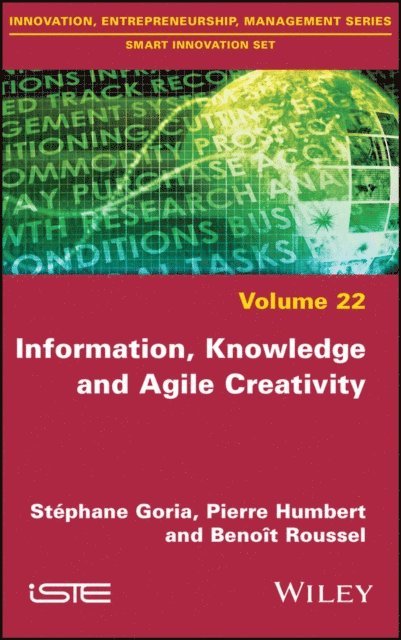
Information, Knowledge and Agile Creativity
AvStéphane Goria,Pierre Humbert
1 836 kr
Beställningsvara. Skickas inom 5-8 vardagar. Fri frakt över 249 kr.
Beskrivning
Produktinformation
- Utgivningsdatum:2019-10-01
- Mått:160 x 239 x 23 mm
- Vikt:612 g
- Format:Inbunden
- Språk:Engelska
- Antal sidor:288
- Förlag:ISTE Ltd and John Wiley & Sons Inc
- ISBN:9781786304025
Utforska kategorier
Mer om författaren
Stéphane Goria is Associate Professor at the University of Lorraine, France. He is member of the Mediation research center (Centre de recherche sur les médiations, Crem) and an expert in creative competitive intelligence.Pierre Humbert is Associate Professor at Université de Lorraine, Information and Communication Sciences Department director and member of the Crem.Benoît Roussel is Associate Professor, member of PErSEUs laboratory at Université de Lorraine. He is an expert in interdisciplinary innovation process for product/service and organization.
Innehållsförteckning
- Introduction ixChapter 1. Creativity for Innovation 11.1. Definitions of creativity 21.2. The different forms of innovation 61.2.1. Incremental innovation and radical innovation 71.2.2. Innovation from the bottom up 81.2.3. Disruptive innovation from the top down 111.2.4. Innovation by market extension 131.2.5. Some other forms of innovation 171.3. The metaphor of the fighter plane to link creativity and innovation 201.3.1. The OODA loop 201.3.2. The space for imagined aerial maneuvers 231.4. Conclusion 27Chapter 2. Recognizing and Questioning the Problem 292.1. Understanding and reformulating a problem 292.1.1. A series of very simple questions 302.1.2. Questioning problems with multiple interpretations 332.1.3. The creation of concepts related to the problem or situation 362.2. The ideal final result and resources 372.2.1. The ideal final result 372.2.2. Start by considering a closed world 432.2.3. The balance of available resources 452.3. The levels of understanding and frameworks of a problem 462.3.1. The levels of scale of an understanding 472.3.2. Frameworks characterizing the treatment of a problem 482.3.3. The division of frames and related issues 492.3.4. The benefit of this division and these questions 522.4. Conclusion 53Chapter 3. Monitoring and the Intelligence Cycle 573.1. Monitoring and its forms 573.1.1. The main steps in a monitoring process 583.1.2. Monitoring according to their location, users and objectives 593.1.3. Digital, punctual and continuous monitoring 603.1.4. The practice of monitoring expressed in the form of metaphors 623.2. Information search and search engines 643.2.1. Keywords and strings 653.2.2. Relevant search engine responses 663.2.3. Choosing and searching on search engines 693.3. Keywords and search engine searches 713.3.1. Keyword categories 733.3.2. The risks inherent in the use of keywords 753.3.3. Keywords and expressions in texts 763.4. Warning systems 793.4.1. Web alert tools 793.4.2. Content aggregation platforms 803.4.3. Human resources for collective monitoring 813.5. The organization of information collection 823.5.1. The monitoring plan 823.5.2. Human sources 873.5.3. Field observations and trade show visits 883.5.4. Information reports 893.5.5. The comparative study or benchmarking 923.6. The processing, formatting and dissemination of information 95Chapter 4. Visual Communication and Idea Management 994.1. Communication at the heart of the innovation process 1004.2. Knowledge mediation and creativity: the intermediary object, the boundary object 1054.3. The role of visual artifacts in the management of ideas 1084.4. The contributions and limitations of visual communication tools for idea management 1094.4.1. Associative representations 1104.4.2. Territorial representations 1164.4.3. Event and causal representations 1194.4.4. Experiential representations 1254.5. Conclusion 127Chapter 5. Animating Teams to Stimulate Collective Creativity 1295.1. (Collective) creativity: a sought-after skill? 1315.2. The “classic” structuring of a collective creativity session 1335.2.1. Step 1 of preparing the creativity session 1335.2.2. Step 2 of the creativity session 1345.2.3. Step 3 of analyzing and reporting all the results of the creativity session 1355.3. The important elements of a collective creativity session 1355.3.1. The attitudes and state of mind for the facilitator to adopt, and for the group of participants to adopt 1365.3.2. Move from analytical to exploratory reasoning 1395.3.3. The three levels of divergence–convergence 1415.4. The choice of creative tools 1475.4.1. The five implementation logics 1475.4.2. The notion of “father tools” 1485.5. Processing the results of a collective creativity session 1505.6. The different forms of production. 1515.6.1. The embryo of an idea 1515.6.2. The idea sheet 1525.6.3. The concept and the percept 1555.7. The selection of ideas 1575.8. Conclusion 161Chapter 6. Some Techniques to Stimulate and Aid Creativity 1636.1. Some techniques and tools such as icebreakers or challenges 1646.1.1. The human knot/human chain 1646.1.2. The enigmas 1656.1.3. The marshmallow challenge 1666.1.4. Non-musical chairs 1676.1.5. The ball point game 1686.1.6. Expressing yourself without speaking and using a game 1706.1.7. The highest card tower 1716.1.8. The curved shot 1726.2. Some techniques using associative logic 1746.2.1. The magic wand or the machine for exploring the future 1746.2.2. Once upon a time – some ideas 1756.2.3. Reasons and changes 1766.2.4. The big mysterious object bag 1776.2.5. Concept serious play 1786.3. Some techniques using analog logic 1806.3.1. The twisting of ideas or the reversal method 1806.3.2. Biostorming 1816.3.3. Miniature men 1836.3.4. Lego serious play 1846.4. Some techniques using combinatorial logic 1866.4.1. The discovery matrix 1866.4.2. Extensive morphological analysis 1876.4.3. Cubification 1896.4.4. The scaffolding of ideas 1916.5. Some techniques using oneiric logic 1956.5.1. The ancient method of the waking dream 1956.5.2. Projective exploration 1976.5.3. The village of originals 1976.6. Some techniques using Aristotelian logic 2006.6.1. UX maps 2006.6.2. Segmentation 2016.6.3. Creative aikido 2026.6.4. Simplified axiomatic design 2046.7. Conclusion 206Chapter 7. System Mapping and Analysis 2077.1. Mapping of the system’s tangible and intangible assets 2077.1.1. Knowledge management and assets considered 2077.1.2. From knowledge assets to ideas 2097.1.3. Assets indirectly involved in knowledge creation 2137.1.4. The glossary of knowledge creation system assets 2167.1.5. Questioning and organizing assets in frameworks 2197.2. System analysis 2227.2.1. The development of a series of indicators 2227.2.2. Beyond the calculation of indicators 231Conclusion 239Bibliography 243Index 259
Du kanske också är intresserad av
Information, Knowledge and Agile Creativity
Benoit Roussel, Pierre Humbert, St phane Goria
2 204 kr
Information, Knowledge and Agile Creativity
Benoit Roussel, Pierre Humbert, St phane Goria
2 185 kr
- Nyhet
- -19%
- Signerad!