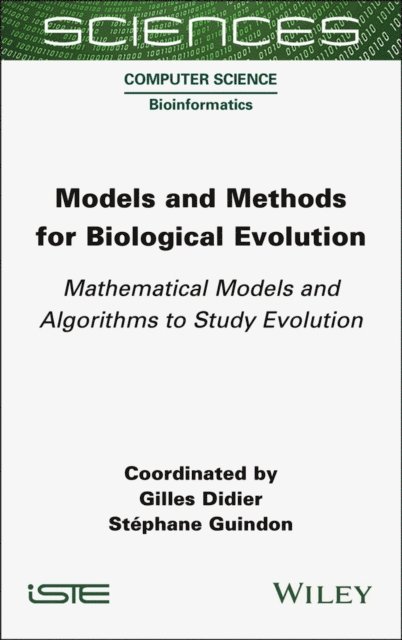
Models and Methods for Biological Evolution
Mathematical Models and Algorithms to Study Evolution
1 733 kr
Beställningsvara. Skickas inom 5-8 vardagar. Fri frakt över 249 kr.
Beskrivning
Produktinformation
- Utgivningsdatum:2024-05-08
- Mått:163 x 243 x 25 mm
- Vikt:794 g
- Format:Inbunden
- Språk:Engelska
- Antal sidor:336
- Förlag:ISTE Ltd
- ISBN:9781789450699
Utforska kategorier
Mer om författaren
Gilles Didier is a researcher in applied mathematics at the Institut Montpellierain Alexander Grothendieck (IMAG), a joint research unit of the Université de Montpellier and the CNRS, France. He is particularly interested in the modeling of biological evolution.Stéphane Guindon is a researcher at the Computer Science, Robotics and Microelectronics Laboratory of Montpellier (LIRMM), a joint research unit of the Université de Montpellier and the CNRS France. His studies focus on probabilistic models describing evolution at different time scales.
Innehållsförteckning
- Preface xiiiGilles DIDIER and Stéphane GUINDONChapter 1 Trees: Combinatorics and Models 1Gilles DIDIER and Stéphane GUINDON1.1 Introduction 11.2 Preliminary definitions 21.3 Counting trees 41.3.1 Fully labeled non-rooted trees 41.3.2 Binary trees with labeled leaves 61.3.3 Binary trees with labeled leaves and ordered internal nodes 71.3.4 Number of orders of internal nodes of a given tree 81.3.5 Directed binary trees 91.4 Probabilities of trees resulting from branching processes 91.5 Birth-death processes 121.5.1 Probability density of a birth-death tree 151.6 The coalescent 181.6.1 Links with "classical" models in population genetics 191.6.2 Moran's model 191.6.3 The Wright-Fisher model 211.6.4 Generic model 211.6.5 Coalescent-generated tree probability density 231.7 Conclusion 231.8 References 25Chapter 2 Models of Sequences and Discrete Traits Evolution 27Étienne PARDOUX2.1 Introduction 272.2 Discrete set-valued continuous-time Markov process 282.2.1 Poisson processes 282.2.2 Finite set-valued continuous-time Markov process 292.3 Models of DNA sequence evolution 322.3.1 The Jukes-Cantor model 322.3.2 The Kimura model 332.3.3 The Felsenstein model 332.3.4 The HKY model 342.3.5 The general time reversible model 352.4 Models of rate evolution along the sequence 352.4.1 Independent and identically distributed rates along the sequence 352.4.2 Hidden Markov model 362.5 Models of discrete trait evolution 372.6 References 38Chapter 3 Evolutionary Models of Continuous Traits 39Paul BASTIDE, Mahendra MARIADASSOU and Stéphane ROBIN3.1 Motivations 393.1.1 Comparative methods 403.1.2 Studies of evolutionary phenomena 413.2 Brownian motion 423.2.1 Description 433.2.2 Phylogenetic regression and statistical transformations 443.2.3 Recursive algorithms for inference 473.3 Multivariate analysis 483.3.1 Description 483.3.2 Phylogenetic contrasts 493.3.3 Phylogenetic PCA 493.4 Gaussian models 513.4.1 Some limits of the Brownian motion 513.4.2 Ornstein-Uhlenbeck process 523.4.3 Biological interpretations and caveats 563.4.4 Further Gaussian processes 583.4.5 Heterogeneous evolution 603.4.6 Observation models 643.4.7 Model selection 663.5 Extensions and generalizations 673.5.1 Non-Gaussian models 673.5.2 Tree-trait interactions 673.5.3 Interactions between species 683.5.4 Trait of high dimension 693.6 Useful references 693.7 Acknowledgements 703.8 References 71Chapter 4 Correlated Evolution: Models and Methods 79Guillaume ACHAZ and Julien Y DUTHEIL4.1 Introduction 794.2 Correlated evolution between traits 824.2.1 Species are not independent 824.2.2 The phylogenetically independent contrasts 844.2.3 Extending the linear model to account for phylogeny 864.2.4 Correlation between discrete traits 914.2.5 Examples of correlated traits 924.2.6 Jointly modeling traits and sequences 934.3 Correlated evolution within genomes 944.3.1 Within genes, between nucleotides 944.3.2 Within proteins, between amino acids 964.3.3 Within genomes, between genes 1014.4 Genetics is also correlated evolution 1034.4.1 In individuals 1034.4.2 In pedigrees 1044.4.3 In the population 1064.5 Conclusion 1094.6 References 110Chapter 5 A Century of Genomic Rearrangements 117Anne BERGERON and Krister M SWENSON5.1 Introduction 1175.2 Orderings of genes and the rearrangements that act on them 1185.2.1 Basic representations and definitions 1195.2.2 DCJ operations and the breakpoint graph 1215.3 Counting DCJ scenarios 1255.3.1 Scenarios for a balanced cycle of length 2m 1255.3.2 The (many) cycle decompositions of a breakpoint graph 1265.4 Chromosomal contact data and weighted scenarios 1295.4.1 A model incorporating chromosomal contacts 1295.4.2 Planar trees and an algorithm for exploring them 1315.4.3 Planar trees 1325.5 Conclusion 1365.6 References 138Chapter 6 Phylogenetic Inference: Distance-Based Methods 141Fabio PARDI6.1 Introduction 1416.2 Mathematical basis 1436.3 Distance estimation 1466.3.1 Estimating distances from aligned sequences 1466.3.2 Other approaches to estimate distances 1486.4 Tree inference 1506.4.1 Fitting branch lengths with least squares 1516.4.2 Scoring trees: from least squares to minimum evolution 1536.4.3 NJ and other agglomerative algorithms 1546.4.4 Beyond distances 1576.5 Conclusion 1586.6 References 159Chapter 7 Computing Inference in Phylogenetic Trees 165Laurent GUÉGUEN7.1 Inferences and modeling 1657.1.1 Inferences 1657.1.2 Parsimony and likelihood 1667.1.3 Maximum parsimony 1667.2 Dynamic programming 1697.2.1 Over the branches 1707.2.2 Over the nodes 1717.2.3 Over the tree 1717.2.4 At the root 1727.2.5 Recursion relations 1727.2.6 Complexity reduction 1747.2.7 Root management 1757.3 Maximum parsimony 1777.3.1 Ancestral interference 1797.4 Likelihood 1797.4.1 Root management 1827.4.2 Computation at the nodes 1827.4.3 Maximization, differentiation 1847.4.4 Ancestral interference 1887.5 References 190Chapter 8 The Bayesian Paradigm in Molecular Phylogeny 193Nicolas RODRIGUE8.1 Introduction 1938.2 General principles of the Bayesian approach in phylogeny 1948.2.1 Markov chain Monte Carlo sampling 1978.2.2 Summary of posterior distribution and sampling 2008.3 Demarginalization of the likelihood function 2008.3.1 Parameter expansion 2008.3.2 Data augmentation 2028.4 Bayesian selection of substitution models 2038.4.1 Relative model comparison via the Bayes factor 2048.4.2 Absolute evaluation of models via predictive posterior simulation 2068.5 Impacts and future directions 2078.6 References 208Chapter 9 Measures of Branch Support in Phylogenetics 213Olivier GASCUEL and Frédéric LEMOINE9.1 Introduction 2139.2 Local supports: parametric and non-parametric aLRT 2159.2.1 Null branch test and its limitations 2159.2.2 Local aLRT test, parametric version 2179.2.3 Local aLRT test, SH-like nonparametric version 2189.2.4 Comparison with an example of aLRT support and bootstrap 2199.3 Phylogenetic bootstrap 2219.3.1 Statistic bootstrap 2219.3.2 The Felsenstein bootstrap 2219.3.3 Transfer bootstrap 2239.3.4 Comparison with an example of bootstrap supports 2269.4 Bayesian supports 2289.4.1 Principle, use of Markov Monte Carlo chains 2289.4.2 Local Bayesian support 2309.4.3 Comparison of Bayesian supports with an example 2319.5 Discussion 2319.6 References 234Chapter 10 Fossils and Phylogeny 237Michel LAURIN10.1 Inferences on topology 23710.1.1 First approaches 23710.1.2 Traits usable in paleontology 23910.1.3 First quantitative approach: phenetics 24110.1.4 Stratophenetics 24210.1.5 Cladistics 24210.1.6 Model-based approaches: likelihood, Bayesian approaches 24310.1.7 Fossils and molecular data 24510.2 Dating the tree of life 24510.2.1 First qualitative approaches 24510.2.2 First statistical approaches 24610.2.3 Molecular dating 24710.2.4 Tip dating 24910.2.5 Birth-death model-based dating 25010.3 Conclusion 25210.4 References 252Chapter 11 Phylodynamics 259Samuel ALIZON11.1 Reconciling ecology, evolution and mathematics 25911.2 Data and processors 26011.2.1 New generation sequencing 26111.2.2 PCR and capture 26111.3 Infection phylogenies 26211.3.1 Link to transmission chains 26211.3.2 Dating and evolutionary rates 26311.3.3 Biological applications of time calibration 26411.4 Phylodynamics 26511.4.1 A field in search of definition 26511.4.2 As closely as possible to epidemiology 26611.4.3 Coalescent 26711.4.4 Birth-death models 26911.4.5 Limitations of likelihood approaches 26911.4.6 ABC phylodynamics 27011.5 Infection phylogeography 27111.6 Infection and viral life history traits 27211.7 Perspectives and challenges 27311.8 References 275Chapter 12 Inference of Demographic Processes in Human Populations 283Frédéric AUSTERLITZ12.1 Introduction 28312.2 Demographic inferences from population genetics data 28612.2.1 Reconstruction of the history of Central African Pygmies 28612.2.2 Inference of the history of populations in Central Asia 28812.2.3 Impact of lifestyle on population growth dynamics 28812.3 Inferring human expansions from next-generation sequence data 29112.4 Reconstructing population dynamics from genetic and cultural data 29412.4.1 Simultaneous analysis of genetic and linguistic diversity 29412.4.2 Detecting the intergenerational transmission of reproductive success 29512.5 Conclusion 29612.6 References 297List of Authors 303Index 305
Mer från samma författare
Modèles et méthodes pour l'évolution biologique
Gilles Didier, Stéphane Guindon
Inbunden, 2022
2 500 kr
Du kanske också är intresserad av
Modèles et méthodes pour l'évolution biologique
Gilles Didier, Stéphane Guindon
Inbunden, 2022
2 500 kr
- Signerad!
- 4 för 3
Mackans kost : goda och enkla recept för veckans alla dagar
Marcus Frank
Inbunden, 2025
259 kr
- 4 för 3
En flicka som kallas Alice
Kristin Hannah
Pocket, 2025
99 kr
- Nyhet
- -43%
Det fallna imperiet : Ryssland och väst under Vladimir Putin
Martin Kragh
Inbunden, 2023
139 kr245 kr
- -15%
Historiens återkomst : Europa och världsordningens sammanbrott
Martin Kragh
Inbunden, 2025
219 kr259 kr