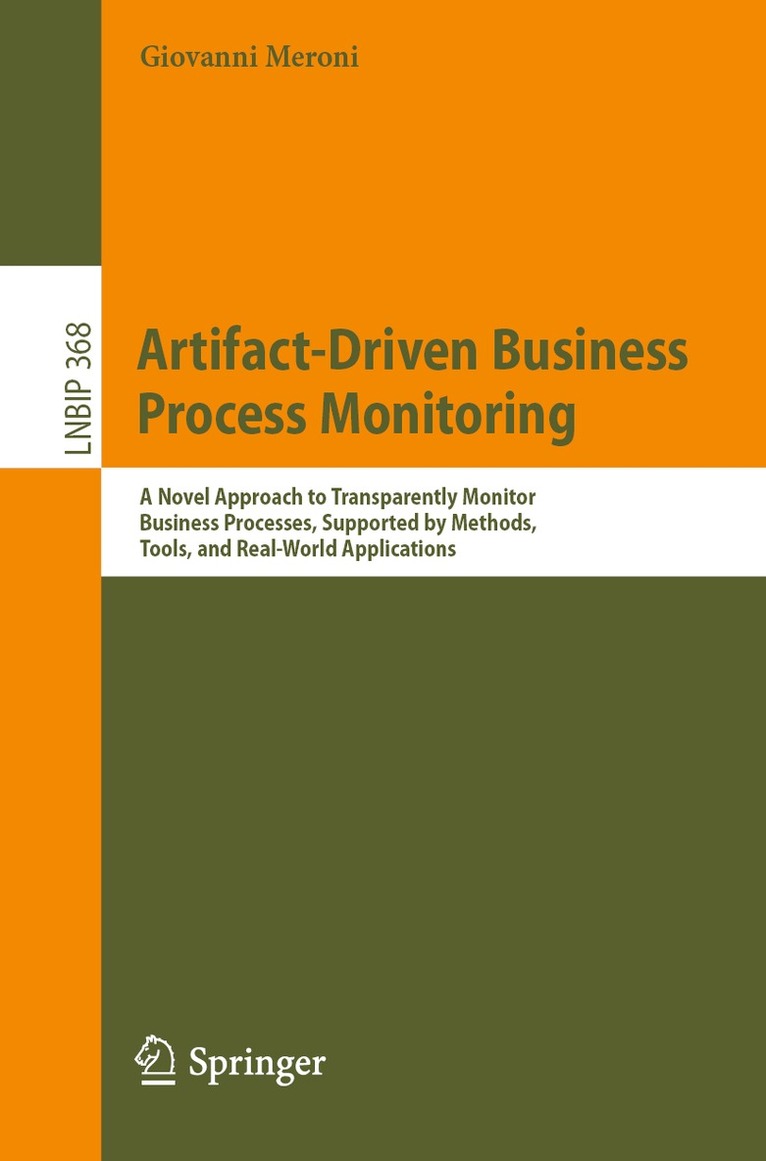
Artifact-Driven Business Process Monitoring
A Novel Approach to Transparently Monitor Business Processes, Supported by Methods, Tools, and Real-World Applications
Del 368 i serien Lecture Notes in Business Information Processing
534 kr
Beställningsvara. Skickas inom 10-15 vardagar. Fri frakt över 249 kr.
Beskrivning
Produktinformation
- Utgivningsdatum:2019-10-24
- Mått:155 x 235 x 10 mm
- Vikt:277 g
- Format:Häftad
- Språk:Engelska
- Serie:Lecture Notes in Business Information Processing
- Antal sidor:161
- Förlag:Springer Nature Switzerland AG
- ISBN:9783030324117
Utforska kategorier
Innehållsförteckning
- 1 Introduction.- 1.1 Motivations.- 1.2 Research Challenges.- 1.3 Research Questions.- 1.4 Major Contributions.- 1.5 Book Structure.- 2 Related Work.- 2.1 Business Process Monitoring.- 2.1.1 Process Monitoring Based on Sensor Data.- 2.1.2 Event Data Logging.- 2.1.3 Business Activity Monitoring.- 2.1.4 Conformance and Compliance Checking.- 2.2 Declarative Languages.- 2.2.1 Constraint-based Languages.- 2.2.2 Artifact-centric Languages.- 2.2.3 Case Management Languages.- 2.2.4 Imperative to Declarative Model Translators.- 2.3 The Internet of Things.- 2.3.1 Enabling technologies of the IoT.- 2.3.2 Ontologies for the IoT.- 2.3.3 Synergies between the IoT and BPM.- 3 Artifact-driven Process Monitoring Overview.- 3.1 Motivating Example.- 3.2 Introducing Artifact-driven Process Monitoring.- 3.3 Reference Architecture.- 3.4 Summary.- 4 E-GSM: an Artifact-centric Language for Process Monitoring.- 4.1 The Guard-Stage-Milestone Artifact-centric Language.- 4.2 Extending GSM.- 4.3 Assessing the severity of Constraints Violations.- 4.4 E-GSM Expressiveness.- 4.4.1 Activity Exclusion.- 4.4.2 Activity Overlap.- 4.4.3 Responded Existence.- 4.4.4 Constrained Iteration.- 4.5 Summary.- 5 A Method to Easily Configure the Monitoring Platform.- 5.1 Steps.- 5.1.1 Enriching the BPMN Process Model With Artifacts.- 5.1.2 Extracting the Artifact-oriented Process View.- 5.1.3 Generating the E-GSM Process Model.- 5.1.4 Generating the E-GSM Artifact Lifecycle Model.- 5.1.5 Generating the Artifact-to-object Mapping Criteria.- 5.2 Proof of Correctness.- 5.2.1 Trace Conformance.- 5.2.2 Execution Flow Alignment.- 5.2.3 Artifact Lifecycle Alignment.- 5.3 Summary.- 6 Assessing and Improving Process Monitorability.- 6.1 Formalizing the Capabilities of the Smart Objects.- 6.1.1 Smart Objects Ontology.- 6.1.2 State Detection Rules Ontology.- 6.2 Problem Setting.- 6.3 Process Monitorability Assessment.- 6.4 Process Monitorability Improvement.- 6.4.1 Process model improvement.- 6.4.2 State detection rules improvement.- 6.4.3 Infrastructure improvement.- 6.5 Summary.- 7 Implementing and Evaluating Artifact-driven Process Monitoring.- 7.1 SMARTifact: an Artifact-driven Monitoring Platform.- 7.2 Simulated Environment.- 7.3 Field Evaluation.- 7.4 Summary.- 8 Conclusions.- 8.1 Answers to the Research Questions.- 8.2 Achievements in Runtime Process Monitoring.- 8.3 Achievements in the Integration Among BPM and IoT.- 8.4 Current Limitations and Future Work.- A Criteria to Evaluate the Integration Among BPM and IoT.- A.1 Placing sensors in a process-oriented way (IC1).- A.2 Monitoring manual activities (IC2).- A.3 Connecting analytical processes with the IoT (IC3).- A.4 Exploiting the IoT to do process correctness check (IC4).- A.5 Dealing with unstructured environments (IC5).- A.6 Managing the links between micro processes (IC6).- A.7 Breaking down end-to-end processes (IC7).- A.8 Detecting new processes from data (IC8).- A.9 Specifying the autonomy level of smart objects (IC9).- A.10 Specifyingthe socialroles of smart objects (IC10).- A.11 Concretizing abstract process models (IC11).- A.12 Dealing with new situations (IC12).- A.13 Bridging the gap between process-based and event-based systems (IC13).- A.14 Improving online conformance checking (IC14).- A.15 Improving resource utilization optimization (IC15).- A.16 Improving resource monitoring and quality of task execution (IC16).- B BPMN to E-GSM Translation Proof of Correctness.- B.1 Process Model.- B.1.1 Data Component.- B.1.2 Blocks.- B.1.3 Process Model.- B.2 Trace Conformance.- B.3 Conformance Preservation of the Translation.- References.
Mer från samma författare
Business Process Management: Blockchain and Robotic Process Automation Forum
Aleksandre Asatiani, José María García, Nina Helander, Andrés Jiménez-Ramírez, Agnes Koschmider, Jan Mendling, Giovanni Meroni, Hajo A. Reijers
550 kr
Mer från samma serie
Information Systems: Research, Development, Applications, Education
Stanisław Wrycza, Jacek Maślankowski
550 kr
Exploring Service Science
Gerhard Satzger, Lia Patrício, Mohamed Zaki, Niklas Kühl, Peter Hottum
534 kr
Enterprise and Organizational Modeling and Simulation
Robert Pergl, Eduard Babkin, Russell Lock, Pavel Malyzhenkov, Vojtěch Merunka
534 kr
Practice of Enterprise Modeling
Robert Andrei Buchmann, Dimitris Karagiannis, Marite Kirikova
534 kr
Software Quality: The Complexity and Challenges of Software Engineering and Software Quality in the Cloud
Dietmar Winkler, Stefan Biffl, Johannes Bergsmann
550 kr
Advances in Enterprise Engineering XII
David Aveiro, Giancarlo Guizzardi, Sérgio Guerreiro, Wided Guédria
550 kr
Data-Driven Process Discovery and Analysis
Paolo Ceravolo, Maurice van Keulen, Kilian Stoffel
550 kr
Du kanske också är intresserad av
Business Process Management: Blockchain and Robotic Process Automation Forum
Aleksandre Asatiani, José María García, Nina Helander, Andrés Jiménez-Ramírez, Agnes Koschmider, Jan Mendling, Giovanni Meroni, Hajo A. Reijers
550 kr
- Signerad!
Fuzzy and Multi-Level Decision Making: Soft Computing Approaches
Chi-Bin Cheng, Hsu-Shih Shih, E. Stanley Lee
1 094 kr