Inbunden, Engelska, 2020
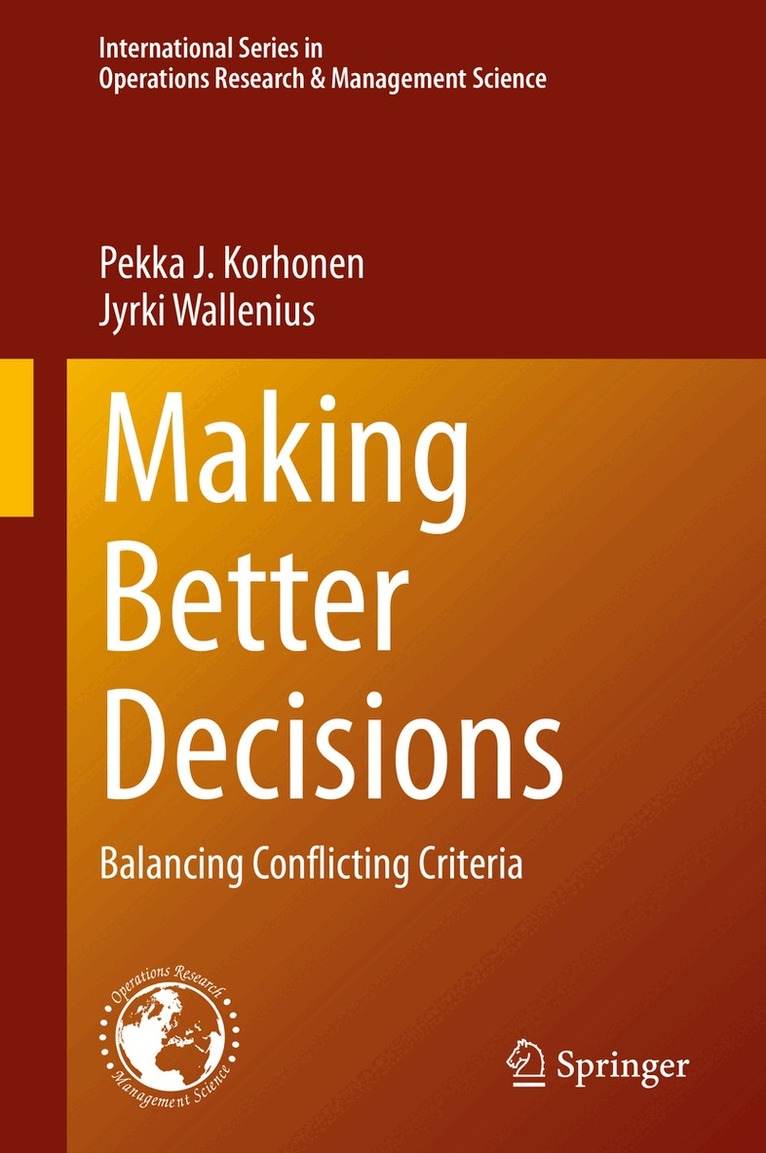
Making Better Decisions
Av Pekka J. Korhonen, Jyrki Wallenius
375 kr
Beställningsvara. Skickas inom 10-15 vardagar. Fri frakt över 249 kr.
Beskrivning
This book offers a comprehensive introduction to decision-making in an MCDM framework. Designed as a tutorial, it presents the main concepts and methods to be applied, together with essential background information. This includes the concept of nondominance, Simon’s bounded rationality, Tversky and Kahneman’s prospect theory, and the concepts of behavioral vs. mathematical convergence and premature stopping put forward by Korhonen, Moskowitz and Wallenius. The book concludes with a non-technical review of many popular decision algorithms, including the Analytic Hierarchy Process (AHP), VIMDA, and a number of classic interactive man-machine algorithms. In essence, the book is a “one-stop” source on everything you need to know about managerial decision-making in the multiple-criteria setting.
Produktinformation
- Utgivningsdatum: 2020-08-19
- Mått: 155 x 235 x 18 mm
- Vikt: 440 g
- Format: Inbunden
- Språk: Engelska
- Serie: International Series in Operations Research & Management Science
- Antal sidor: 167
- Förlag: Springer Nature Switzerland AG
- ISBN: 9783030494575
Utforska kategorier
Betyg & recensioner
0 recensioner
Inga recensioner tillgängliga.