Discoveries at the Frontiers of Science
Johannes Kirsch, Stefan Schramm, Jan Steinheimer-Froschauer, Horst Stöcker
1 695 kr
Du är på sajten för privatpersoner.
Del i serien FIAS Interdisciplinary Science Series
1 589 kr
Beställningsvara. Skickas inom 10-15 vardagar. Fri frakt över 249 kr.
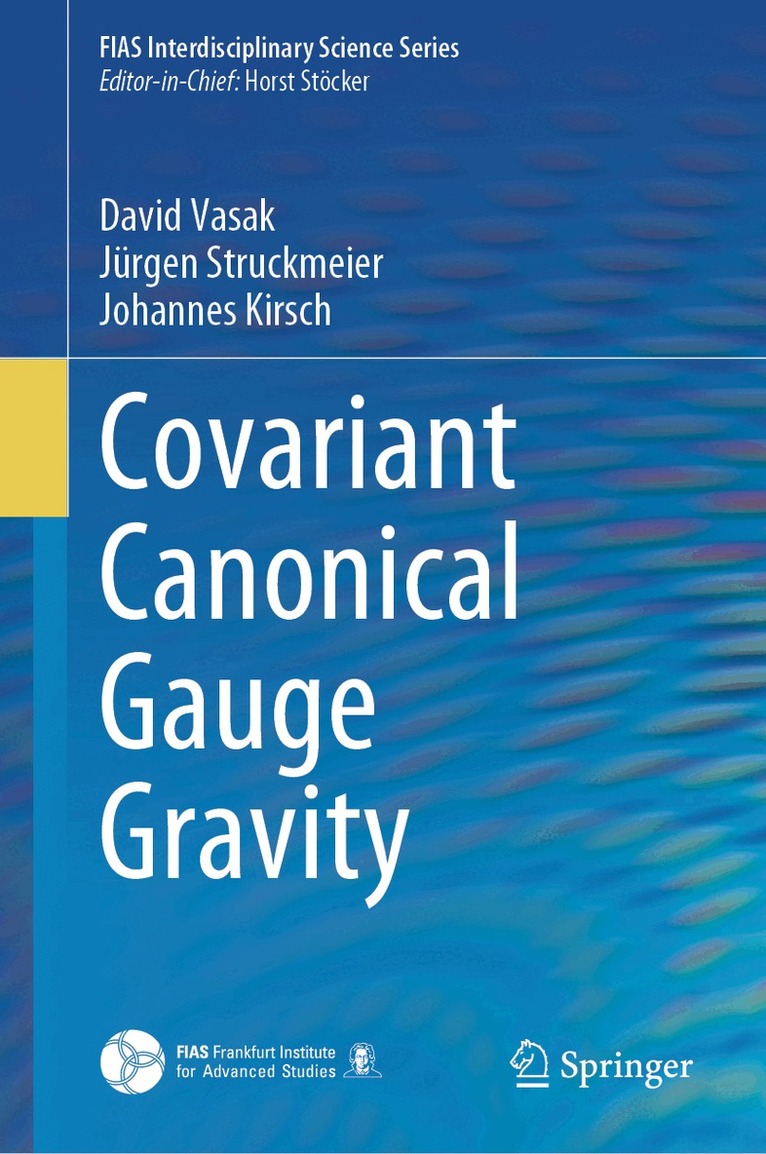
David Vasak studied theoretical nuclear physics and mathematics at the Goethe University in Frankfurt, Germany. His research work dealt with heavy-ion physics (diploma thesis) and with dynamics of quark matter (PhD thesis). Later, as guest scientist at the Gesellschaft für Schwerionenforschung (GSI) in Darmstadt, Germany, and as research scientist at the Lawrence Berkeley Laboratory at Berkeley, California, USA, he developed the quantum version of the relativistic transport theory of fermions in external fields. After a career in technology and management consulting he returned to physics working now at the Frankfurt Institute for Advanced Studies (FIAS) in Frankfurt, Germany, on the novel gauge theory of gravity (CCGG) and its cosmological implications.Jürgen Struckmeier studied physics at the Goethe University in Frankfurt, Germany. His research work dealt with charged particle optics (diploma thesis) and with space charge effects in intense chargedparticle beams (PhD thesis). Later, as staff scientist at the Gesellschaft für Schwerionenforschung (GSI) in Darmstadt, Germany, he developed the covariant Hamiltonian version of classical field theories in his Habilitation thesis. The generalization of the Hamiltonian representation of field theories to a dynamics spacetime background then opened the door to work out a canonical transformation formulation of the gauge theory of gravity. In the year 2010, Dr. Struckmeier received the Professorship at the Physics faculty of the Goethe University Frankfurt. Prof. Struckmeier moved to the Frankfurt Institute for Advanced Studies (FIAS) in Frankfurt, Germany, where he has been a Fellow ever since. His research topics are broad, but recently he focused on diverse aspects of extensions of Einstein's general theory of relativity. His covariant canonical gauge theory of gravity (CCGG) are at the center of numerous physical implications of CCGG in astrophysics and cosmology.Johannes Kirsch studied physics, mathematics and economics at the Goethe University in Frankfurt, Germany. He graduated with degrees in physics and business administration and earned his doctorate at the Institute for Theoretical Physics in Frankfurt under Walter Greiner. After a career in industry, where he was responsible for hardware and software development in the field of medical technology in a large German industrial company, he joined the Frankfurt Institute for Advanced Studies (FIAS) and is now working on a gauge theory of gravitation in the covariant canonical transformation framework (CCGG), which leads to an extension of Einstein's field equation. One focus of his research is its implications for cosmology.
“I liked this book and found it interesting. It is not easy to write a research book that does not look like a collection of research papers. In this sense, the authors try their best. They provide a homogeneous and uniform description of the problem. Anyone interested in the CCGG will find in this book a very clear, friendly and complete description of the matter, as well as the main physical/cosmological motivations. It is definitely well worth a reading.” (Giuseppe Maria Coclite, Mathematical Reviews, June, 2025)
Johannes Kirsch, Stefan Schramm, Jan Steinheimer-Froschauer, Horst Stöcker
1 695 kr
Johannes Kirsch, Stefan Schramm, Jan Steinheimer-Froschauer, Horst Stöcker
1 695 kr
Johannes Kirsch, Stefan Schramm, Jan Steinheimer-Froschauer, Horst Stöcker
1 695 kr
Johannes Kirsch, Stefan Schramm, Jan Steinheimer-Froschauer, Horst Stöcker
1 695 kr