Inbunden, Engelska, 2027
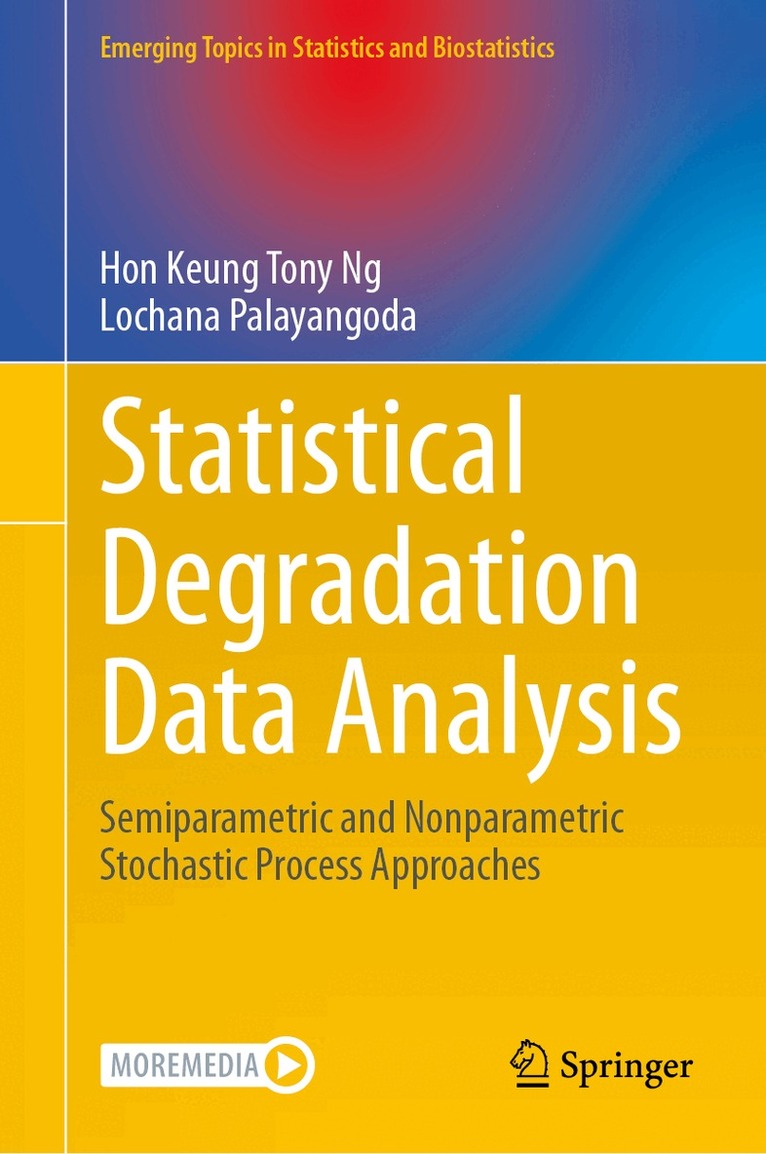
Statistical Degradation Data Analysis
Av Hon Keung Tony Ng, Lochana Palayangoda
1645 kr
Kommande
Beskrivning
This book provides a systematic treatment of efficient methods for modeling, analyzing, and designing degradation tests, with particular emphasis on stochastic-process-based semiparametric and nonparametric approaches motivated by practical applications. Statistical Degradation Data Analysis: Semiparametric and Nonparametric Stochastic Process Approaches compares parametric, semiparametric, and nonparametric methods through Monte Carlo simulation studies and real data examples, and demonstrates how these methodologies can be applied across a range of disciplines. The book also discusses extensions and open problems in this area.In engineering and the sciences, degradation refers to the gradual and irreversible decline in the performance, reliability, or remaining life of a system or asset. Because many systems are equipped with sensors that collect degradation measurements over time, statistical degradation modeling plays an important role in understanding the evolution of such processes and supporting reliability assessment.A common approach to degradation data analysis is stochastic process modeling. Classical models such as the Wiener, gamma, and inverse Gaussian processes have been widely studied and applied. However, these parametric models require specific assumptions on the distributions of degradation increments and may perform poorly when those assumptions are violated. To address this limitation, semiparametric and nonparametric methods, which rely on fewer distributional assumptions, can provide more robust and reliable alternatives.This book is intended for senior undergraduates, graduate students, researchers, and practitioners. It can also serve as a reference for courses in lifetime data analysis or reliability engineering. Computer programs for numerical examples are provided to facilitate replication and practical implementation.
Produktinformation
- Utgivningsdatum: 2027-02-03
- Mått: 155 x 235 x undefined mm
- Format: Inbunden
- Språk: Engelska
- Serie: Emerging Topics in Statistics and Biostatistics
- Antal sidor: 199
- Förlag: Springer Nature Switzerland AG
- ISBN: 9783032278159
Utforska kategorier
Betyg & recensioner
0 recensioner
Inga recensioner tillgängliga.