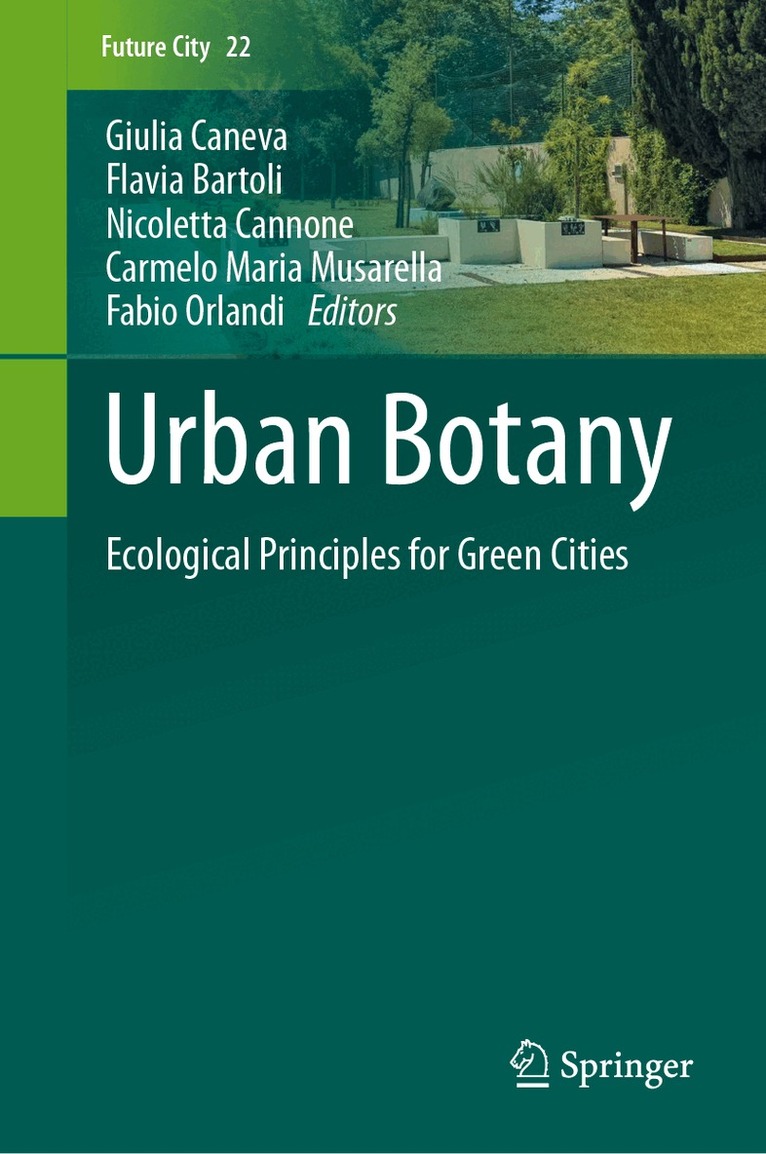
Urban Botany
Ecological Principles for Green Cities
AvGiulia Caneva,Flavia Bartoli
Del i serien Future City
2 902 kr
Kommande
Beskrivning
Produktinformation
- Utgivningsdatum:2026-08-15
- Mått:155 x 235 x undefined mm
- Format:Inbunden
- Språk:Engelska
- Serie:Future City
- Förlag:Springer Nature Switzerland AG
- ISBN:9783032289858
Utforska kategorier
Mer om författaren
Giulia Caneva is a Full professor in Environmental and Applied Botany at the Department of Sciences of the University Roma Tre. Previously she worked as an Associate professor of Systematic Botany at the Facolty of Agrary of the University of Basilicata, Campus Potenza and later at the University Roma Tre. She has been the Coordinator of the Working Group on Applied Botany of the Italian Botanical Society and the Director and later the President of the University Centre for Studies on Rome. Her didactic activity is extensive, she was the Coordinator of the Master courses of Ecosystem Analysis and Management of the Faculty of Sciences, at the University Roma Tre, as well as the Director of The International Master Biology for the knowledge and conservation of cultural heritage. She has also lectured numerous international courses, She is a member of the Scientific Committee of “Restaurateurs Without Borders” and of the Cultural Heritage Committee of the National Order of Biologists. Her research focuses on urban and ruderal vegetation and on flora and thermophilus Mediterranean vegetation with a more specific focus on plant biology and cultural heritage. She carried out several studies, which are mainly focused on bio deterioration of stone, botanical planning, and management of the archaeological areas and the valorisation of tangible and intangible cultural heritage. She was involved in many national projects on cultural heritage conservation in archaeological sites of Rome (e.g., Domus Aurea, Palatine, Colosseum, Trajan Column) and Museums (Vatican Museum, Villa Farnesina) and in other locations of Italy (e.g. Matera, Paestum, Florence, Venice), as well as in other countries such as Pakistan, China, Turkey, Cambodia, Spain, Myanmar, Jordan among others. She is the author of over 370 publications including 28 monographs. She has won several awards, including in 2011 the Giacomo Lumbroso Award; 2012 the European Union’s Gran Prix for Cultural Heritage and the Europa Nostra; in 2019 the Art and Science Award from the National Society of Sciences, Letters, and Arts of Naples. In 2024 the “Maria Teresa Messori-Roncaglia and Eugenio Mari”, Award of the Accademia Nazionale dei Lincei for Science.Flavia Bartoli is a Researcher at the Institute of Heritage Science (ISPC) at the National Research Council of Italy (CNR), where she conducts research in applied botany, urban ecology, and biological diagnostics for cultural heritage conservation. Her scientific activity lies at the intersection of botanical sciences, ecology, and heritage preservation, focusing on interactions between vegetation, microorganisms, environmental factors, and cultural substrates. Her research output includes more than sixty peer reviewed publications indexed in international databases, alongside book chapters and conference proceedings. She earned her degree in Biology cum laude from Roma Tre University, where she also completed her Master’s degree and later PhD. Her doctoral research investigated bio deterioration and bio protection processes on stone monuments, analysing the ecological and environmental drivers of biological colonisation in heritage environments. This work laid the foundation for her ongoing research on biological growth dynamics on cultural surfaces, with particular emphasis on diagnostic methods, bioclimatic influences, and preventive conservation approaches. In 2023, she obtained the Italian National Scientific Qualification as Associate Professor in Botany.A major focus of her research concerns floristic and vegetation studies in environmentally heterogeneous and culturally sensitive contexts, including archaeological sites, historic gardens, monumental complexes, and urban areas. Her investigations have contributed to the definition of floristic baselines and ecological indicators used for assessing vegetation dynamics and biological risk. Her research in urban ecology addresses plant biodiversity, ecosystem services, and the adaptive role of vegetation in cities. Bartoli also works on Nature Based Solutions, particularly extensive green roofs, analysing Mediterranean plant assemblages under water limited conditions. Her long term experimental studies provide criteria for species selection aimed at ensuring ecological stability, reduced maintenance, and climatic benefits.Alongside her research, she teaches at Roma Tre University and the European University of Rome and has supervised numerous undergraduate and postgraduate theses. She is a member of the UNI Sub commission for biological applications in cultural heritage and the Applied Botany Working Group of the Italian Botanical Society, contributing to national guidelines and scientific coordination.Nicoletta Cannone is a Full professor of Systematic Botany at the University of Insubria, where she performs her research activities in botany, climatic change impacts on flora and vegetation, adaptation and mitigation to climate change, biodiversity conservation and environmental restoration. She earned her degree cum laude in Natural Sciences from Milan University, and completed her PhD in Geobotany at the University of Pavia, which focused on periglacial and nival vegetation. She was Researcher in Systematic Botany at the University of Ferrara (2005-2010) and at the Insubria University (2010-2014), where she achieved the position of Associate Professor in Systematic Botany (2014-2022) and then the position of Full Professor in Systematic Botany since 2022.Her research activities focus on the relation between vegetation, climatic and environmental change in mountain environments and polar areas, addressing several issues in vegetation changes, biodiversity conservation, and climate impacts on soil chemistry and microbiota on CO2 fluxes. More recently, she expanded her research activities to on urban environments and the management of urban green areas to promote climate change mitigation and adaptation. She has participated in several research projects, including being the principal investigator of the projects CRIOHAB “Monitoring of cryosphere and associated habitats threatened by Climate Change”. She published more than seventy peer-reviewed papers in international journals.Carmelo Maria Musarella is an Associate Professor of Environmental and Applied Botany at the Department of Agriculture of the University "Mediterranea" of Reggio Calabria (Italy). After graduating in Biology from the University of Messina (Italy), he furthered his studies in Plant Biology at the Botanical Garden of the University of Valencia (Spain) and at the University of Catania (Italy), where he reached the PhD in Environmental Sciences with a thesis focusing on the flora and vegetation of the mountains of central-southern and insular Greece. Throughout his academic career, he has gained significant international experience, collaborating with various European universities and research centers, mostly in Spain and Portugal. He teaches in different university courses of Agricultural Sciences and Technologies, Forestry and Environmental Sciences, and Food Sciences and Technologies on topics of structure and functioning of plants, plant biodiversity, ethnobotany, and applications in the food and environmental sectors. His research focuses primarily on flora, vegetation and nature conservation, with a particular emphasis on Mediterranean ecosystems. His main areas of interest include flora, vegetation, biogeography and the study of natural habitats, relationships between human communities and plants, highlighting the wealth of traditional knowledge linked to the use of plant resources. In this field, he contributed to highlight the cultural and economic value of traditional practices, emphasizing their importance for the sustainable development of local areas.Another significant area of his work concerns the study of invasive alien species, with reference to the flora of Calabria and southern Italy. His research has contributed to the creation of updated checklists of alien flora and to the assessment of the ecological impacts of such species on local ecosystems, also contributing to understand of the distribution and dynamics of plant species in the Mediterranean environment. Since 2022, he is the point of contact for the Metropolitan City of Reggio Calabria for all urban forestry projects.He is the author of numerous scientific publications in indexed journals, as well as book chapters and editorial contributions. The focus of his scientific output, comprising over a hundred works, ranges from floristic and vegetation studies to research on environmental education and sustainability. He is member and national councillor of the Italian Society of Vegetation Science. He also participates in the Italian Botanical Society, where he serves as a councillor and active member of various working groups. He also serves on the editorial board of several indexed scientific journals. He has received recognition for his scientific work, including research awards and certificates of merit in the academic sphere.Fabio Orlandi, PhD, is an Associate Professor in Environmental and Applied Botany at the Department of Civil and Environmental Engineering, University of Perugia, Italy. He holds a degree in Agricultural Sciences (1994) and a PhD in Applied Botany (2000), both from the University of Perugia. His doctoral research focused on the analysis of biological parameters in olive trees, with particular emphasis on flowering and fruit formation, followed by postdoctoral research on the validation of olive yield forecasting models across the Mediterranean region.Dr. Orlandi has been a researcher at the University of Perugia since 2005 and has held his current position as Associate Professor since 2018. His teaching experience includes courses and seminars in plant biology and cultivation sciences.His research activities focus on the reproductive biology of economically important plants—particularly olive and grapevine—the development of biostatistical models for yield prediction, and environmental biomonitoring through aerobiological and phenological analyses. Additional areas of interest include bioclimatic and ecological studies of agricultural, forestry, and urban plant species, as well as the role of urban green infrastructure and ecosystem services in mitigating climate change.He has participated in several national and international research projects, including Erasmus+ initiatives, LIFE Climate Governance projects, and the ongoing PRIN 2022 project PhytoMuscleBone, which investigates Mediterranean plant-based supplements to counteract osteosarcopenia in the elderly.
Innehållsförteckning
- .- PART 1 INTRODUCTION TO URBAN BOTANY..- 1.The urban ecosystem: features and needs..- 2.The wild plants in urban ecosystems: character-istics, evolutive trends and conservation needs..- PART 2 PLANTS AND PEOPLE IN THE URBAN BOTANY..- 3.Alien Species in Cities, issues and threats..- 4.Traditional Ecological knowledge vs Plant blind-ness: plants and humans in urban areas..- 5.Plants in the view of Ecosystem Services and their role in Nature-based Solutions..- PART 3. ECOLOGICAL INTEGRATED APPROACHES IN URBAN GREEN INTERVENTIONS .- 6.Botany in an integrated view and in One Health perspective..- 7.Forests, Parks and Gardens..- 8.Green Ways..- 9.Green buildings.
Du kanske också är intresserad av
Urban Services to Ecosystems
Chiara Catalano, Maria Beatrice Andreucci, Riccardo Guarino, Francesca Bretzel, Manfredi Leone, Salvatore Pasta
1 761 kr
Holistic Approach for Decision Making Towards Designing Smart Cities
George Cristian Lazaroiu, Mariacristina Roscia, Vasile Sebastian Dancu
1 710 kr
Urban Forest
David Pearlmutter, Carlo Calfapietra, Roeland Samson, Liz O'Brien, Silvija Krajter Ostoić, Giovanni Sanesi, Rocío Alonso del Amo
1 603 kr
Urban Vulnerability and Climate Change in Africa
Stephan Pauleit, Adrien Coly, Sandra Fohlmeister, Paolo Gasparini, Gertrud Jørgensen, Sigrun Kabisch, Wilbard J. Kombe, Sarah Lindley, Ingo Simonis, Kumelachew Yeshitela
1 603 kr
Urban Vulnerability and Climate Change in Africa
Stephan Pauleit, Adrien Coly, Sandra Fohlmeister, Paolo Gasparini, Gertrud Jørgensen, Sigrun Kabisch, Wilbard J. Kombe, Sarah Lindley, Ingo Simonis, Kumelachew Yeshitela
1 651 kr
Urban Services to Ecosystems
Chiara Catalano, Maria Beatrice Andreucci, Riccardo Guarino, Francesca Bretzel, Manfredi Leone, Salvatore Pasta
1 761 kr