• Fri frakt över 249 kr
  • •
  • Snabba leveranser
  • •
  • Billiga böcker
Kundservice

Du är på sajten för privatpersoner.

Företag, bibliotek eller offentlig verksamhet?

Du handlar på classic.bokus.com, där alla dina funktioner finns intakta.
Till classic.bokus.com
Bokus logotyp. Gå till startsidan.
  • Erbjudanden
  • Student
  • Topplistor
  • Barn & ungdom
  • Bokus Play
  • E-böcker
  • Ljudböcker
  • Pocketböcker
  • Spel och pussel

Pocketfynda! Hundratals böcker för 49 kr/st →

Sidfot

Mina sidor

    Hjälp

    • Kundservice
    • Vanliga frågor och svar
    • Frakt och leverans
    • Retur vid ångerrätt
    • Reklamera vara
    • Betalning
    • Köpvillkor
    • Allmänna villkor
    • Information om webbplatsens tillgänglighet

    Om Bokus

    • Om oss
    • Pressrum
    • För studenter
    • För företag
    • För bibliotek och offentlig verksamhet
    • För leverantörer
    • Hållbarhet

    Populärt

    • Aktuella erbjudanden
    • Presentkort
    • Studentlitteratur
    • Nya böcker
    • Topplistor
    • Signerade böcker
    • Engelska böcker

    Inspiration

    • Boktips
    • BookTok
    • Barnbokskaraktärer
    • Populära författare
    Logotyp för Bokus
    Följ oss på Facebook (extern länk)Följ oss på Instagram (extern länk)Följ oss på YouTube (extern länk)Följ oss på TikTok (extern länk)
    bokus @ CookiesAnpassa cookiesIntegritetspolicyKöpvillkor
    Till Citymail hemsida (extern länk)Till Budbee hemsida (extern länk)Till Postnord hemsida (extern länk)Till Schenker hemsida (extern länk)Till Early Bird hemsida (extern länk)Till Walleys hemsida (extern länk)
    1. Data och IT
    2. Systemvetenskap och AI
    3. Artificiell intelligens

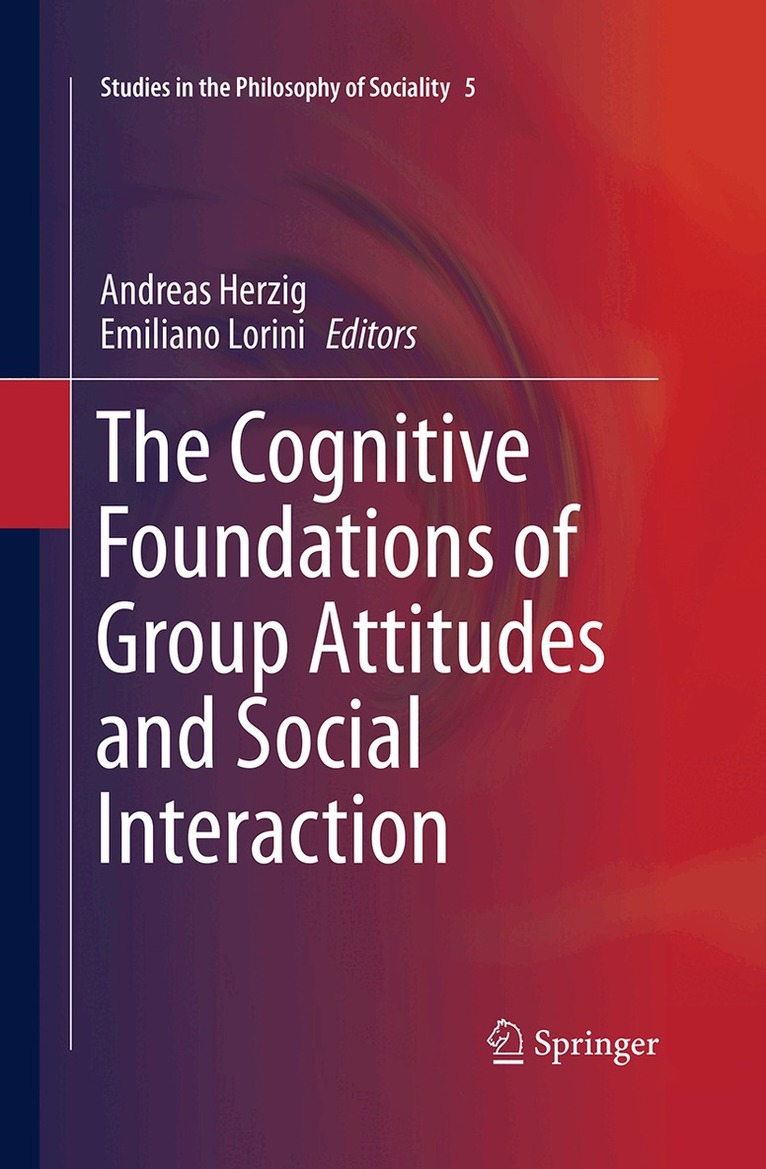
    Cognitive Foundations of Group Attitudes and Social Interaction

    AvAndreas Herzig,Emiliano Lorini

    Häftad, Engelska, 2016

    Del 5 i serien Studies in the Philosophy of Sociality

    542 kr

    Beställningsvara. Skickas inom 10-15 vardagar. Fri frakt över 249 kr.

    Beskrivning

    This book offers a widely interdisciplinary approach to investigating important questions surrounding the cognitive foundations of group attitudes and social interaction. The volume tackles issues such as the relationship between individual and group attitudes, the cognitive bases of group identity and group identification and the link between emotions and individual attitudes.This volume delves into the links between individual attitudes (such as beliefs, goals and intentions) and how they are reflected in shared attitudes where common belief, collective acceptance, joint intentions, and group preferences come into play. It pursues answers to the connections between trust and beliefs, goals and intentions and attempts to investigate questions such as: does trust have an affective component and how it may relate to hope and fear? The volume also scrutinizes game theory and questions whether it can satisfactorily explain and model social interaction and if there may be any concepts which are not addressed by the current theory. Contributors are derived from disciplines including philosophy, economics, psychology, logic and computer science. Interdisciplinary in scope and comprehensive detail, this volume integrates a variety of approaches – philosophical, psychological and artificial intelligence – to strategic, normative and emotional aspects of social interaction.

    Produktinformation

    • Utgivningsdatum:2016-08-23
    • Mått:155 x 235 x 12 mm
    • Vikt:330 g
    • Format:Häftad
    • Språk:Engelska
    • Serie:Studies in the Philosophy of Sociality
    • Antal sidor:202
    • Förlag:Springer International Publishing AG
    • ISBN:9783319345512

    Utforska kategorier

    • Artificiell intelligens inom Data och IT
    • Filosofiska discipliner inom Filosofi och religion

    Mer om författaren

    Andreas Herzig (born 1960) is a research director at the Institut de Recherche en Informatique de Toulouse (IRIT) of the French National Research Council (CNRS). His main research topic is the investigation of logical models of interaction, with a focus on logics for reasoning about knowledge, belief, time, action, intention and obligation and the development of reasoning methods for them.Herzig Emiliano Lorini (born 1977) is a researcher at the Institut de Recherche en Informatique de Toulouse (IRIT) of the French National Research Council (CNRS). His main research topics are epistemic logic and formal epistemology, game theory, logics of intention, logics of agency, deontic logic, theory of emotions, theory of trust and reputation, theory of institutions.

    Innehållsförteckning

    • Chapter 1 "On the philosophy and logic of help" Emanuele Bottazzi and Nicolas Troquard (Lab of Applied Ontology, ISTC-CNR, Trento, Italy).- Chapter 2 "Healing social sciences’ psycho-phobia – Founding social action and structure on mental representations" Cristiano Castelfranchi (ISTC-CNR, Rome).- Chapter 3 "Analytical decomposition of trust in terms of mental and social attitudes" Robert Demolombe (IRIT, Toulouse).- Chapter 4 "On modal logics of group belief" Benoit Gaudou, Andreas Herzig, Dominique Longin and Emiliano Lorini (IRIT, Toulouse).- Chapter 5 "Logic of promotion and demotion" Patrick Girard (The University of Auckland, NZ).- Chapter 6 "On the attitude of trust – a formal characterization of trust, distrust, and associated notions" Andrew I.J. Jones (Dept. of Informatics, King’s College, London).- Chapter 7 "The topology of common belief" David Pearce and Levan Uridia (Universidad Politécnica de Madrid; TSU Razmadze Mathematical Institute, Georgia).- Chapter 8 "Social emotions from the perspective of the computational belief-desire theory of emotion" Rainer Reisenzein (Dept. of Psychology, University of Greifswald).- Chapter 9 "Reasoning with Normative Systems" Giovanni Sartor (Dept. of Law, Eur. University Institute, Florence and Faculty of Law, Bologna).- Chapter 10 "An agent based model of Camorra: comparing punishment and norm-based policies in contrasting illegal activities".- Chapter 11 Barbara Sonzogni, Federico Cecconi, Giulia Andrighetti, Rosaria Conte(Dept. of Communication and Social Research at Sapienza University, Rome; Lab. of Agent-Based Simulation, ISTC-CNR, Rome; Eur. University Institute, Florence).   ​