• Fri frakt över 249 kr
  • •
  • Snabba leveranser
  • •
  • Billiga böcker
Kundservice

Du är på sajten för privatpersoner.

Företag, bibliotek eller offentlig verksamhet?

Du handlar på classic.bokus.com, där alla dina funktioner finns intakta.
Till classic.bokus.com
Bokus logotyp. Gå till startsidan.
  • Erbjudanden
  • Nyheter
  • Student
  • Topplistor
  • Barn & ungdom
  • Bokus Play
  • E-böcker
  • Pocketböcker
  • Spel & pussel

10% rabatt på allt med kod: NYSTART10 →

Sidfot

Mina sidor

    Hjälp

    • Kundservice
    • Vanliga frågor och svar
    • Frakt och leverans
    • Retur vid ångerrätt
    • Reklamera vara
    • Betalning
    • Köpvillkor
    • Allmänna villkor
    • Information om webbplatsens tillgänglighet

    Om Bokus

    • Om oss
    • Pressrum
    • För studenter
    • För företag
    • För bibliotek och offentlig verksamhet
    • För leverantörer
    • Hållbarhet

    Populärt

    • Aktuella erbjudanden
    • Presentkort
    • Studentlitteratur
    • Nya böcker
    • Topplistor
    • Signerade böcker
    • Engelska böcker

    Inspiration

    • Boktips
    • BookTok
    • Populära bokserier
    • Barnbokskaraktärer
    • Populära författare
    Logotyp för Bokus
    Följ oss på Facebook (extern länk)Följ oss på Instagram (extern länk)Följ oss på YouTube (extern länk)Följ oss på TikTok (extern länk)
    bokus @ CookiesAnpassa cookiesIntegritetspolicyKöpvillkor
    Till Citymail hemsida (extern länk)Till Budbee hemsida (extern länk)Till Postnord hemsida (extern länk)Till Schenker hemsida (extern länk)Till Early Bird hemsida (extern länk)Till Walleys hemsida (extern länk)
    1. Ekonomi och Ledarskap
    2. Nationalekonomi
    3. Mikroekonomi

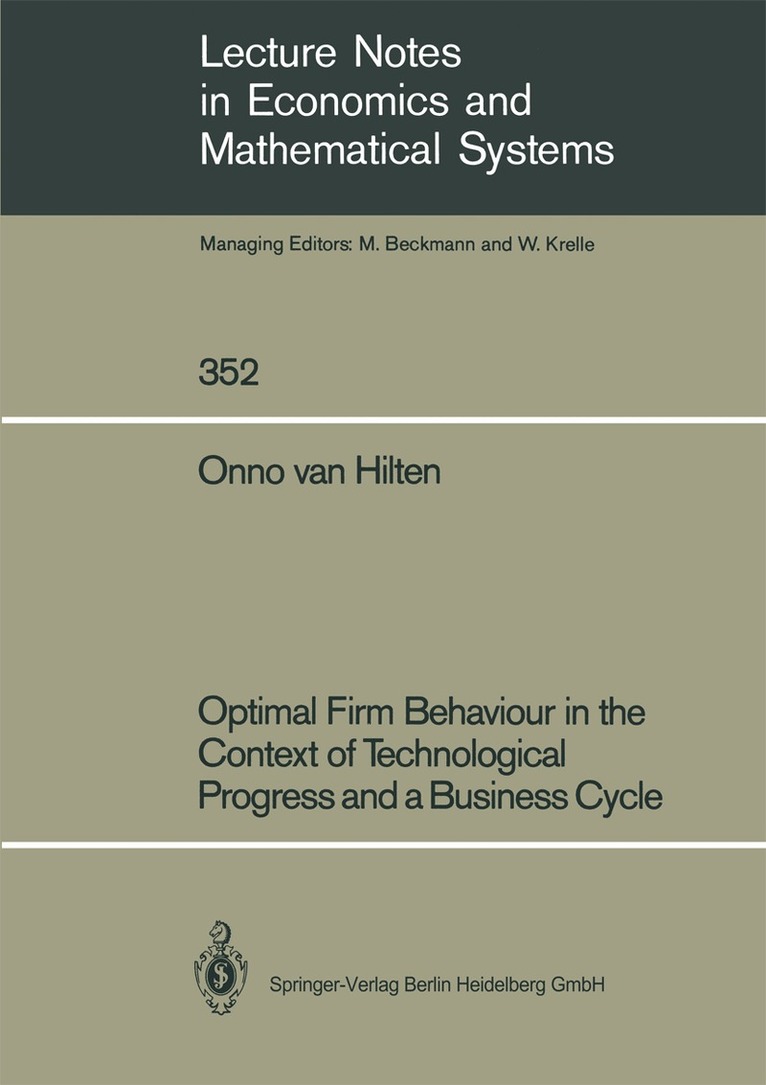
    Optimal Firm Behaviour in the Context of Technological Progress and a Business Cycle

    AvOnno van Hilten

    Häftad, Engelska, 1991

    Del 352 i serien Lecture Notes in Economics and Mathematical Systems

    547 kr

    Beställningsvara. Skickas inom 10-15 vardagar. Fri frakt över 249 kr.

    Fler format och utgåvor

    E-bok

    732 kr

    Beskrivning

    This thesis is a theoretical study of the optimal dynamic policies of a, to some extent, slowly adjusting firm that faces an exogeneously given technological progress and an exogeneously given business cycle. It belongs to the area of mathematical economics. It is intended to appeal to mathematical economists in the first place, economists in the second place and mathematicians in the third place. It entails an attempt to stretch the limits of the application of deterministic dynamic optimisation to economics, in particular to firm behaviour. A well-known· Dutch economist (and trained mathematician) recently stated in 1 a local university newspaper that mathematical economists give economics a bad reputation, since they formulate their problems from a mathematical point of view and they are only interested in technical, mathematical problems. At the same time, however, "profound as economists may be, when it comes to extending or modifying the existing theory to make it applicable to a certain economic problem, an understanding of optimal control theory (which is the mathematical theory used in this thesis, ovh) based solely on heuristic arguments will often turn out to be inadequate" (SydS

    Produktinformation

    • Utgivningsdatum:1991-02-12
    • Mått:170 x 242 x 14 mm
    • Vikt:432 g
    • Format:Häftad
    • Språk:Engelska
    • Serie:Lecture Notes in Economics and Mathematical Systems
    • Antal sidor:233
    • Upplaga:1991
    • Förlag:Springer-Verlag Berlin and Heidelberg GmbH & Co. KG
    • ISBN:9783540535638

    Utforska kategorier

    • Mikroekonomi inom Ekonomi och Ledarskap
    • Teknik: allmänt inom Naturvetenskap och teknik
    • Naturvetenskap:allmänt inom Naturvetenskap och teknik

    Innehållsförteckning

    • One Introduction.- Two A Selective Literature Survey.- Three On Dynamic Optimisation Models of the Firm as a Branch of ‘Pure Theory’ and on the Use of Mathematics.- Four The Basic Model.- Five A Model with a Business Cycle.- Six Shadow Prices in a Model with Pure State Constraints.- Seven Technological Progress in Vintage Models of the Firm: Scrapping Condition and Steady State.- Eight Optimal Policies in Models with Technological Progress, with and without a Business Cycle.- Nine Summary and Conclusions.- Appendix One Optimality Conditions for the Basic Model of Chapter 4.- A1.1 Necessary and sufficient conditions.- A1.2 The coupling procedure.- A1.2.1 The paths.- A1.2.2 Derivation of the final paths.- A1.2.3 The coupling procedure.- Appendix Two The Mathematical Details of Chapter 5.- A2.1 General remarks.- A2.2 The details of section 5.3.3.- A2.3 The details of section 5.3.4.- A2.4 The details of section 5.3.5.- A2.5 Uniqueness of the solution.- A2.6 Numerical illustrations.- A2.7 The details of section 5.4.- Appendix Three On the Shadow Price Interpretation of the Multipliers of Pure State Constraints in Optimal Control Problems.- A3.1 Introduction.- A3.2 The class of models to be considered.- A3.3 An outline of the proof.- A3.4 A general sensitivity result.- A3.6 The Kuhn-Tucker conditions and Theorem 1 for problem II.- Appendix Four Necessary and Sufficient Conditions for an Optimal Control Problem with an Endogeneously Determined ‘Lag-Structure’.- A4.1 Introduction.- A4.2 The model.- A4.3 The tric.- A4.4 Derivation of the necessary conditions for optimality for a special case.- A4.5 Sufficient conditions for the general model.- Appendix Five Various Derivations.- A5.1 The details of section 7.4.- A5.1.1 Existence of a steady state solution in section7.4.1.- A5.1.2 Derivation of equation (7.57).- A5.1.3 Convergence of the upper and lower bounds on M and T.- A5.2 The optimal policy of section 8.2.2.- A5.3 The pattern of investments in section 8.4.2.- A5.4 Discussion of ‘zero investment’-periods.- References.