• Fri frakt över 249 kr
  • •
  • Snabba leveranser
  • •
  • Billiga böcker
Kundservice

Du är på sajten för privatpersoner.

Företag, bibliotek eller offentlig verksamhet?

Du handlar på classic.bokus.com, där alla dina funktioner finns intakta.
Till classic.bokus.com
Bokus logotyp. Gå till startsidan.
  • Erbjudanden
  • Student
  • Topplistor
  • Barn & ungdom
  • Bokus Play
  • E-böcker
  • Ljudböcker
  • Pocketböcker
  • Spel och pussel

Skapa nya rutiner – hälsoböcker upp till 50% →

Sidfot

Mina sidor

    Hjälp

    • Kundservice
    • Vanliga frågor och svar
    • Frakt och leverans
    • Retur vid ångerrätt
    • Reklamera vara
    • Betalning
    • Köpvillkor
    • Allmänna villkor
    • Information om webbplatsens tillgänglighet

    Om Bokus

    • Om oss
    • Pressrum
    • För studenter
    • För företag
    • För bibliotek och offentlig verksamhet
    • För leverantörer
    • Hållbarhet

    Populärt

    • Aktuella erbjudanden
    • Presentkort
    • Studentlitteratur
    • Nya böcker
    • Topplistor
    • Signerade böcker
    • Engelska böcker

    Inspiration

    • Boktips
    • BookTok
    • Barnbokskaraktärer
    • Populära författare
    Logotyp för Bokus
    Följ oss på Facebook (extern länk)Följ oss på Instagram (extern länk)Följ oss på YouTube (extern länk)Följ oss på TikTok (extern länk)
    bokus @ CookiesAnpassa cookiesIntegritetspolicyKöpvillkor
    Till Citymail hemsida (extern länk)Till Budbee hemsida (extern länk)Till Postnord hemsida (extern länk)Till Schenker hemsida (extern länk)Till Early Bird hemsida (extern länk)Till Walleys hemsida (extern länk)
    1. Psykologi och pedagogik
    2. Pedagogik
    3. Utbildningsstrategier och utbildningspolitik

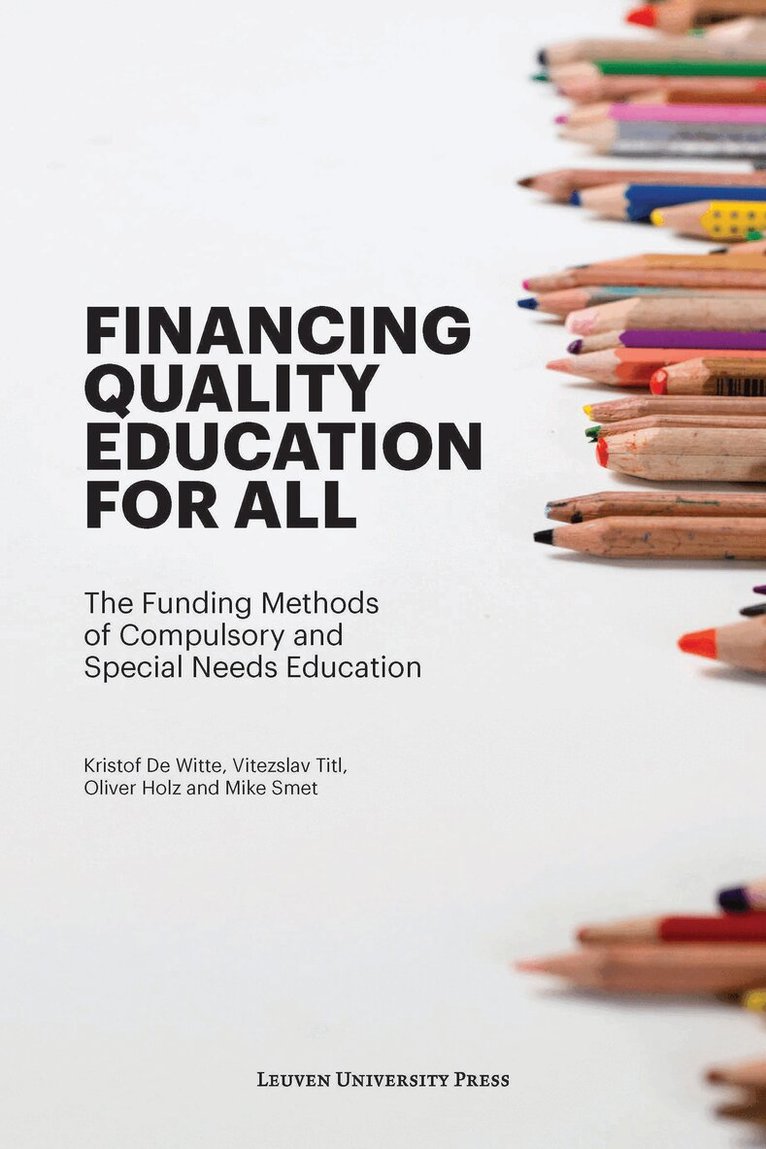
    Financing Quality Education for All

    The Funding Methods of Compulsory and Special Needs Education

    AvKristof De Witte,Vitezslav Titl

    Häftad, Engelska, 2019

    397 kr

    Beställningsvara. Skickas inom 5-8 vardagar. Fri frakt över 249 kr.

    Beskrivning

    Funding, efficiency, and equity in education In OECD countries the average expenditure on primary and secondary education institutions is about 3.5% of GDP. The investment in education has large implications for economic development and the proper functioning of democratic institutions, as well as overall well-being. However, clear consensus and guidance on which system leads to the best educational outcomes is lacking. This volume describes the resource allocation for compulsory and special needs education for a selection of well-performing countries and regions on PISA tests. By studying the funding systems in well-performing countries and regions the authors identify the elements in the respective funding systems that are associated with best outcomes and have the ideal characteristics to pursue particular goals of education systems such as equity and efficiency. The funding methods of primary and secondary education as well as special needs education are covered.Ebook available in Open Access.This publication is GPRC-labeled (Guaranteed Peer-Reviewed Content).

    Produktinformation

    • Utgivningsdatum:2019-09-11
    • Mått:156 x 234 x 10 mm
    • Vikt:270 g
    • Format:Häftad
    • Språk:Engelska
    • Antal sidor:164
    • Förlag:Leuven University Press
    • ISBN:9789462701915

    Utforska kategorier

    • Utbildningsstrategier och utbildningspolitik inom Psykologi och pedagogik

    Mer om författaren

    Kristof De Witte is professor at the Faculty of Economics and Business at KU Leuven and holds the chair in Effectiveness and Efficiency of Educational Innovations at United Nations University (UNU-MERIT) at Maastricht University. Vitezslav Titl is doctoral researcher in political economy at KU Leuven. Prior to his doctoral studies, he finished traineeships at the European Parliament and the German Development Institute. Oliver Holz is assistant professor at KU Leuven, where he works in the teacher training programme. He is affiliated with the research group Leuven Economics of Education Research. Mike Smet is assistant professor of Research Methods at the Faculty of Economics and Business at KU Leuven. He is affiliated with the research group Leuven Economics of Education Research.

    Recensioner i media

    Discusses the funding formulas for compulsory and special needs education in countries and regions that have performed well on international tests, focusing specifically on Estonia, Finland, the state of Massachusetts, the province of British Columbia, and the Flemish Community of Belgium. Highlights specific features of the selected countries and regions. Describes the education systems in these regions and their approaches to special needs students. Explains how the funding system in each region works by comprehensively looking at its funding formulas for primary, secondary, and special needs education.2021. "Annotated Listing of New Books." Journal of Economic Literature, 59 (1): 297-371. DOI: 10.1257/jel.59.1.297

    Innehållsförteckning

    • List of Figures List of Tables Chapter 1. Introduction Chapter 2. The choice of countries and regions2.1 British Columbia2.2 Estonia2.3 Finland2.4 Flanders2.5 MassachusettsChapter 3. Overview of education systems3.1 British Columbia Expenditure on educationApproach to special needs students and language minorities The autonomy and providers of education3.2 Estonia Expenditure on education Approach to special needs students and language minoritiesThe autonomy and providers of education3.3 Finland Expenditure on education Approach to special needs students and language minorities The autonomy and providers of education 3.4 FlandersExpenditure on education Approach to special needs students and language minorities Autonomy and providers of education 3.5 MassachusettsExpenditure on educationApproach to special needs students and language minorities Autonomy and providers of education Chapter 4. Funding formulas4.1 British Columbia Primary schools An example a primary school budget in the district of Mission Secondary schools An example of a secondary school budget in the district of Mission Support for special needs studentsA case study on special needs funding in the district of Mission A case-study of the funding formula in the district of Mission Summary of the education funding system in British Columbia and the district of Mission 4.2 Estonia Primary schools An example of a primary school budget in Estonia Secondary schoolsAn example of a secondary school budget in Estonia Special needs schools An example of a an additional funding calculation for special needs students in Estonia Summary of the Estonian education funding system 4.3 Finland Primary schools An example of a primary school in a municipality in Finland Secondary schools An example of a secondary school in a municipality in Finland Special needs schools The case of the municipality of Hanko An example of a school in a municipality in Finland Summary of the Finnish education funding system 4.4 Flanders Primary schools An example of a primary school board budget in Flanders Secondary schools An example of a secondary school board budget in Flanders Special needs education An example of the budget of a school with special needs students in Flanders Summary of the Flemish education funding system 4.5 Massachusetts The mechanism behind the formula The calculation of allocations An example of a primary school district budget in Massachusetts Required local contribution calculation Filling the gap with Chapter 70 education aid An example of a secondary school district budget in Mas­sachusetts Effective funding per student Funding outside the main formula Summary of the education funding in Massachusetts Chapter 5. Conclusions Summary of the funding formulas in the selected regions and countries Discussion Appendix List of primary sources British ColumbiaEstonia Finland Flanders Massachusetts References