• Fri frakt över 249 kr
  • •
  • Snabba leveranser
  • •
  • Billiga böcker
Kundservice

Du är på sajten för privatpersoner.

Företag, bibliotek eller offentlig verksamhet?

Du handlar på classic.bokus.com, där alla dina funktioner finns intakta.
Till classic.bokus.com
Bokus logotyp. Gå till startsidan.
  • Erbjudanden
  • Student
  • Topplistor
  • Barn & ungdom
  • Bokus Play
  • E-böcker
  • Ljudböcker
  • Pocketböcker
  • Spel och pussel

Pocketfynda! Hundratals böcker för 49 kr/st →

Sidfot

Mina sidor

    Hjälp

    • Kundservice
    • Vanliga frågor och svar
    • Frakt och leverans
    • Retur vid ångerrätt
    • Reklamera vara
    • Betalning
    • Köpvillkor
    • Allmänna villkor
    • Information om webbplatsens tillgänglighet

    Om Bokus

    • Om oss
    • Pressrum
    • För studenter
    • För företag
    • För bibliotek och offentlig verksamhet
    • För leverantörer
    • Hållbarhet

    Populärt

    • Aktuella erbjudanden
    • Presentkort
    • Studentlitteratur
    • Nya böcker
    • Topplistor
    • Signerade böcker
    • Engelska böcker

    Inspiration

    • Boktips
    • BookTok
    • Barnbokskaraktärer
    • Populära författare
    Logotyp för Bokus
    Följ oss på Facebook (extern länk)Följ oss på Instagram (extern länk)Följ oss på YouTube (extern länk)Följ oss på TikTok (extern länk)
    bokus @ CookiesAnpassa cookiesIntegritetspolicyKöpvillkor
    Till Citymail hemsida (extern länk)Till Budbee hemsida (extern länk)Till Postnord hemsida (extern länk)Till Schenker hemsida (extern länk)Till Early Bird hemsida (extern länk)Till Walleys hemsida (extern länk)
    1. Samhälle och politik
    2. Politik och statsskick
    3. Politiska ideologier och rörelser

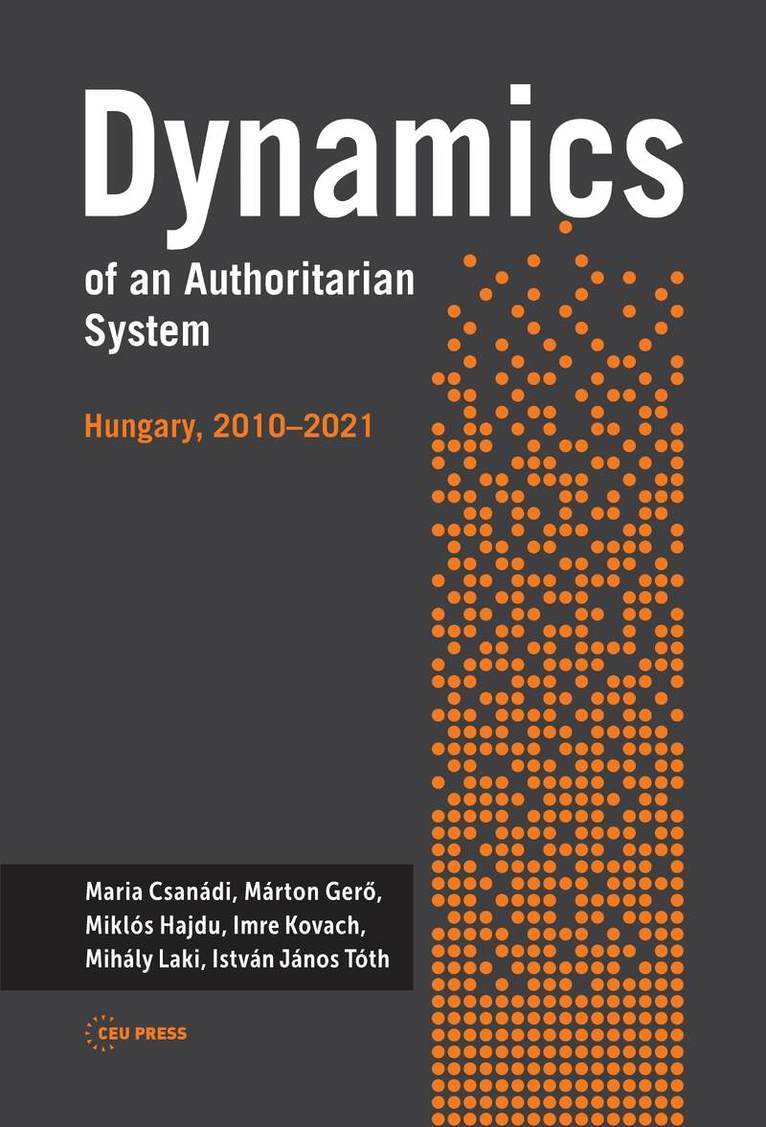
    Dynamics of an Authoritarian System

    Hungary, 2010–2021

    AvMária Csanádi,Imre Kovách

    Inbunden, Engelska, 2022

    1 264 kr

    Skickas . Fri frakt över 249 kr.

    Beskrivning

    This conceptually synthetic and empirically rich book demonstrates the vulnerability of democratic settings to authoritarianism and populism. Six scholars from various professional fields explore here the metamorphosis of a political party into a centralized authoritarian system. Viktor Orbán and his Fidesz party needed less than ten years to accomplish this transformation in Hungary. In 2010, after winning a majority that could make changes in the constitution – two-thirds of the parliamentary seats, they evolved and stabilized the system, which produced again the two-thirds majority in 2014 and 2018. The authors reveal how a democratic setting can be used as a device for political capture. They show how a political entity managed to penetrate almost all sub-fields of the economy to arrive at institutionalized corruption, and how the centralized power structure reproduces itself. With the help of a powerful empirical apparatus—among others analyses of more than 220,000 public tenders, redistributions of state subsidies, and the interconnectedness of those privileged with the political elite — the authors detail the functioning of a crony system and the network aspects of political connections in the rapid enrichment of politically-linked businesses. Their studies demonstrate the role of political capture in this redistribution and how this capture leads to a new social stratification.

    Produktinformation

    • Utgivningsdatum:2022-08-10
    • Mått:152 x 229 x 30 mm
    • Vikt:690 g
    • Format:Inbunden
    • Språk:Engelska
    • Antal sidor:375
    • Förlag:Central European University Press
    • ISBN:9789633865774

    Utforska kategorier

    • Politiska ideologier och rörelser inom Samhälle och politik
    • Ekonomisk politik inom Ekonomi och Ledarskap
    • Korruption inom Samhälle och politik

    Mer om författaren

    Maria Csanádi is DSc in political science, scientific advisor, emerita at Institute of Economics of the Centre for Economic and Regional Studies in Hungary. Imre Kovách is DSc in sociology, Scientific advisor, Institute of Sociology CSS, professor, University of Debrecen, head of Sociology PhD program. Márton Gero is Assistant professor of sociology at the Eötvös Loránd University, Faculty of Social Sciences and a research fellow at the Centre for Social Sciences. Miklós Hajdu is MSc in survey statistics, assistant lecturer at the Corvinus University of Budapest. István János Tóth is a senior research fellow at the Institute of Economics of Centre for Economic and Regional Studies at the Hungarian Academy of Sciences and managing director of Corruption Research Center Budapest (CRCB).

    Recensioner i media

    "This is a dazzling book, researched in depth, elegantly presented and brilliantly argued. I am not aware of any other book that analyses the workings of the Orbán regime as comprehensively and as insightfully as this volume. This impressive book brings the Orbán dictatorship into full focus and should be in every serious university library."https://doi.org/10.1080/09668136.2023.2205320

    Innehållsförteckning

    • List of FiguresList of TablesPrefaceMaria CsanádiIntroductionMaria Csanádi, Márton Gerő, Mihály Laki, and István János TóthPART I. Metamomorphosis of a Party into a System1. Paths to Political Capture and Institutionalized Corruption in Hungary, 2010–2021Maria CsanádiSystem evolutions in comparative perspectivePolitical-economic context of systemic evolutionFrom political dominance to political captureDiffusion of political capture into autonomous national, local and grass-roots institutionsForced resource redeployment as instruments of self reproduction of the evolving systemPolitically selective resource distribution and those most privileged by forced resource redeploymentThe domestic and external factors of persistent self-reproduction during evolutionConclusionsPART II. Reproduction through Redistribution2. Redistribution and IntegrationMárton Gerő and Imre KováchIntroductionWelfare redistribution, social integration and inequalitiesProject-based redistributionRecombinant redistributionConclusions3. Cronyism in the Orbán Regime: An Empirical Analysis of Public Tenders, 2005–2020István János Tóth and Miklós HajduIntroductionLiteratureData and IndicatorsThe Orbán Regime and MGTS+ companies: descriptive statisticsModels and estimationsConclusionsReferencesAnnex4. Political Connectedness in Hungarian State Capitalism: The Case of the “Fidesz-Connected” Mészáros Group of CompaniesMihály LakiIntroductionMethodology: data collection and processingFidesz-connected entrepreneurs on the list of the 100 wealthiest HungariansRegulatory and procurement advantages or favorsLőrincz Mészáros: family and businessAnnexSummaryMaria CsanádiList of AuthorsBibliographySubject IndexName Index