
Darius Staliunas - Böcker
Visar alla böcker från författaren Darius Staliunas. Handla med fri frakt och snabb leverans.
6 produkter
6 produkter
Pragmatic Alliance
Jewish-Lithuanian political cooperation at the beginning of the 20th century
Inbunden, Engelska, 2011
1 651 kr
Skickas inom 10-15 vardagar
Discusses the political cooperation between Jews and Lithuanians in the Tsarist Empire from the last decades of the 19th century until the early 1920s. These years saw the transformation of both Jewish and Lithuanian political life. Within the Jewish community, the previously dominant integrationists were now challenged both by those who believed that the Jews were not a religious but an ethnic or proto-nationalist group and those who believed that only with the abolition of capitalism and the establishment of a socialist state would Jewish integration be possible. Among the Lithuanians, the emergence of a modern national identity became increasingly prevalent.
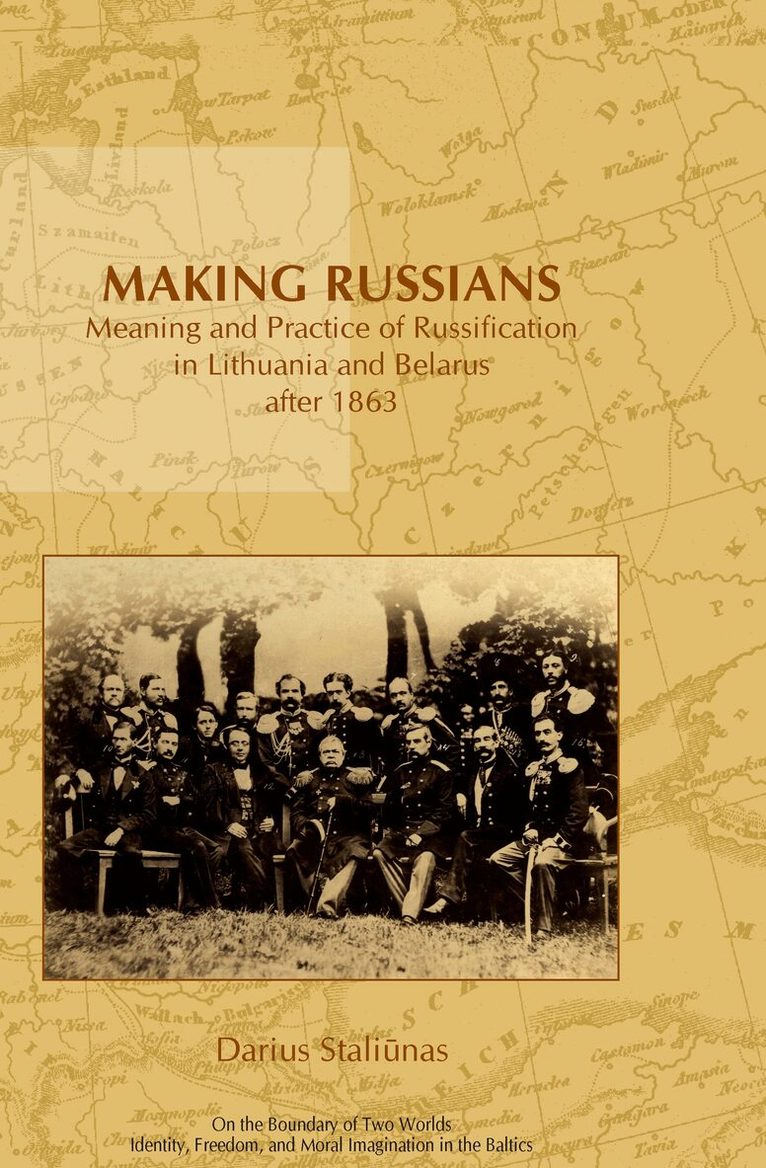
Del 11 - On the Boundary of Two Worlds
Making Russians
Meaning and Practice of Russification in Lithuania and Belarus after 1863
Inbunden, Engelska, 2007
2 480 kr
Skickas inom 5-8 vardagar
Making Russians is an innovative study dealing with Russian nationalities policy in Lithuania and Belarus in the aftermath of the 1863 Uprising. The book devotes most attention to imperial confessional and language policy, for in Russian discourse at that time it was religion and language that were considered to be the most important criteria determining nationality. The account of Russian nationalities policy presented here differs considerably from the assessments usually offered by historians from east-central Europe primarily because the author provides a more subtle description of the aims of imperial nationalities policy, rejecting the claim that the Russian authorities consistently sought to assimilate members of other national groups. At the same time the interpretation this study offers opens a discussion with western and Russian historians, especially those, who lay heavy emphasis on discourse analysis. This study asserts that the rhetoric of officials and certain public campaigners was influenced by a concept of political correctness, which condemned all forms of ethnic denationalisation. A closer look at the implementation of discriminatory policy allows us to discern within Russian imperial policy more attempts to assimilate or otherwise repress the cultures of non-dominant national groups than it is possible to appreciate simply by analysing discourse alone.
- Nyhet
1 860 kr
Skickas inom 10-15 vardagar
This collected volume offers an original perspective on the Baltic region by examining the intricate relationships between its diverse ethnic groups from the mid-nineteenth century to the present. Rather than focusing solely on national narratives or comparisons of historical development, the book analyzes ethnic relations through the lenses of identity, governance, empire, and violence. The nearly constant redrawing of geographic borders and boundaries among communities during this period destabilized fixed identities, generating novel, hybrid ways of self-identification along with a hardening of oppositions. Innovative forms of coexistence came with violent, sometimes genocidal conflicts. The contributors explore topics such as evolving senses of belonging, the impact of imperial and Soviet rule, instances of cooperation and conflict, and the legacies of historical trauma. By incorporating new sources and interdisciplinary approaches, they update traditional understandings of nations and nationalism in the Baltic region and provide insights relevant to similar regions.
Enemies for a Day
Antisemitism and Anti-Jewish Violence in Lithuania under the Tsars
Inbunden, Engelska, 2015
1 657 kr
Skickas inom 10-15 vardagar
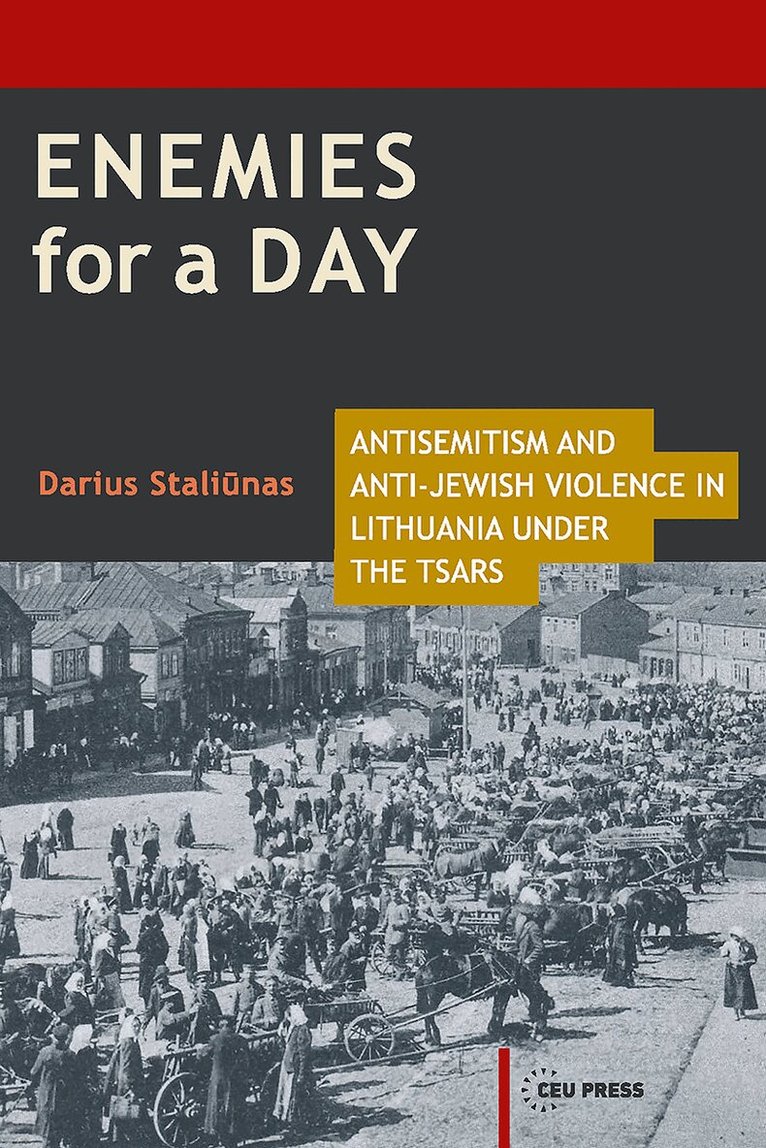
It begins by illustrating how widespread anti-Jewish feelings were among the Christian population in 19 th century, focusing on blood libel accusations as well as describing the role of modern antisemitism. Secondly, it tries to identify the structural preconditions as well as specific triggers that turned anti-Jewish feelings into collective violence and analyzes the nature of this violence. Lastly, pogroms in Lithuania are compared to anti-Jewish violence in other regions of the Russian Empire and East Galicia. This research is inspired by the cultural turn in social sciences, an approach that assumes that violence is filled with meaning, which is “culturally constructed, discursively mediated, symbolically saturated, and ritually regulated.” The author argues that pogroms in Lithuania instead followed a communal pattern of ethnic violence and was very different from deadly pogroms in other parts of the Russian Empire.
Enemies for a Day
Antisemitism and Anti-Jewish Violence in Lithuania under the Tsars
Häftad, Engelska, 2015
642 kr
Skickas inom 10-15 vardagar
It begins by illustrating how widespread anti-Jewish feelings were among the Christian population in 19 th century, focusing on blood libel accusations as well as describing the role of modern antisemitism. Secondly, it tries to identify the structural preconditions as well as specific triggers that turned anti-Jewish feelings into collective violence and analyzes the nature of this violence. Lastly, pogroms in Lithuania are compared to anti-Jewish violence in other regions of the Russian Empire and East Galicia. This research is inspired by the cultural turn in social sciences, an approach that assumes that violence is filled with meaning, which is “culturally constructed, discursively mediated, symbolically saturated, and ritually regulated.” The author argues that pogroms in Lithuania instead followed a communal pattern of ethnic violence and was very different from deadly pogroms in other parts of the Russian Empire.
Tsar, The Empire, and The Nation
Dilemmas of Nationalization In Russia’s Western Borderlands, 1905-1915
Inbunden, Engelska, 2021
1 985 kr
Skickas inom 10-15 vardagar
This collection of essays addresses the challenge of modern nationalism to the tsarist Russian Empire. First appearing on the empire’s western periphery this challenge, was most prevalent in twelve provinces extending from Ukrainian lands in the south to the Baltic provinces in the north, as well as to the Kingdom of Poland.At issue is whether the late Russian Empire entered World War I as a multiethnic state with many of its age-old mechanisms run by a multiethnic elite, or as a Russian state predominantly managed by ethnic Russians. The tsarist vision of prioritizing loyalty among all subjects over privileging ethnic Russians and discriminating against non-Russians faced a fundamental problem: as soon as the opportunity presented itself, non-Russians would increase their demands and become increasingly separatist.The authors found that although the imperial government did not really identify with popular Russian nationalism, it sometimes ended up implementing policies promoted by Russian nationalist proponents. Matters addressed include native language education, interconfessional rivalry, the “Jewish question,” the origins of mass tourism in the western provinces, as well as the emergence of Russian nationalist attitudes in the aftermath of the first Russian revolution.