
David Fishman - Böcker
Visar alla böcker från författaren David Fishman. Handla med fri frakt och snabb leverans.
6 produkter
6 produkter
359 kr
Skickas inom 7-10 vardagar
Long before there were Jewish communities in the land of the tsars, Jews inhabited a region which they called medinat rusiya, the land of Russia. Prior to its annexation by Russia, the land of Russia was not a center of rabbinic culture. But in 1772, with its annexation by Tsarist Russia, this remote region was severed from the Polish-Lithuanian Commonwealth; its 65,000 Jews were thus cut off from the heartland of Jewish life in Eastern Europe. Forced into independence, these Jews set about forging a community with its own religious leadership and institutions.The three great intellectual currents in East European Jewry--Hasidism, Rabbinic Mitnagdism, and Haskalah--all converged on Eastern Belorussia, where they clashed and competed. In the course of a generation, the community of Shklovthe most prominent of the towns in the areawitnessed an explosion of intellectual and cultural activity.Focusing on the social and intellectual odysseys of merchants, maskilim, and rabbis, and their varied attempts to combine Judaism and European culture, David Fishman here chronicles the remarkable story of these first modern Jews of Russia.
362 kr
Skickas inom 7-10 vardagar
In 1973, homosexuality was officially depathologized with a revision in the Diagnostic and Statistical Manual of Psychiatry. In 1980, a new diagnosis appeared: Gender Identity Disorder of Childhood (GID). The shift separated gender from sexuality, while it simultaneously reinforced traditional concepts of "male" and "female" and made it possible for cross-gendered behavior and/or identification to be deemed psychiatric illness.What is the difference then between a child being called a sissy on the playground and being labeled with a disorder in a psychiatric hospital? Combining theory and personal narrative, this volume interrogates the meaning of "the normal" that pervades the literature on GID and investigates the theoretical underpinnings of the diagnosis. Sissies and Tomboys considers how the stigma of illness influences a child's development and what homosexual childhood, freed from the constraints of conventionally acceptable gender expression, might look like.
587 kr
Skickas inom 7-10 vardagar
The Rise of Modern Yiddish Culture explores the transformation of Yiddish from a low-status vernacular to the medium of a complex modern culture. David Fishman examines the efforts of east European Jews to establish their linguistic distinctiveness as part of their struggle for national survival in the diaspora. Fishman considers the roots of modern Yiddish culture in social and political conditions in Imperial Tsarist and inter-war Poland, and its relationship to Zionism and Bundism. In so doing, Fishman argues that Yiddish culture enveloped all socioeconomic classes, not just the proletarian base, and considers the emergence, at the turn of the century, of a pro-Yiddish intelligentsia and a Yiddishist movement.As Fishman points out, the rise of Yiddishism was not without controversy. Some believed that the rise of Yiddish represented a shift away from a religious-dominated culture to a completely secular, European one; a Jewish nation held together by language, rather than by land or religious content. Others hoped that Yiddish culture would inherit the moral and national values of the Jewish religious tradition, and that to achieve this result, the Bible and Midrash would need to exist in modern Yiddish translation. Modern Yiddish culture developed in the midst of these opposing concepts.Fishman follows the rise of the culture to its apex, the founding of the Yiddish Scientific Institute (YIVO) in Vilna in 1925, and concludes with the dramatic story of the individual efforts that preserved the books and papers of YIVO during the destruction and annihilation of World War II and in postwar Soviet Lithuania. The Rise of Modern Yiddish Culture, like those efforts, preserves the cultural heritage of east European Jews with thorough research and fresh insights.
1 204 kr
Skickas
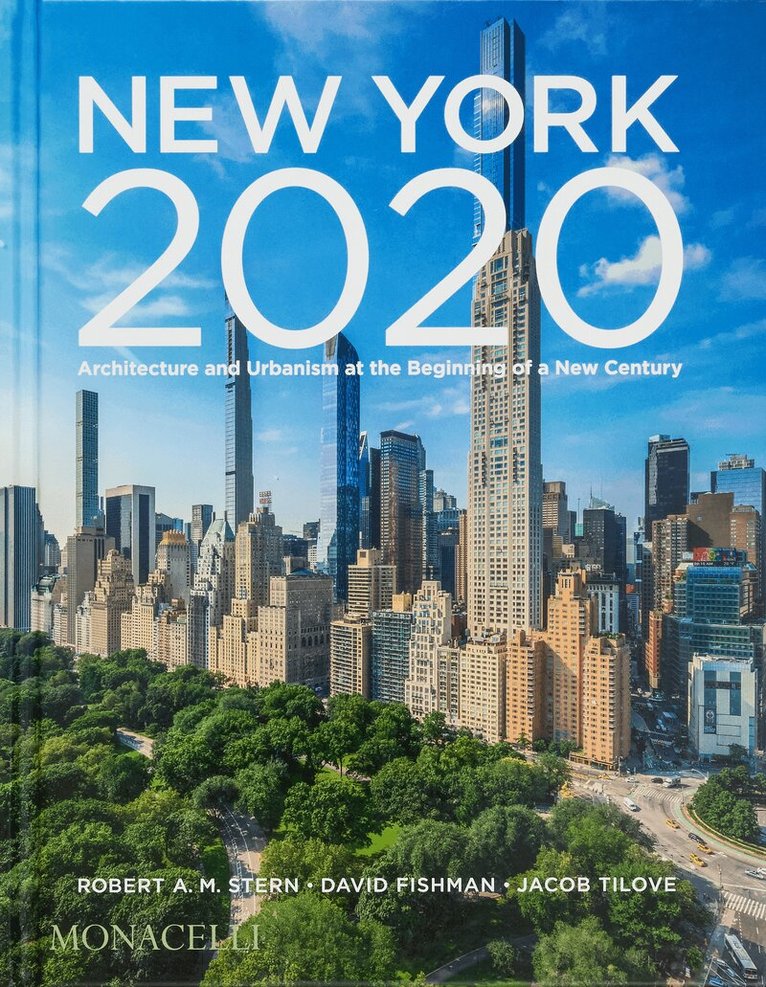
‘A 10.5-pound megalith [Stern] finished just before his death that will serve as a fitting memorial. These encyclopedic books serve no dogma other than celebrating the glories of New York as a city, of urbanism as a civilizing value, and of architecture as a noble pursuit.’ – Paul Goldberger, The New York Times‘The book on New York architecture’ – CurbedThe culmination of Robert A.M. Stern’s monumental history of architecture in New York City and a comprehensive record of building over the last twenty-five yearsA landmark in architectural publishing, New York 2020 explores the planning and politics of building in New York City during the first decades of the 21st century. This encyclopedic book, as complex and vast as the city itself, references more than 3,000 projects constructed between the year 2000 and the present day.Across 1,500 pages, New York 2020 describes and illustrates the ‘supertalls’ now populating our skyline, lush riverfront parks born from derelict waterfront, iconic cultural destinations, and thousands of smaller, unheralded residential and civic projects that enhance the built environment and the urban fabric.Readers will discover work by leading architects, including Norman Foster, Renzo Piano, Bjarke Ingels, Diller Scofidio + Renfro, Selldorf Architects, Frank Gehry, and Robert A.M. Stern Architects; a dazzling array of museums and institutions, including the High Line, Hudson Yards, the new Whitney Museum, and the expansions of MoMA and Lincoln Center; the rebuilding of the World Trade Center site; and more.The much-anticipated final volume in architect Robert A.M. Stern’s critically acclaimed New York series, which traces the evolution of the city from the Civil War to present day, New York 2020 tells the story of a remarkable period of urban development, architectural experiment, and seismic cultural shifts.
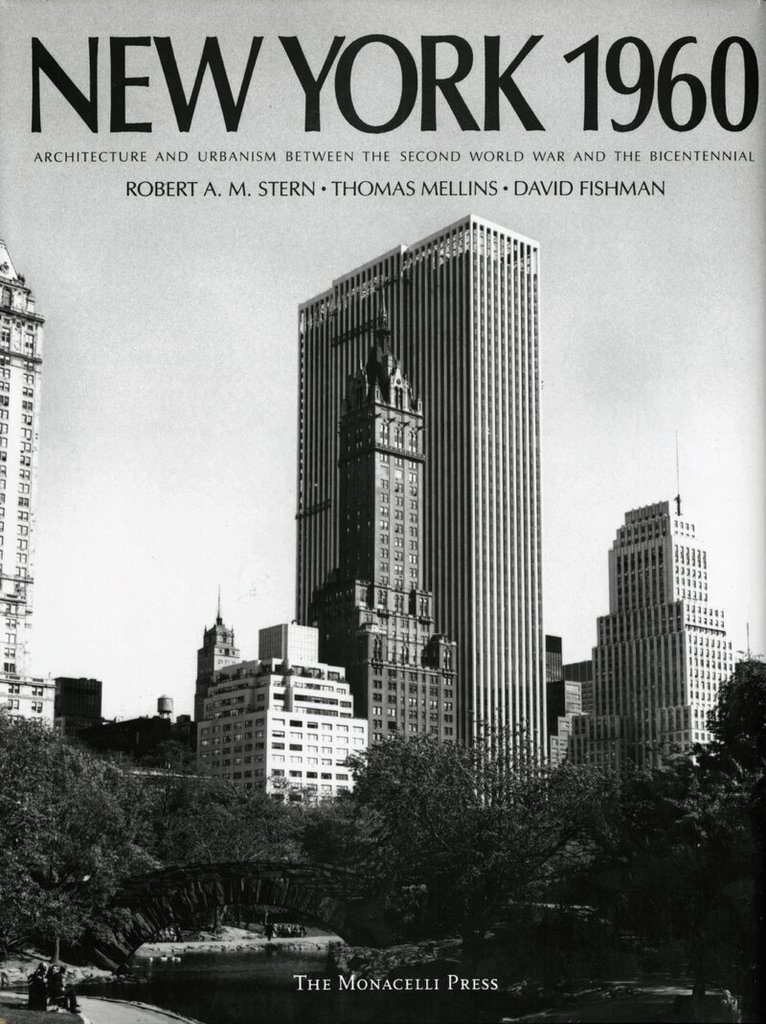
New York 1960
Architecture and Urbanism Between the Second World War and the Bicentennial
Inbunden, Engelska, 1997
825 kr
Tillfälligt slut
The post-World War II era witnessed New York's reign as the unofficial but undisputed economic and artistic capital of the world. By the mid-1970s, the city had experienced a profound reversal, and both its economy and its reputation were at a historic nadirThis is the third volume (and the fourth chronologically) in architect and historian Robert A. M. Stern's monumental series of documentary studies of New York City architecture and urbanism.New York 1880, New York 1900, and New York 1930 have comprehensively covered the architects and urban planners who defined New York from the end of the nineteenth century to the middle of the twentieth century. The post-World War II era witnessed New York's reign as the unofficial but undisputed economic and artistic capital of the world. By the mid-1970s, the city had experienced a profound reversal, and both its economy and its reputation were at a historic nadir. The architectural history of the period offered an exceptionally abundant and varied mix of building styles and types, from the faltering traditionalism of the 1940s through the heyday of International Style modernism in the 1950s and 1960s to the incipient postmodernism of the 1970s.Organized geographically, New York 1960 provides an encyclopedic survey of the city's postwar architecture as well as relating a coherent story about each of its diverse neighborhoods. Primary sources are emphasized, including the commentaries of the preeminent architecture critics of the day; the text is illustrated exclusively with a rich collection of period photographs.

244 kr
Skickas inom 3-6 vardagar