A. D. Nuttall - Böcker
Visar alla böcker från författaren A. D. Nuttall. Handla med fri frakt och snabb leverans.
6 produkter
6 produkter
1 259 kr
Skickas inom 3-6 vardagar
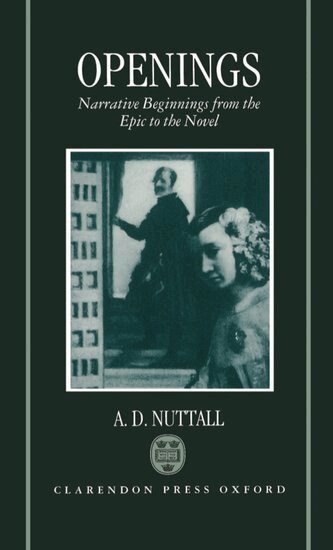
What is the difference between a natural beginning and the beginning of a story? Some deny that there are any beginnings in nature, except perhaps for the origin of the universe itself, suggesting that elsewhere we have only a continuum of events, into which beginnings are variously `read' by different societies. This book argues that history is full of real beginnings but that poets and novelists are indeed free to begin their stories wherever they like. The ancient poet Homer laid down a rule for his successors when he began his epic by plunging in medias res, `into the midst of things'. Later writers, however, persistently play off the `interventionist', in medias res opening against some sense of a `deep', natural beginning: Genesis or the birth of a child. The author also outlines how the inspiring Muse of epic gives way to the poet's ego, dies, revives and dies again.Ranging from Greek and Roman epic to the modern novel via Dante, Milton, Wordsworth, Sterne and Dickens, A. D. Nuttall has written an ambitious and original book which will be of interest to a wide variety of readers.
1 019 kr
Skickas inom 5-8 vardagar
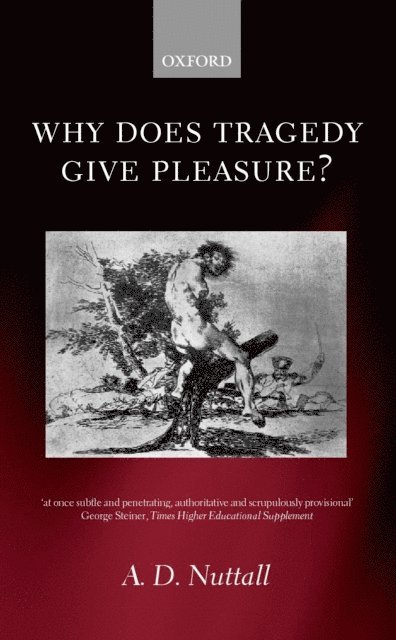
Why does tragedy give pleasure? Why do people who are neither wicked nor depraved enjoy watching plays about suffering or death? Is it because we see horrific matter controlled by majestic art? Or because tragedy actually reaches out to the dark side of human nature? A. D. Nuttall's wide-ranging, lively and engaging book offers a new answer to this perennial question. The 'classical' answer to the question is rooted in Aristotle and rests on the unreality of the tragic presentation: no one really dies; we are free to enjoy watching potentially horrible events controlled and disposed in majestic sequence by art. In the nineteenth century, Nietzsche dared to suggest that Greek tragedy is involved with darkness and unreason and Freud asserted that we are all, at the unconscious level, quite wicked enough to rejoice in death. But the problem persists: how can the conscious mind assent to such enjoyment? Strenuous bodily exercise is pleasurable. Could we, when we respond to a tragedy, be exercising our emotions, preparing for real grief and fear? King Lear actually destroys an expected majestic sequence. Might the pleasure of tragedy have more to do with possible truth than with 'splendid evasion'?
458 kr
Skickas inom 5-8 vardagar
In pursuit of a powerful, common-sense argument about realism, renowned scholar A. D. Nuttall discusses English eighteenth-century and French neo-classical conceptions of realism, and considers Julius Caesar, Coriolanus, The Merchant of Venice, Othello, and both parts of King Henry IV as a prolonged feat of mimesis, with particular emphasis on Shakespeare’s perception of society and culture as subject to historical change. Shakespeare is chosen as the great example of realism because he addresses not only the stable characteristics but also the flux of things, and he is thus seen as a perceiver of that flux and not a mere specimen. An acknowledged classic of literary studies, A New Mimesis is reissued here with a new preface by the author.
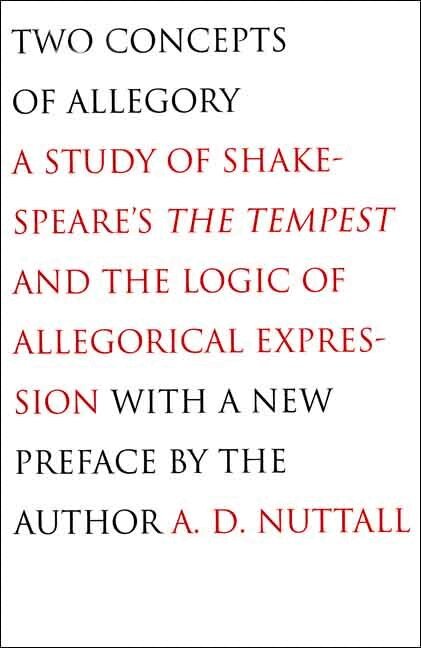
Two Concepts of Allegory
A Study of Shakespeare's The Tempest and the Logic of Allegorical Expression
Häftad, Engelska, 2007
418 kr
Skickas inom 5-8 vardagar
The fundamental subject of A. D. Nuttall’s bold and daring first book, Two Concepts of Allegory, is a particular habit of thought—the practice of thinking about universals as though they were concrete things. His study takes the form of an inquiry into certain conceptual questions raised, in the first place, by the allegorical critics of The Tempest, and, in the second place, by allegorical and quasi-allegorical poetry in general. The argument has the further consequence of suggesting that allegory and metaphysics are in practice more closely allied than is commonly supposed. This paperback reissue includes a new preface by the author.
199 kr
Skickas inom 7-10 vardagar
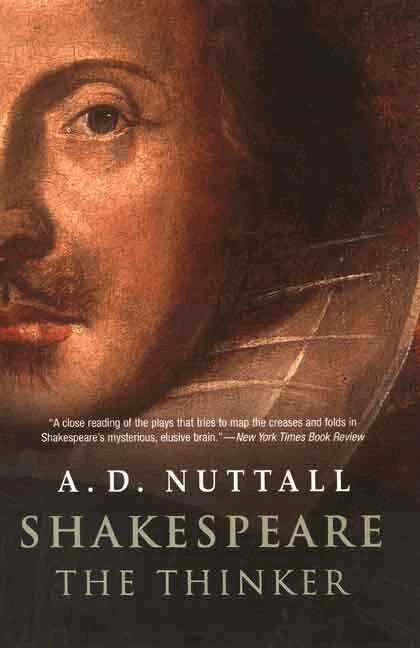
"A close reading of the plays that tries to map the creases and folds in Shakespeare's mysterious, elusive brain."— New York Times Book ReviewA. D. Nuttall’s study of Shakespeare’s intellectual preoccupations is a literary tour de force and comes to crown the distinguished career of a Shakespeare scholar. Certain questions engross Shakespeare from his early plays to the late romances: the nature of motive, cause, personal identity and relation, the proper status of imagination, ethics and subjectivity, language and its capacity to occlude and to communicate. Yet Shakespeare’s thought, Nuttall demonstrates, is anything but static. The plays keep returning to, modifying, and complicating his creative preoccupations. Nuttall allows us to hear and appreciate the emergent cathedral choir of play speaking to play. By the later stages of Nuttall’s book this choir is nearly overwhelming in its power and dimensions. The author does not limit discussion to moments of crucial intellection but gives himself ample space in which to get at the distinctive essence of each work.Much recent historicist criticism has tended to “flatten” Shakespeare by confining him to the thought-clichés of his time, and this in its turn has led to an implicitly patronizing view of him as unthinkingly racist, sexist, and so on. Nuttall shows us that, on the contrary, Shakespeare proves again and again to be more intelligent and perceptive than his 21st-century readers. This book challenges us to reconsider the relation of great literature to its social and historical matrix. It is also, perhaps, the best guide to Shakespeare’s plays available in English.
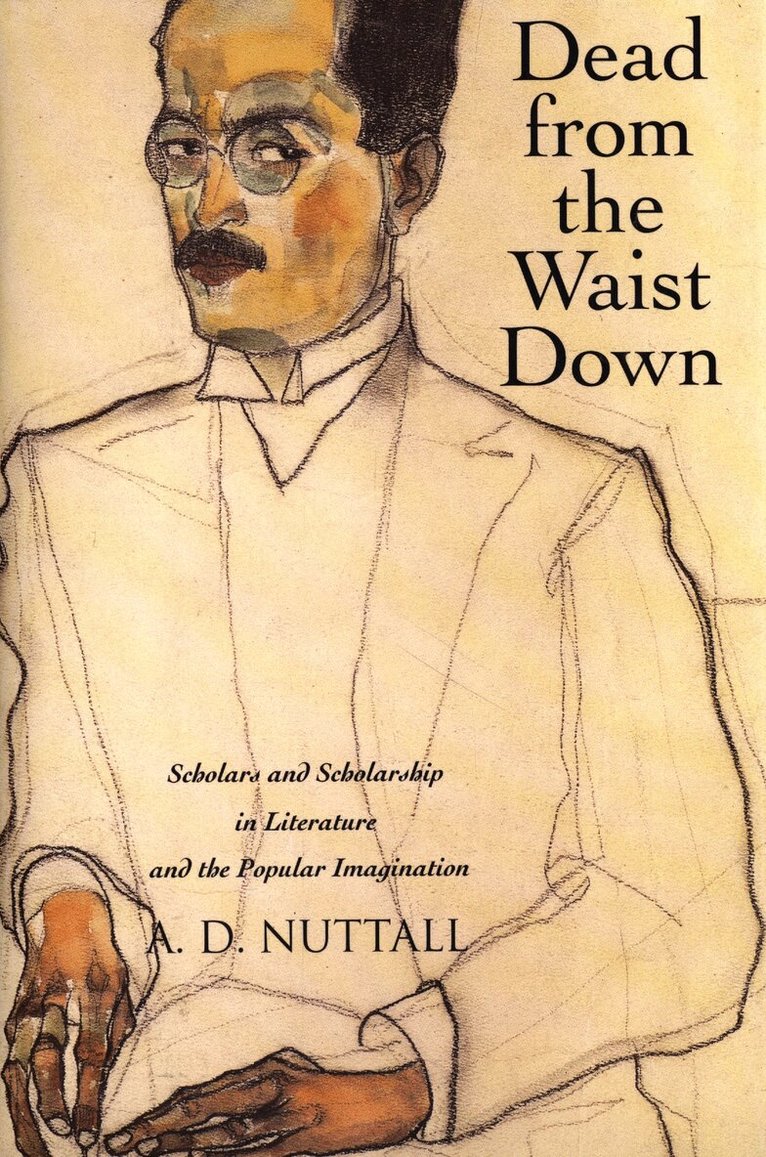
Dead from the Waist Down
Scholars and Scholarship in Literature and the Popular Imagination
Häftad, Engelska, 2011
478 kr
Skickas inom 5-8 vardagar
At the end of the sixteenth century, scholars and intellectuals were seen as Faustian magicians, dangerous and sexy. By the nineteenth century, they were perceived as dusty and dried up, “dead from the waist down,” as Browning so wickedly put it. In this erudite and entertaining book, a renowned literary critic explores the various ways we have thought about scholars and scholarship through the ages.A.D. Nuttall focuses on three people, two real and one fictitious: the classical scholar Isaac Casaubon who lived from 1559 to 1614; Mark Pattison, nineteenth-century rector at Oxford; and Mr. Casaubon in George Eliot’s Middlemarch. The three are intricately related, for Pattison was seen by many as the model for Eliot’s Mr. Casaubon, and he was also the author of the best book on Isaac Casaubon. Nuttall offers a penetrating interpretation of Middlemarch and then describes how Pattison recorded his own introverted intellectual life and self-lacerating depression. He presents Isaac Casaubon, on the other hand, as a fulfilled scholar who personifies the ideal of detailed, unspectacular truth-telling, often imperiled in our own culture. Nuttall concludes with a meditation on morality, sexuality, and the true virtues of scholarship.