• Fri frakt över 249 kr
  • •
  • Snabba leveranser
  • •
  • Billiga böcker
Kundservice

Du är på sajten för privatpersoner.

Företag, bibliotek eller offentlig verksamhet?

Du handlar på classic.bokus.com, där alla dina funktioner finns intakta.
Till classic.bokus.com
Bokus logotyp. Gå till startsidan.
  • Erbjudanden
  • Student
  • Topplistor
  • Barn & ungdom
  • Bokus Play
  • E-böcker
  • Ljudböcker
  • Pocketböcker
  • Spel och pussel

Pocketfynda! Hundratals böcker för 49 kr/st →

Sidfot

Mina sidor

    Hjälp

    • Kundservice
    • Vanliga frågor och svar
    • Frakt och leverans
    • Retur vid ångerrätt
    • Reklamera vara
    • Betalning
    • Köpvillkor
    • Allmänna villkor
    • Information om webbplatsens tillgänglighet

    Om Bokus

    • Om oss
    • Pressrum
    • För studenter
    • För företag
    • För bibliotek och offentlig verksamhet
    • För leverantörer
    • Hållbarhet

    Populärt

    • Aktuella erbjudanden
    • Presentkort
    • Studentlitteratur
    • Nya böcker
    • Topplistor
    • Signerade böcker
    • Engelska böcker

    Inspiration

    • Boktips
    • BookTok
    • Barnbokskaraktärer
    • Populära författare
    Logotyp för Bokus
    Följ oss på Facebook (extern länk)Följ oss på Instagram (extern länk)Följ oss på YouTube (extern länk)Följ oss på TikTok (extern länk)
    bokus @ CookiesAnpassa cookiesIntegritetspolicyKöpvillkor
    Till Citymail hemsida (extern länk)Till Budbee hemsida (extern länk)Till Postnord hemsida (extern länk)Till Schenker hemsida (extern länk)Till Early Bird hemsida (extern länk)Till Walleys hemsida (extern länk)
    1. Skönlitteratur
    2. Litteraturvetenskap
    3. Litteraturvetenskap

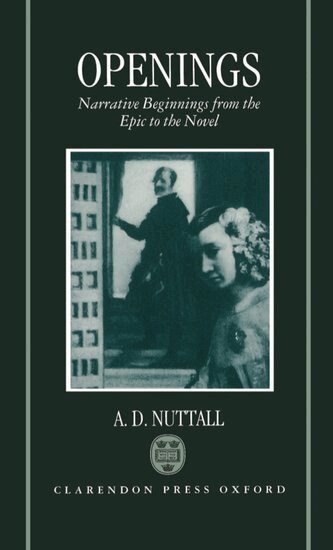
    Openings

    Narrative Beginnings from the Epic to the Novel

    AvA. D. Nuttall

    Inbunden, Engelska, 1992

    Del i serien OUP Oxford

    1 201 kr

    Beställningsvara. Skickas inom 5-8 vardagar. Fri frakt över 249 kr.

    Beskrivning

    What is the difference between a natural beginning and the beginning of a story? Some deny that there are any beginnings in nature, except perhaps for the origin of the universe itself, suggesting that elsewhere we have only a continuum of events, into which beginnings are variously `read' by different societies. This book argues that history is full of real beginnings but that poets and novelists are indeed free to begin their stories wherever they like. The ancient poet Homer laid down a rule for his successors when he began his epic by plunging in medias res, `into the midst of things'. Later writers, however, persistently play off the `interventionist', in medias res opening against some sense of a `deep', natural beginning: Genesis or the birth of a child. The author also outlines how the inspiring Muse of epic gives way to the poet's ego, dies, revives and dies again.Ranging from Greek and Roman epic to the modern novel via Dante, Milton, Wordsworth, Sterne and Dickens, A. D. Nuttall has written an ambitious and original book which will be of interest to a wide variety of readers.

    Produktinformation

    • Utgivningsdatum:1992-04-02
    • Mått:141 x 225 x 20 mm
    • Vikt:465 g
    • Format:Inbunden
    • Språk:Engelska
    • Serie:OUP Oxford
    • Antal sidor:266
    • Förlag:Clarendon Press
    • ISBN:9780198117414

    Utforska kategorier

    • Litteraturvetenskap inom Skönlitteratur
    • Litteraturteori inom Skönlitteratur

    Recensioner i media

    `This is a subtle account of the relationship between art and ontology. Its gusto, if not always free from self-indulgence, exerts a continuous grip on the reader's attention.'A Journal of English Language and Literature, Vol 74, No 6 (Dec 1993)

    Innehållsförteckning

    • Part 1 The beginning of the "Aeneid": the voice of the Muse and the voice of the poet; polysemous epic; the beginning of the story. Part 2 The "Commedia": intervention - poetic and divine; Dante and Virgil; Chaucer and the "overheard opening". Part 3 "Paradise Lost": Renaissance ego and the rebirth of the Muse; Genesis and the beginning of "Paradise Lost". Part 4 "The Prelude": the retroactive poem; the Muse and the dead self. Part 5 "Tristram Shandy": telling versus explaining; comedy as bodily critique. Part 6 David and Pip: the discarded face; modes of self-reference. Part 7 The sense of a beginning: the idea of a natural beginning; finding the Muse.