Adriano Prosperi - Böcker
Visar alla böcker från författaren Adriano Prosperi. Handla med fri frakt och snabb leverans.
3 produkter
3 produkter
323 kr
Skickas inom 7-10 vardagar
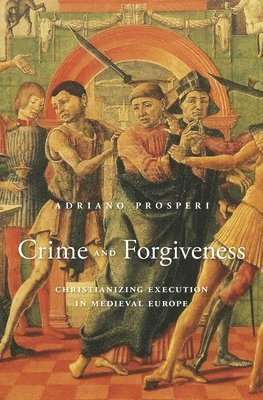
A provocative analysis of how Christianity helped legitimize the death penalty in early modern Europe, then throughout the Christian world, by turning execution into a great cathartic public ritual and the condemned into a Christ-like figure who accepts death to save humanity.The public execution of criminals has been a common practice ever since ancient times. In this wide-ranging investigation of the death penalty in Europe from the fourteenth to the eighteenth century, noted Italian historian Adriano Prosperi identifies a crucial period when legal concepts of vengeance and justice merged with Christian beliefs in repentance and forgiveness.Crime and Forgiveness begins with late antiquity but comes into sharp focus in fourteenth-century Italy, with the work of the Confraternities of Mercy, which offered Christian comfort to the condemned and were for centuries responsible for burying the dead. Under the brotherhoods’ influence, the ritual of public execution became Christianized, and the doomed person became a symbol of the fallen human condition. Because the time of death was known, this “ideal” sinner could be comforted and prepared for the next life through confession and repentance. In return, the community bearing witness to the execution offered forgiveness and a Christian burial. No longer facing eternal condemnation, the criminal in turn publicly forgave the executioner, and the death provided a moral lesson to the community.Over time, as the practice of Christian comfort spread across Europe, it offered political authorities an opportunity to legitimize the death penalty and encode into law the right to kill and exact vengeance. But the contradictions created by Christianity’s central role in executions did not dissipate, and squaring the emotions and values surrounding state-sanctioned executions was not simple, then or now.
319 kr
Kommande
A seminar, a sixteenth-century heretical text, and the art of slow reading—this is historical research as you’ve never seen it before.Patience Games: A Seminar on the 'Benefit of Christ' invites readers into the unpredictable world of scholarly discovery, where interpretation is not a straight path but a labyrinth of dialogue revision. At the heart of this book is a seminar held forty years ago at the University of Bologna, where students wrestled with The Beneficio di Cristo, the incendiary sixteenth-century text that questioned Church authority and championed salvation through grace alone. This is not a neatly packaged historical study, however—it is an unfiltered look at the errors and insights that emerge in the collective process of reading and debating a text.Through shifting hypotheses and the sheer unpredictability of research, Patience Games dismantles the illusion of scholarship as a sterile pursuit, revealing instead a messy, deeply human endeavor. Blending sharp analysis with wit and self-irony, the book makes a compelling case for the continued importance of slow reading—even in an age where knowledge is just a click away.
1 849 kr
Skickas inom 5-8 vardagar
Justice Blindfolded gives an overview of the history of “justice” and its iconography through the centuries. Justice has been portrayed as a woman with scales, or holding a sword, or, since the fifteenth century, with her eyes bandaged. This last symbol contains the idea that justice is both impartial and blind, reminding indirectly of the bandaged Christ on the cross, a central figure in the Christian idea of fairness and forgiveness. In this rich and imaginative journey through history and philosophy, Prosperi manages to convey a full account of the ways justice has been described, portrayed and imagined. Translation of Giustizia bendata. Percorsi storici di un'immagine (Einaudi, 2008).