Alan L. Yuille - Böcker
Visar alla böcker från författaren Alan L. Yuille. Handla med fri frakt och snabb leverans.
6 produkter
6 produkter
531 kr
Skickas inom 5-8 vardagar
1 590 kr
Skickas inom 10-15 vardagar
The science associated with the development of artificial sen sory systems is occupied primarily with determining how information about the world can be extracted from sensory data. For example, computational vision is, for the most part, concerned with the de velopment of algorithms for distilling information about the world and recognition of various objects in the environ (e. g. localization ment) from visual images (e. g. photographs or video frames). There are often a multitude of ways in which a specific piece of informa tion about the world can be obtained from sensory data. A subarea of research into sensory systems has arisen which is concerned with methods for combining these various information sources. This field is known as data fusion, or sensor fusion. The literature on data fusion is extensive, indicating the intense interest in this topic, but is quite chaotic. There are no accepted approaches, save for a few special cases, and many of the best methods are ad hoc. This book represents our attempt at providing a mathematical foundation upon which data fusion algorithms can be constructed and analyzed. The methodology that we present in this text is mo tivated by a strong belief in the importance of constraints in sensory information processing systems. In our view, data fusion is best un derstood as the embedding of multiple constraints on the solution to a sensory information processing problem into the solution pro cess.
1 590 kr
Skickas inom 10-15 vardagar
The science associated with the development of artificial sen sory systems is occupied primarily with determining how information about the world can be extracted from sensory data. For example, computational vision is, for the most part, concerned with the de velopment of algorithms for distilling information about the world and recognition of various objects in the environ (e. g. localization ment) from visual images (e. g. photographs or video frames). There are often a multitude of ways in which a specific piece of informa tion about the world can be obtained from sensory data. A subarea of research into sensory systems has arisen which is concerned with methods for combining these various information sources. This field is known as data fusion, or sensor fusion. The literature on data fusion is extensive, indicating the intense interest in this topic, but is quite chaotic. There are no accepted approaches, save for a few special cases, and many of the best methods are ad hoc. This book represents our attempt at providing a mathematical foundation upon which data fusion algorithms can be constructed and analyzed. The methodology that we present in this text is mo tivated by a strong belief in the importance of constraints in sensory information processing systems. In our view, data fusion is best un derstood as the embedding of multiple constraints on the solution to a sensory information processing problem into the solution pro cess.
Energy Minimization Methods in Computer Vision and Pattern Recognition
5th International Workshop, EMMCVPR 2005, St. Augustine, FL, USA, November 9-11, 2005, Proceedings
Häftad, Engelska, 2005
1 105 kr
Skickas inom 10-15 vardagar
This volume consists of the 42 papers presented at the International Workshop on Energy Minimization Methods in Computer Vision and Pattern Recog- tion (EMMCVPR 2005), which was held at the Hilton St. Augustine Historic Bayfront,St. Augustine, Florida,USA, during November9-11,2005.This wo- shop is the ?fth in a series which began with EMMCVPR 1997 held in Venice, Italy, in May 1997 and continued with EMMCVPR 1999 held in York, UK, in July 1999, EMMCVPR 2001 held in Sophia-Antipolis, France, in September 2001 and EMMCVPR 2003 held in Lisbon, Portugal, in July 2003. Many problems in computer vision and pattern recognition (CVPR) are couchedintheframeworkofoptimization.Theminimizationofaglobalquantity, often referred to as the energy, forms the bulwark of most approachesin CVPR. Disparate approaches such as discrete and probabilistic formulations on the one hand and continuous, deterministic strategies on the other often have optimi- tion or energy minimization as a common theme.Instances of energy minimi- tion arise in Gibbs/Markov modeling, Bayesian decision theory, geometric and variational approaches and in areas in CVPR such as object recognition and - trieval, image segmentation, registration, reconstruction, classi?cation and data mining. The aim of this workshop was to bring together researchers with interests in thesedisparateareasofCVPRbutwithanunderlyingcommitmenttosomeform of not only energy minimization but global optimization in general. Although thesubjectistraditionallywellrepresentedinmajorinternationalconferenceson CVPR, recent advances-information geometry, Bayesian networks and gra- ical models, Markov chain Monte Carlo, graph algorithms, implicit methods in variational approaches and PDEs-deserve an informal and focused hearing in a workshop setting.
Energy Minimization Methods in Computer Vision and Pattern Recognition
6th International Conference, EMMCVPR 2007, Ezhou, China, August 27-29, 2007, Proceedings
Häftad, Engelska, 2007
1 105 kr
Skickas inom 10-15 vardagar
This volume contains the papers presented at the Sixth International Conference on Energy Minimization Methods on Computer Vision and Pattern Recognition (EMMCVPR 2007), held at the Lotus Hill Institute, Ezhou, Hubei, China, August 27–29, 2007. The motivation for this conference is the realization that many problems in computer vision and pattern recognition can be formulated in terms of probabilistic inference or optimization of energy functions. EMMCVPR 2007 addressed the critical issues of representation, learning, and inference. Important new themes include pr- abilistic grammars, image parsing, and the use of datasets with ground-truth to act as benchmarks for evaluating algorithms and as a way to train learning algorithms. Other themes include the development of efficient inference algorithms using advanced techniques from statistics, computer science, and applied mathematics. We received 140 submissions for this workshop. Each paper was reviewed by three committee members. Based on these reviews we selected 22 papers for oral presen- tion and 15 papers for poster presentation. This book makes no distinction between oral and poster papers. We have organized these papers in seven sections on al- rithms, applications, image parsing, image processing, motion, shape, and thr- dimensional processing. Finally, we thank those people who helped make this workshop happen. We - knowledge the Program Committee for their help in reviewing the papers.
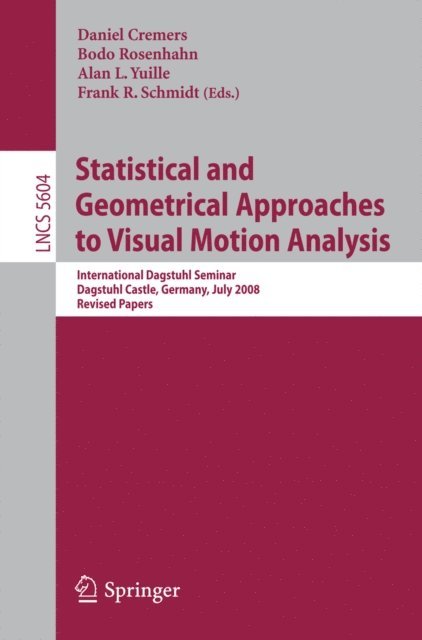
Statistical and Geometrical Approaches to Visual Motion Analysis
International Dagstuhl Seminar, Dagstuhl Castle, July 13-18, 2008, Revised Papers
Häftad, Engelska, 2009
540 kr
Skickas inom 10-15 vardagar
Motion analysis is central to both human and machine vision. It involves the interpretation of image data over time and is crucial for a range of motion tasks suchasobstacledetection,depthestimation,videoanalysis,sceneinterpretation, videocompressionandotherapplications. Motionanalysisis unsolvedbecauseit requires modeling of the complicated relationships between the observed image data and the motion of objects and motion patterns (e. g. , falling rain) in the visual scene. The Dagstuhl Seminar 08291 on Statistical and Geometrical Approaches to Visual Motion Analysis was held during July 13-18, 2008 at the International Conference and Research Center (IBFI), Schloss Dagstuhl, near Wadern in G- many. The workshop focused on critical aspects of motion analysis, including motion segmentation, the modeling of motion patterns and the di?erent te- niques used. These techniques include variationalapproaches,level set methods, probabilistic models, graph cut approaches, factorization techniques, and neural networks. All these techniques can be subsumed within statistical and geomet- cal frameworks. We further involved experts in the study of human and primate vision.Primatevisualsystemsareextremely sophisticatedat processingmotion, thus there is much to be learnt from studying them. In particular, we discussed how to relate the computational models of primate visual systems to those - veloped for machine vision. In total, 15 papers were accepted for these proceedings after the workshop. We werecarefulto ensurea high standardof qualityfor the accepted papers. All submissions were double-blind reviewed by at least two experts.