Alexandra Xanthaki - Böcker
Visar alla böcker från författaren Alexandra Xanthaki. Handla med fri frakt och snabb leverans.
4 produkter
4 produkter
Del 52 - Cambridge Studies in International and Comparative Law
Indigenous Rights and United Nations Standards
Self-Determination, Culture and Land
Häftad, Engelska, 2010
515 kr
Skickas inom 7-10 vardagar
The debate on indigenous rights has revealed some serious difficulties for current international law, posed mainly by different understandings of important concepts. This book explores the extent to which indigenous claims, as recorded in the United Nations forums, can be accommodated by international law. By doing so, it also highlights how the indigenous debate has stretched the contours and ultimately evolved international human rights standards. The book first reflects on the international law responses to the theoretical arguments on cultural membership. After a comprehensive analysis of the existing instruments on indigenous rights, the discussion turns to self-determination. Different views are assessed and a fresh perspective on the right to self-determination is outlined. Ultimately, the author refuses to shy away from difficult questions and challenging issues and offers a comprehensive discussion of indigenous rights and their contribution to international law.
Del 52 - Cambridge Studies in International and Comparative Law
Indigenous Rights and United Nations Standards
Self-Determination, Culture and Land
Inbunden, Engelska, 2007
1 387 kr
Skickas inom 7-10 vardagar
The debate on indigenous rights has revealed some serious difficulties for current international law, posed mainly by different understandings of important concepts. This book explores the extent to which indigenous claims, as recorded in the United Nations forums, can be accommodated by international law. By doing so, it also highlights how the indigenous debate has stretched the contours and ultimately evolved international human rights standards. The book first reflects on the international law responses to the theoretical arguments on cultural membership. After a comprehensive analysis of the existing instruments on indigenous rights, the discussion turns to self-determination. Different views are assessed and a fresh perspective on the right to self-determination is outlined. Ultimately, the author refuses to shy away from difficult questions and challenging issues and offers a comprehensive discussion of indigenous rights and their contribution to international law.
1 235 kr
Skickas inom 10-15 vardagar
The adoption of the Declaration on the Rights of Indigenous Peoples by the United Nations General Assembly on 13 September 2007 was acclaimed as a major success for the United Nations system given the extent to which it consolidates and develops the international corpus of indigenous rights. This is the first in-depth academic analysis of this far-reaching instrument. Indigenous representatives have argued that the rights contained in the Declaration, and the processes by which it was formulated, obligate affected States to accept the validity of its provisions and its interpretation of contested concepts (such as 'culture', 'land', 'ownership' and 'self-determination'). This edited collection contains essays written by the main protagonists in the development of the Declaration; indigenous representatives; and field-leading academics. It offers a comprehensive institutional, thematic and regional analysis of the Declaration. In particular, it explores the Declaration's normative resonance for international law and considers the ways in which this international instrument could catalyse institutional action and influence the development of national laws and policies on indigenous issues.
2 168 kr
Skickas inom 5-8 vardagar
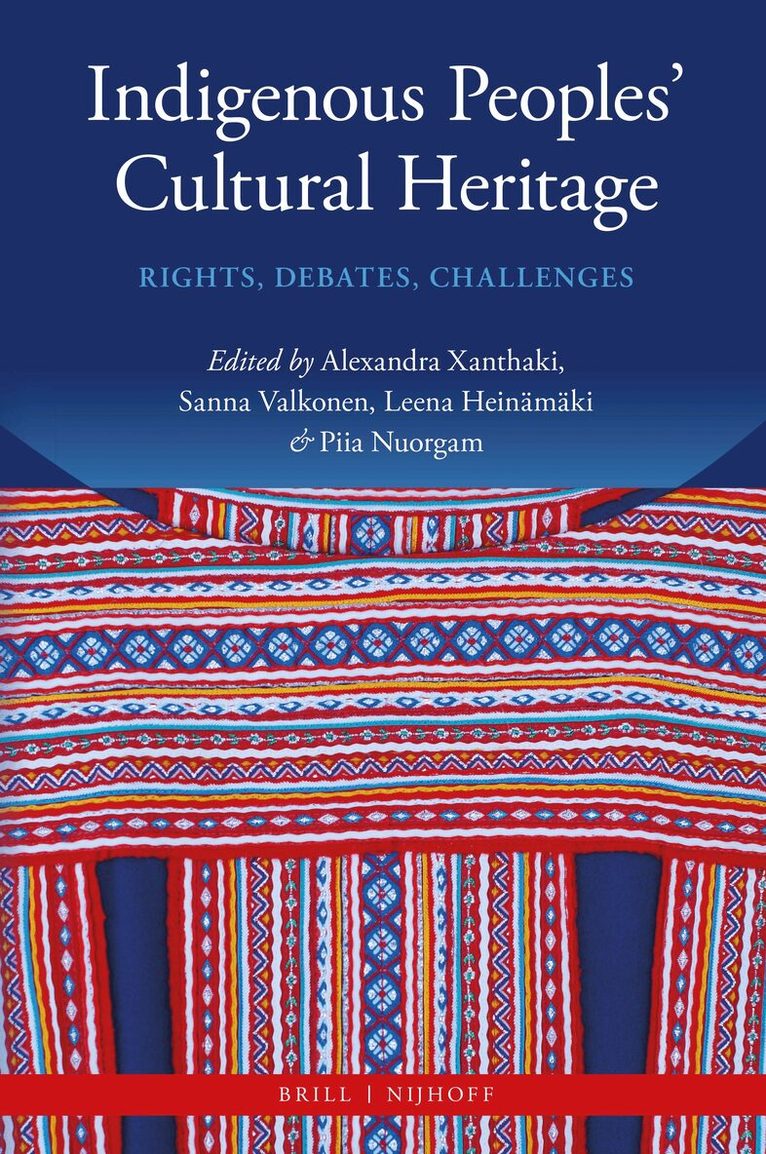
Indigenous rights to heritage have only recently become the subject of academic scholarship. This collection aims to fill that gap by offering the fruits of a unique conference on this topic organised by the University of Lapland with the help of the Office of the High Commissioner for Human Rights. The conference made clear that important information on Indigenous cultural heritage has remained unexplored or has not been adequately linked with specific actors (such as WIPO) or specific issues (such as free, prior and informed consent). Indigenous leaders explained the impact that disrespect of their cultural heritage has had on their identity, well-being and development. Experts in social sciences explained the intricacies of indigenous cultural heritage. Human rights scholars talked about the inability of current international law to fully address the injustices towards indigenous communities. Representatives of International organisations discussed new positive developments. This wealth of experiences, materials, ideas and knowledge is contained in this important volume.