Alexandros Kampakoglou - Böcker
Visar alla böcker från författaren Alexandros Kampakoglou. Handla med fri frakt och snabb leverans.
3 produkter
3 produkter
2 881 kr
Skickas inom 7-10 vardagar
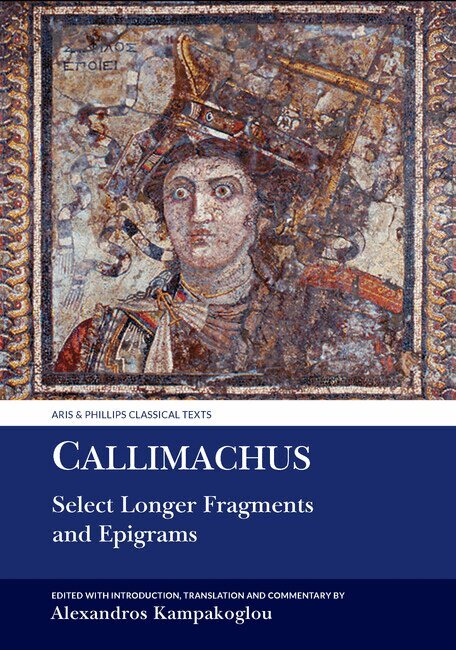
Few among the surviving Hellenistic poets can rival the fame of Callimachus of Cyrene (approximately 320–240 BCE). Active as a poet and scholar in Ptolemaic Alexandria, Callimachus associated his name with a new set of aesthetic principles that proved influential for such poets as Vergil, Horace, and Ovid. Even so, except for six Hymns and several epigrams, most of his work survives in fragments. Offering a selection of longer fragments, this edition provides a rounded view of Callimachus’ literary output. It also sheds light on lesser-studied aspects of Callimachus’ activity at the Ptolemaic court in Alexandria. For the first time in an English volume, a commentary explores and elucidates the occasional and lyric pieces Callimachus composed for the Ptolemies and their officials (such as the Elegy for Sosibius and the Ektheosis of Arsinoe). By focusing on Callimachus’ longer fragments (e.g., Aetia, Iambs, and Hecale), this edition offers an indispensable tool that guides the reader through the intricacies of his poetic art. It also includes an exhaustive introduction to Callimachus’ life, professional activity, and aesthetics.
2 230 kr
Skickas inom 5-8 vardagar
Visual culture, performance and spectacle lay at the heart of all aspects of ancient Greek daily routine, such as court and assembly, cult and ritual, and art and culture. Seeing was considered the most secure means of obtaining knowledge, with many citing the etymological connection between ‘seeing’ and ‘knowing’ in ancient Greek as evidence for this. Seeing was also however often associated with mere appearances, false perception and deception. Gazing and visuality in the ancient Greek world have had a central place in the scholarship for some time now, enjoying an abundance of pertinent discussions and bibliography. If this book differs from the previous publications, it is in its emphasis on diverse genres: the concepts ‘gaze’, ‘vision’ and ‘visuality’ are considered across different Greek genres and media. The recipients of ancient Greek literature (both oral and written) were encouraged to perceive the narrated scenes as spectacles and to ‘follow the gaze’ of the characters in the narrative. By setting a broad time span, the evolution of visual culture in Greece is tracked, while also addressing broader topics such as theories of vision, the prominence of visuality in specific time periods, and the position of visuality in a hierarchisation of the senses.
Del 76 - Trends in Classics - Supplementary Volumes
Studies in the Reception of Pindar in Ptolemaic Poetry
Inbunden, Engelska, 2019
2 334 kr
Skickas inom 5-8 vardagar
Recent years have witnessed a revival of interest in the influence of archaic lyric poetry on Hellenistic poets. However, no study has yet examined the reception of Pindar, the most prominent of the lyric poets, in the poetry of this period. This monograph is the first book to offer a systematic examination of the evidence for the reception of Pindar in the works of Callimachus of Cyrene, Theocritus of Syracuse, Apollonius of Rhodes and Posidippus of Pella. Through a series of case studies, it argues that Pindaric poetry exercised a considerable influence on a variety of Hellenistic genres: epinician elegies and epigrams, hymns, encomia, and epic poetry. For the poets active at the courts of the first three Ptolemies, Pindar's poetry represented praise discourse in its most successful configuration. Imitating aspects of it, they lent their support to the ideological apparatus of Greco-Egyptian kingship, shaped the literary profile of Pindar for future generations of readers, and defined their own role and place in Greek literary history. The discussion offered in this book suggests new insights into aspects of literary tradition, Ptolemaic patronage, and Hellenistic poetics, placing Pindar's work at the very heart of an intricate nexus of political and poetic correspondences.