Anna Novokhatko – författare
1 412 kr
Skickas inom 5-8 vardagar
1 427 kr
Läs direkt efter köp
This work covers the history of the text of the invectives of Sallust against Cicero and of Cicero against Sallust. Though these speeches seem unsophisticated to some, they are in fact of considerable importance. The question of the authenticity of both invectives, especially of the invective against Cicero, considered in the book diachronically, has long troubled scholars, commencing with Quintilian’s quotation from the text as though it were authentic. This dispute continues down to our own time. In all probability, both invectives are a product of the rhetorical schools of Rome, as students at such schools might have been set the task of writing a speech against Cicero imitating Sallust, or of responding to Sallust in the style of Cicero. Thus, we possess a sample of rhetorical school exercises, preserved due to their similarities to the prototypes on which they were modelled. The work covers: the full manuscript tradition of the text and also the history of the changes which arose during its transmission, the history of the printed text and the text itself with an apparatus criticus and also a translation. This work should be of interest to classicists, philologists interested in the history of medieval and renaissance texts, and also to those erudite readers concerned with rhetorical style and the functioning of the rhetorical schools of Rome.
2 198 kr
Skickas inom 5-8 vardagar
2 224 kr
Läs direkt efter köp
2 224 kr
Läs direkt efter köp
2 658 kr
Skickas inom 5-8 vardagar
2 685 kr
Läs direkt efter köp
This volume examines whether dramatic fragments should be approached as parts of a greater whole or as self-contained entities. It comprises contributions by a broad spectrum of international scholars: by young researchers working on fragmentary drama as well as by well-known experts in this field.
The volume explores another kind of fragmentation that seems already to have been embraced by the ancient dramatists: quotations extracted from their context and immersed in a new whole, in which they work both as cohesive unities and detachable entities. Sections of poetic works circulated in antiquity not only as parts of a whole, but also independently, i.e. as component fractions, rather like quotations on facebook today. Fragmentation can thus be seen operating on the level of dissociation, but also on the level of cohesion.
The volume investigates interpretive possibilities, quotation contexts, production and reception stages of fragmentary texts, looking into the ways dramatic fragments can either increase the depth of fragmentation or strengthen the intensity of cohesion.
2 685 kr
Läs direkt efter köp
This volume examines whether dramatic fragments should be approached as parts of a greater whole or as self-contained entities. It comprises contributions by a broad spectrum of international scholars: by young researchers working on fragmentary drama as well as by well-known experts in this field.
The volume explores another kind of fragmentation that seems already to have been embraced by the ancient dramatists: quotations extracted from their context and immersed in a new whole, in which they work both as cohesive unities and detachable entities. Sections of poetic works circulated in antiquity not only as parts of a whole, but also independently, i.e. as component fractions, rather like quotations on facebook today. Fragmentation can thus be seen operating on the level of dissociation, but also on the level of cohesion.
The volume investigates interpretive possibilities, quotation contexts, production and reception stages of fragmentary texts, looking into the ways dramatic fragments can either increase the depth of fragmentation or strengthen the intensity of cohesion.
1 538 kr
Skickas inom 5-8 vardagar
1 500 kr
Läs direkt efter köp
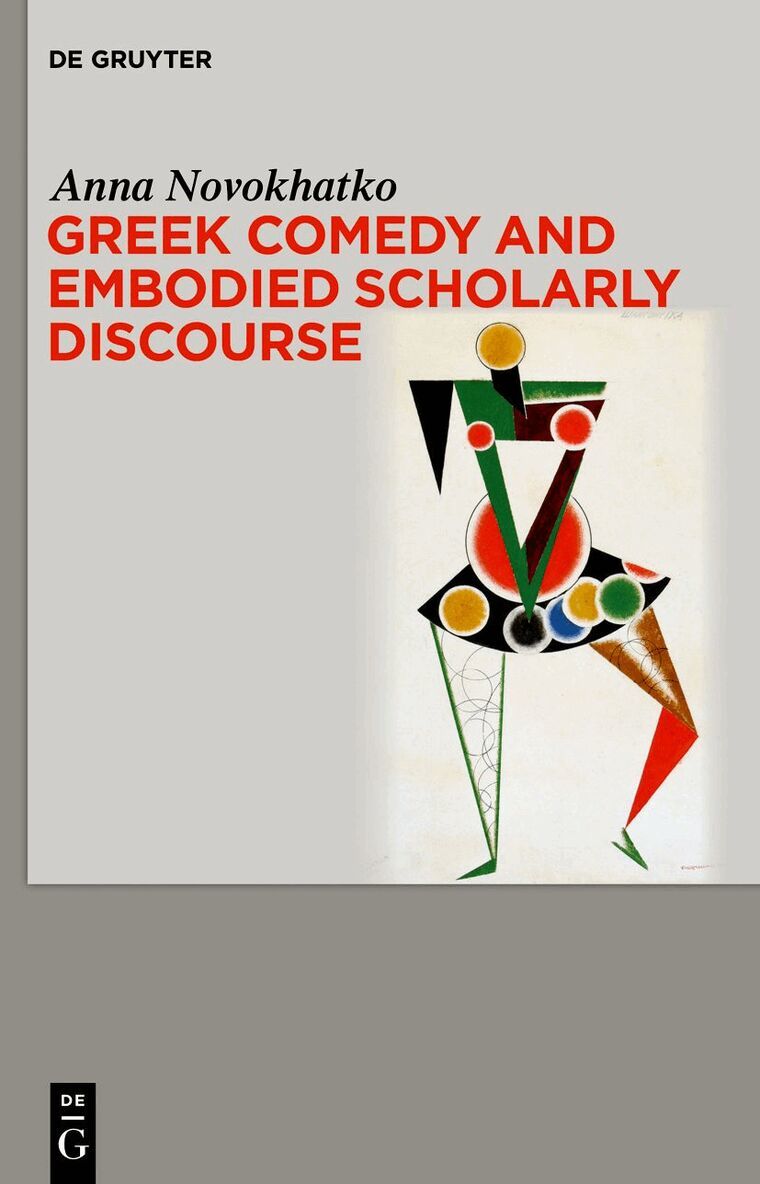
Comedy created a joyful mode of perceiving rhetoric, grammar, and literary criticism through the somatic senses of the author, the characters, the actors and the spectators. This was due to generic peculiarities including the omnivore mirroring of contemporary (scholarly) ideas, the materiality of costumes and masks, and the embodiment of abstract notions on stage, in short due to the correspondence between body, language and environment. The materiality of words, letters and syllables in ancient grammar and stylistic criticism is related to the embodied criticism found in Greek comedy. How are scholarly discourses embodied? The act of writing is vividly enacted on stage through carving with effort the shape of the letter ''rho'' and commenting emotionally on it. The letters of the alphabet are danced by the chorus, the cognitive and communicative power of gestures and body expression providing emotional context. A barking pickle brine from Thasos is perhaps an olfactory somatosensory visual and auditory embodiment of Archilochean poetry, whilst the actor’s foot in dance is a visual and motor embodiment of a metrical foot on stage. Comedy with its actors, costumes, masks, and props is overflowing with such examples. In this book, the author suggests that comedy made a significant contribution to the establishment of scholarly discourses in Classical Greece.
International Yearbook for Hermeneutics
Volume 21 Focus: Finiteness
1 903 kr
Skickas inom 5-8 vardagar
1 168 kr
Skickas inom 3-6 vardagar
760 kr
Skickas inom 10-15 vardagar
733 kr
Läs direkt efter köp
1 512 kr
Skickas inom 10-15 vardagar
1 832 kr
Läs direkt efter köp
1 512 kr
Skickas inom 10-15 vardagar
889 kr
Läs direkt efter köp
889 kr
Läs direkt efter köp