Alexandros Kentikelenis - Böcker
Visar alla böcker från författaren Alexandros Kentikelenis. Handla med fri frakt och snabb leverans.
6 produkter
6 produkter
371 kr
Skickas inom 5-8 vardagar
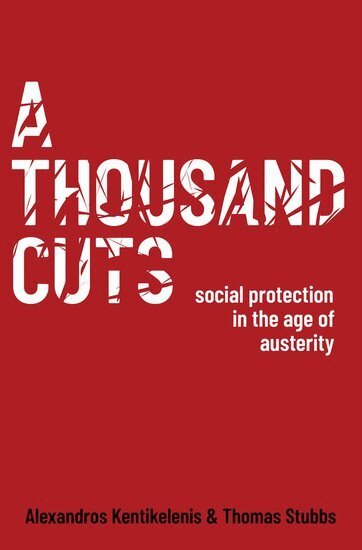
The dominant policy response to economic crises over the past four decades has been the introduction of austerity--a mix of budget cuts and reforms to downsize the role of the state. The International Monetary Fund (IMF) has been the world's lender of last resort and leading advocate of austerity, and has been consistently chastised by policymakers and civil society for the consequences of its economic policy reforms on social protection. Critics of the IMF have identified so-called structural adjustment programs as a key cause of global increases in poverty, widespread disease, and unemployment. In the face of such criticisms, the IMF has advanced a narrative of wholesale reform to its practices. In A Thousand Cuts, Alexandros Kentikelenis and Thomas Stubbs provide a systematic and comprehensive analysis of IMF policies around the world. Based on novel data from the IMF archives, Kentikelenis and Stubbs have generated a replicable database of all IMF-mandated reforms from 1980-2019 to examine their effects on social policies and outcomes. They reveal that although the precise content of IMF-mandated austerity has changed considerably over time, the organization continues to place a high burden of reform on countries in crisis. These reforms then decrease the availability of important social services and contribute to rises in income inequality and decline in population health. Kentikelenis and Stubbs argue that in spite of reform rhetoric, the IMF's practices--and the outcomes they produce--have changed very little over the past three decades. As one of the first systematic assessments of the impact of austerity on people's lives around the world, A Thousand Cuts makes an important contribution to the continuing debate regarding the consequences of the IMF and how it might better support social protection.
1 456 kr
Skickas inom 3-6 vardagar
Global norms form the core infrastructure of economic and political globalization. To be influential, these norms need to be codified into policy scripts that spell out how they are to be applied in practice. This process of developing scripts is a key job of international organizations, which act as venues where states can collectively make major decisions. When forging policy prescriptions, these organizations draw on scientific knowledge but are also highly attune to political pressures. Making Global Norms provides a theoretical account and advanced methodological toolkit to study how variation in the intensity of scientific consensus and political contestation produces policy scripts that modify global norms. This book shows that the policymakers involved in scriptwriting processes within international organizations wear two hats: they are both political representatives of the states that appoint them and experts in their own right with worldviews that correspond to their expertise. They have to negotiate with each other, as well as with their organization's technocratic staff, to shape the ultimate content of global policy scripts. The implication of the authors' findings is that diversity within IOs matters: changes in the kinds of expertise that are present in deliberations can yield significant differences in how norms are modified. Their empirical focus is on the International Monetary Fund's scripts for capital controls, sovereign debt management, and taxation. Drawing on a novel mixed-method methodological approach, Making Global Norms opens the black box on how some of the most important norms underpinning globalization were made.This is an open access title available under the terms of a [CC BY-NC-ND 4.0 International] licence. It is free to read at Oxford Scholarship Online and offered as a free PDF download from OUP and selected open access locations.
497 kr
Skickas inom 3-6 vardagar
Global norms form the core infrastructure of economic and political globalization. To be influential, these norms need to be codified into policy scripts that spell out how they are to be applied in practice. This process of developing scripts is a key job of international organizations, which act as venues where states can collectively make major decisions. When forging policy prescriptions, these organizations draw on scientific knowledge but are also highly attune to political pressures. Making Global Norms provides a theoretical account and advanced methodological toolkit to study how variation in the intensity of scientific consensus and political contestation produces policy scripts that modify global norms. This book shows that the policymakers involved in scriptwriting processes within international organizations wear two hats: they are both political representatives of the states that appoint them and experts in their own right with worldviews that correspond to their expertise. They have to negotiate with each other, as well as with their organization's technocratic staff, to shape the ultimate content of global policy scripts. The implication of the authors' findings is that diversity within IOs matters: changes in the kinds of expertise that are present in deliberations can yield significant differences in how norms are modified. Their empirical focus is on the International Monetary Fund's scripts for capital controls, sovereign debt management, and taxation. Drawing on a novel mixed-method methodological approach, Making Global Norms opens the black box on how some of the most important norms underpinning globalization were made.This is an open access title available under the terms of a [CC BY-NC-ND 4.0 International] licence. It is free to read at Oxford Scholarship Online and offered as a free PDF download from OUP and selected open access locations.
344 kr
Kommande
A bold new take on how Europe adapts, endures, and remains powerful in a rapidly shifting world order.Europe is often cast as lurching from one near-death experience to the next—from the eurozone crisis and Brexit to a pandemic and war on its borders. And yet, it endures. Not because it has resolved its contradictions, but because it has adapted through them. Challenging the familiar image of the European Union as fragile or intrinsically flawed, How Europe Survives reimagines Europe and its strengths.Catherine E. De Vries and Alexandros Kentikelenis reframe Europe as a living organism: imperfect, evolving, and responsive to its environment. That messiness is part of its strength. Like an organism, the EU survives by improvising, recalibrating, and absorbing internal tensions and external shocks. Its strengths lie in its malleability and flexibility, which enable it to constantly reinvent itself. It does so both in moments of crisis and in its normal functioning. How Europe Survives is both a reinterpretation of Europe's past and a guide to its future. This is not a triumphalist story. Europe's adaptability has costs and limits. But it offers a practical lesson for governing in an age of permanent crisis: flexible institutions, open contestation, and a willingness to learn can keep a political project alive. Clear-eyed and accessible, How Europe Survives explains how the EU has endured—and what that means for its citizens and its role in the world.
234 kr
Skickas inom 7-10 vardagar
The International Monetary Fund (IMF) has emerged as a key player in climate policy. The organization introduced its Climate Strategy in 2021 and established the Resilience and Sustainability Facility in 2022 to provide financial support to countries facing adaptation and mitigation challenges. The IMF's closer engagement with the economic dimensions of climate change holds the promise of helping countries pre-empt large-scale economic dislocations from climate risks. But how much progress has the IMF made in supporting the green transition? What is the policy track record of the IMF's climate loans? How do regular IMF loans and mandated reforms encompass climate considerations? How have the IMF's economic surveillance activities considered climate risks? Based on new evidence, the findings in this Element point to the multifaceted, and at times contradictory, ways green transition objectives have become embedded within IMF activities. This title is also available as Open Access on Cambridge Core.
753 kr
Skickas inom 7-10 vardagar
The International Monetary Fund (IMF) has emerged as a key player in climate policy. The organization introduced its Climate Strategy in 2021 and established the Resilience and Sustainability Facility in 2022 to provide financial support to countries facing adaptation and mitigation challenges. The IMF's closer engagement with the economic dimensions of climate change holds the promise of helping countries pre-empt large-scale economic dislocations from climate risks. But how much progress has the IMF made in supporting the green transition? What is the policy track record of the IMF's climate loans? How do regular IMF loans and mandated reforms encompass climate considerations? How have the IMF's economic surveillance activities considered climate risks? Based on new evidence, the findings in this Element point to the multifaceted, and at times contradictory, ways green transition objectives have become embedded within IMF activities. This title is also available as Open Access on Cambridge Core.