Alice Y. Tseng - Böcker
Visar alla böcker från författaren Alice Y. Tseng. Handla med fri frakt och snabb leverans.
3 produkter
3 produkter
Kyoto Visual Culture in the Early Edo and Meiji Periods
The arts of reinvention
Häftad, Engelska, 2019
690 kr
Skickas inom 10-15 vardagar
The city of Kyoto has undergone radical shifts in its significance as a political and cultural center, as a hub of the national bureaucracy, as a symbolic and religious center, and as a site for the production and display of art. However, the field of Japanese history and culture lacks a book that considers Kyoto on its own terms as a historic city with a changing identity.Examining cultural production in the city of Kyoto in two periods of political transition, this book promises to be a major step forward in advancing our knowledge of Kyoto’s history and culture. Its chapters focus on two periods in Kyoto’s history in which the old capital was politically marginalized: the early Edo period, when the center of power shifted from the old imperial capital to the new warriors’ capital of Edo; and the Meiji period, when the imperial court itself was moved to the new modern center of Tokyo. The contributors argue that in both periods the response of Kyoto elites—emperors, courtiers, tea masters, municipal leaders, monks, and merchants—was artistic production and cultural revival. As an artistic, cultural and historical study of Japan's most important historic city, this book will be invaluable to students and scholars of Japanese history, Asian history, the Edo and Meiji periods, art history, visual culture and cultural history.
750 kr
Skickas inom 7-10 vardagar
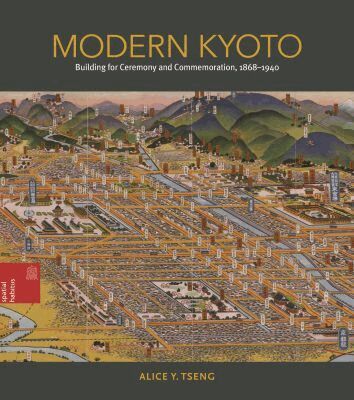
Can an imperial city survive, let alone thrive, without an emperor? Alice Y. Tseng answers this intriguing question in Modern Kyoto, a comprehensive study of the architectural and urban projects carried out in the old capital following Emperor Meiji’s move to Tokyo in 1868. Tseng contends that Kyoto—from the time of the relocation to the height of the Asia-Pacific War—remained critical to Japan’s emperor-centered national agenda as politicians, planners, historians, and architects mobilized the city’s historical connection to the imperial house to develop new public architecture, infrastructure, and urban spaces. Royal births, weddings, enthronements, and funerals throughout the period served as catalysts for fashioning a monumental modern city fit for hosting commemorative events for an eager domestic and international audience.Using a wide range of visual material (including architectural plans, postcards, commercial maps, and guidebooks), Tseng traces the development of four core areas of Kyoto: the palaces in the center, the Okazaki Park area in the east, the Kyoto Station area in the south, and the Kitayama district in the north. She offers an unprecedented framework that correlates nation building, civic boosterism, and emperor reverence to explore a diverse body of built works. Interlinking microhistories of the Imperial Garden, Heian Shrine, Lake Biwa Canal, the prefectural library, zoological and botanical gardens, main railway station, and municipal art museum, among others, her work asserts Kyoto’s vital position as a multi-faceted center of culture and patriotism in the expanding Japanese empire. Richly illustrated with many never-before-published photographs and archival sources, Modern Kyoto challenges readers to look beyond Tokyo for signposts of Japan’s urban modernity and opens up the study of modern emperors to incorporate fully built environments and spatial practices dedicated in their name.
Kyoto Visual Culture in the Early Edo and Meiji Periods
The arts of reinvention
Inbunden, Engelska, 2016
2 236 kr
Skickas inom 10-15 vardagar
The city of Kyoto has undergone radical shifts in its significance as a political and cultural center, as a hub of the national bureaucracy, as a symbolic and religious center, and as a site for the production and display of art. However, the field of Japanese history and culture lacks a book that considers Kyoto on its own terms as a historic city with a changing identity.Examining cultural production in the city of Kyoto in two periods of political transition, this book promises to be a major step forward in advancing our knowledge of Kyoto’s history and culture. Its chapters focus on two periods in Kyoto’s history in which the old capital was politically marginalized: the early Edo period, when the center of power shifted from the old imperial capital to the new warriors’ capital of Edo; and the Meiji period, when the imperial court itself was moved to the new modern center of Tokyo. The contributors argue that in both periods the response of Kyoto elites—emperors, courtiers, tea masters, municipal leaders, monks, and merchants—was artistic production and cultural revival. As an artistic, cultural and historical study of Japan's most important historic city, this book will be invaluable to students and scholars of Japanese history, Asian history, the Edo and Meiji periods, art history, visual culture and cultural history.