Alicia Robb - Böcker
Visar alla böcker från författaren Alicia Robb. Handla med fri frakt och snabb leverans.
6 produkter
6 produkter
1 617 kr
Skickas inom 7-10 vardagar
Women-owned firms represent an increasingly important segment of the small business sector. According to the most recent data from the U.S. Census Bureau, there were 7.8 million women-owned firms in the United States in 2007, generating $1.2 trillion in revenues and providing employment for 7.6 million people. A Rising Tide presents the financial strategies that have helped today's bold and creative women entrepreneurs to succeed.The authors take a "lifecycle approach" in discussing the issues and strategies for different types of women-owned firms, from nascent and home-based firms to growth-oriented and technology-based enterprises. Each chapter includes real-world cases studies featuring women entrepreneurs as a way to bring the book's lessons to life. Uniquely, this book ties together the latest research on financing women-owned businesses and its implications for actual or potential entrepreneurs. Drawing on the Kauffman Firm Survey, a longitudinal survey of over 4,000 new firms, the authors are able to provide particularly useful conclusions, making this a must read for the thousands of women who are starting or may start businesses in the next few years. Please visit www.kauffman.org/sketchbook.aspx?VideoId=1699151957001&type=M to view the book trailer.
400 kr
Skickas inom 7-10 vardagar
Women-owned firms represent an increasingly important segment of the small business sector. According to the most recent data from the U.S. Census Bureau, there were 7.8 million women-owned firms in the United States in 2007, generating $1.2 trillion in revenues and providing employment for 7.6 million people. A Rising Tide presents the financial strategies that have helped today's bold and creative women entrepreneurs to succeed.The authors take a "lifecycle approach" in discussing the issues and strategies for different types of women-owned firms, from nascent and home-based firms to growth-oriented and technology-based enterprises. Each chapter includes real-world cases studies featuring women entrepreneurs as a way to bring the book's lessons to life. Uniquely, this book ties together the latest research on financing women-owned businesses and its implications for actual or potential entrepreneurs. Drawing on the Kauffman Firm Survey, a longitudinal survey of over 4,000 new firms, the authors are able to provide particularly useful conclusions, making this a must read for the thousands of women who are starting or may start businesses in the next few years. Please visit www.kauffman.org/sketchbook.aspx?VideoId=1699151957001&type=M to view the book trailer.
Finance and Economics Discussion Series
Firm, Owner, and Financing Characteristics: Differences Between Female and Male Owned Small Businesses
Häftad, Engelska, 2013
207 kr
Skickas inom 3-6 vardagar
Entrepreneurship Education and Training Programs Around the World
Dimensions for Success
Häftad, Engelska, 2014
318 kr
Skickas inom 10-15 vardagar
Entrepreneurship has attracted global interest for its potential to catalyse economic and social development. Research suggesting that certain entrepreneurial mindsets and skills can be learned has given rise to the field of entrepreneurship education and training (EET). Despite the growth of EET, global knowledge about these programmes and their impact remains thin. In response, this study surveys the available literature and programme evaluations to propose a Conceptual Framework for understanding the EET programme landscape.The study finds that EET today consists of a heterogeneous mix of programmes that can be broken into two groups: entrepreneurship education and entrepreneurship training. These programmes target a range of participants: secondary and post-secondary education students, as well as potential and practicing entrepreneurs. The outcomes measured by programme evaluations are equally diverse but generally fall under the domains of entrepreneurial mindsets and capabilities, entrepreneurial status, and entrepreneurial performance. The dimensions of EET programmes vary according the particular target group. Programs targeting secondary education students focus on the development of foundational skills linked to entrepreneurship, while post-secondary education programmes emphasise skills related to strategic business planning. Programmes targeting potential entrepreneurs generally are embedded within broader support programmes and tend to target vulnerable populations for whom employment alternatives may be limited. While programmes serving practising entrepreneurs focus on strengthening entrepreneurs' knowledge, skills and business practices, which while unlikely to transform an enterprise in the near term, may accrue benefits to entrepreneurs over time.The study also offers implications for policy and programme implementation, emphasising the importance of clarity about target groups and desired outcomes when making programme choices, and sound understanding of extent to which publicly-supported programmes offer a broader public good, and compare favourably to policy alternatives for supporting the targeted individuals as well as the overall economic and social objectives.
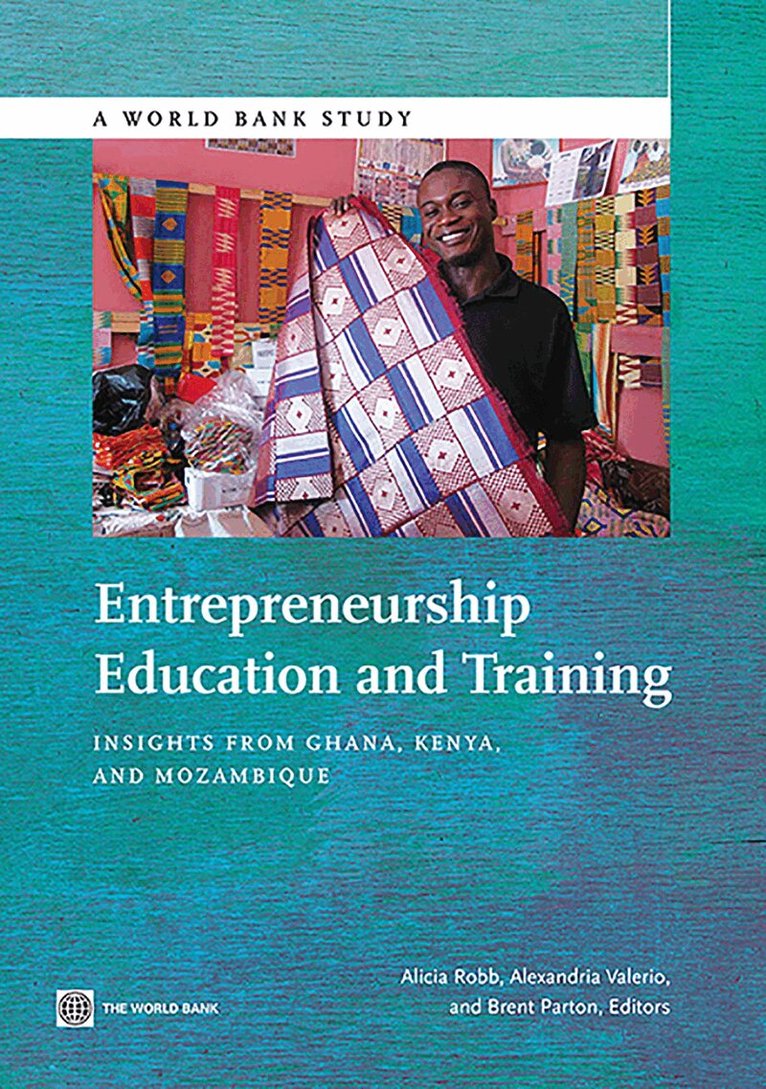
Entrepreneurship Education and Training
Insights from Ghana, Kenya, and Mozambique
Häftad, Engelska, 2014
266 kr
Skickas inom 10-15 vardagar
Empirical research has found that entrepreneurial activity correlates positively with innovation and job creation, and governments around the world have shown a growing interest in interventions that promote entrepreneurial success. However, research on whether entrepreneurial success can be taught has reached mixed conclusions, and even the landscape of what is being taught is poorly known. This study looks closely at entrepreneurial education and training (EET) programs in three case study countries in Africa - Kenya, Ghana, and Mozambique - which are all experiencing sustained economic growth and diversification in their private sectors. It draws on both global and country-specific research and on the experience of stakeholders in the case countries. The study identifies practical insights relevant to various target groups, intended outcomes, and social and economic contexts.Overall, it paints a comprehensive picture of both the context for entrepreneurship and the landscape of programs in the case countries. Among its key findings are these: (i) Key macroeconomic trends give reason for optimism about the trajectory of private sector development, but serious barriers to entrepreneurship remain in each country. Corruption, prohibitively high taxes, and burdensome regulatory regimes remain impediments, along with crime. Stakeholders interviewed (potential and practicing entrepreneurs) also cite cultural disincentives and lack of access to finance. (ii) The EET program landscape is highly varied. The programs often emerge as responses to urgent challenges, such as urban youth unemployment, but in the aggregate they target a wide range of learners, from secondary students to university business majors to rural women, and their focus ranges from poverty reduction to attitudinal change. (iii) Too many programs are insufficiently tailored to their participants’ backgrounds and needs, attempting to use a single curriculum with participants of varying ages, educational backgrounds, and expectations. (iv) Whereas stakeholders believe business acumen and an entrepreneurial mindset are key to business success, few programs address this. (v) Finally, stakeholders express a strong desire for more business community mentorship and for better access to finance; these are areas that some programs do address, and with positive results, but much more is needed.The findings in this report can inform EET policy and program dialogue at multiple levels, guiding the investment decisions that policymakers and government institutions must make and more clearly indicating where further research in the EET realm is most needed.
Entrepreneurial Ecosystems and Growth of Women’s Entrepreneurship
A Comparative Analysis
Inbunden, Engelska, 2017
1 979 kr
Skickas inom 7-10 vardagar
The renowned group of international contributors to this volume provide analysis of where and how gender plays a role in the entrepreneurial ecosystem. Eleven essays examine how ecosystems influence women entrepreneurs and how women entrepreneurs influence their local ecosystems, both cross-nationally and through in-depth country studies. The studies build on rich qualitative and quantitative data from diverse contexts including the United States, Norway, India, Tanzania, Ethiopia, and Chile. A special section of the book examines national and regional policies in support of growth-oriented women's entrepreneurship. The contributions highlight the significant variety of entrepreneurial ecosystems around the world and provide valuable insights for promoting growth-oriented women's entrepreneurship at the local, regional, and country level. Academic researchers in the areas of entrepreneurship, management, business strategy, economic geography, and gender studies as well as policy-makers at the regional, national, and supra-national levels will all find something valuable in this illuminating book.Contributors include: M. Akoorie, G.A. Alsos, J.E. Amorós, C.G. Brush, S. Coleman, D. Dutta, L.F. Edelman, L. Foss, P. Gabaldón, J. Gibb, D. Giménez, U. Guelich, A.T. Hailemariam, M. Haugum, C. Henry, J.G. Hussain, L. Karsten, B. Kroon, E. Ljunggren, I.M. Lugalla, C. Lutz, V. Mandakovic, T.S. Manolova, X. Neumeyer, B. Orser, J. Poncela-Casasnovas, A. Robb, N. Sandhu, S.C. Santos, J.M. Scott, C. Seierstad, P. Sinha, M. van Veldhoven, F. Welter, S.R. Xavier, R.I. Yavuz