and Engineering Education Center for Science, Mathematics - Böcker
Visar alla böcker från författaren and Engineering Education Center for Science, Mathematics. Handla med fri frakt och snabb leverans.
8 produkter
8 produkter
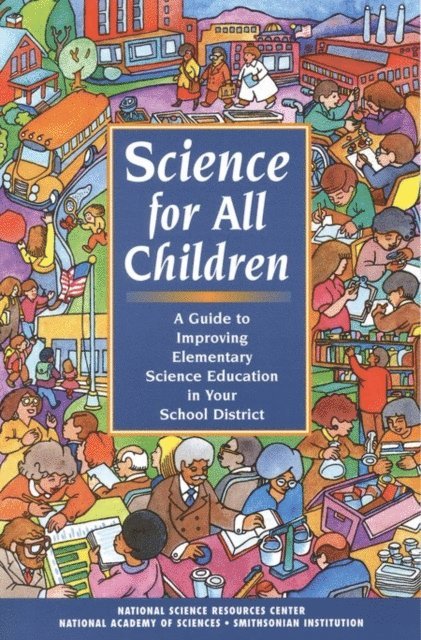
Science for All Children
A Guide to Improving Elementary Science Education in Your School District
Häftad, Engelska, 1997
458 kr
Tillfälligt slut
Remember the first time you planted a seed and watched it sprout? Or explored how a magnet attracted a nail? If these questions bring back memories of joy and wonder, then you understand the idea behind inquiry-based science--an approach to science education that challenges children to ask questions, solve problems, and develop scientific skills as well as gain knowledge. Inquiry-based science is based on research and experience, both of which confirm that children learn science best when they engage in hands-on science activities rather than read from a textbook. The recent National Science Education Standards prepared by the National Research Council call for a revolution in science education. They stress that the science taught must be based on active inquiry and that science should become a core activity in every grade, starting in kindergarten. This easy-to-read and practical book shows how to bring about the changes recommended in the standards. It provides guidelines for planning and implementing an inquiry-based science program in any school district. The book is divided into three parts."Building a Foundation for Change," presents a rationale for inquiry-based science and describes how teaching through inquiry supports the way children naturally learn. It concludes with basic guidelines for planning a program. School administrators, teachers, and parents will be especially interested in the second part, "The Nuts and Bolts of Change." This section describes the five building blocks of an elementary science program: * Community and administrative support. * A developmentally appropriate curriculum. * Opportunities for professional development. * Materials support. * Appropriate assessment tools. Together, these five elements provide a working model of how to implement hands-on science. The third part, "Inquiry-Centered Science in Practice," presents profiles of the successful inquiry-based science programs in districts nationwide. These profiles show how the principles of hands-on science can be adapted to different school settings. If you want to improve the way science is taught in the elementary schools in your community, Science for All Children is an indispensable resource.
Improving Teacher Preparation and Credentialing Consistent with the National Science Education Standards
Report of a Symposium
Häftad, Engelska, 1997
419 kr
Tillfälligt slut
Improving Student Learning in Mathematics and Science
The Role of National Standards in State Policy
Häftad, Engelska, 1997
298 kr
Tillfälligt slut
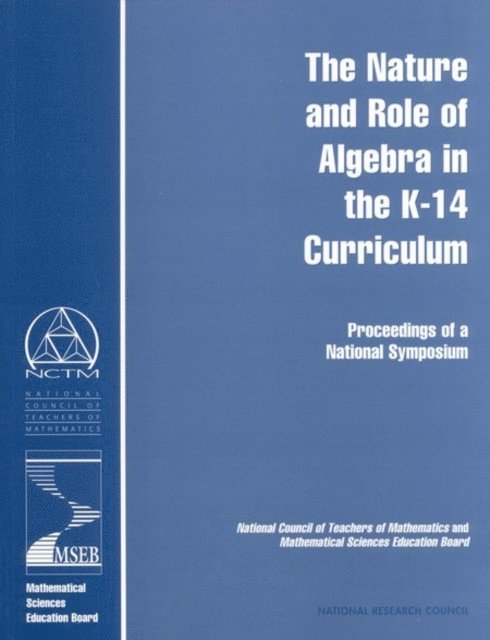
Nature and Role of Algebra in the K-14 Curriculum
Proceedings of a National Symposium
Häftad, Engelska, 1998
551 kr
Tillfälligt slut
With the 1989 release of Everybody Counts by the Mathematical Sciences Education Board (MSEB) of the National Research Council and the Curriculum and Evaluation Standards for School Mathematics by the National Council of Teachers of Mathematics (NCTM), the "standards movement" in K-12 education was launched. Since that time, the MSEB and the NCTM have remained committed to deepening the public debate, discourse, and understanding of the principles and implications of standards-based reform. One of the main tenets in the NCTM Standards is commitment to providing high-quality mathematical experiences to all students. Another feature of the Standards is emphasis on development of specific mathematical topics across the grades. In particular, the Standards emphasize the importance of algebraic thinking as an essential strand in the elementary school curriculum. Issues related to school algebra are pivotal in many ways. Traditionally, algebra in high school or earlier has been considered a gatekeeper, critical to participation in postsecondary education, especially for minority students.Yet, as traditionally taught, first-year algebra courses have been characterized as an unmitigated disaster for most students. There have been many shifts in the algebra curriculum in schools within recent years. Some of these have been successful first steps in increasing enrollment in algebra and in broadening the scope of the algebra curriculum. Others have compounded existing problems. Algebra is not yet conceived of as a K-14 subject. Issues of opportunity and equity persist. Because there is no one answer to the dilemma of how to deal with algebra, making progress requires sustained dialogue, experimentation, reflection, and communication of ideas and practices at both the local and national levels. As an initial step in moving from national-level dialogue and speculations to concerted local and state level work on the role of algebra in the curriculum, the MSEB and the NCTM co-sponsored a national symposium, "The Nature and Role of Algebra in the K-14 Curriculum," on May 27 and 28, 1997, at the National Academy of Sciences in Washington, D.C.
54 kr
Tillfälligt slut
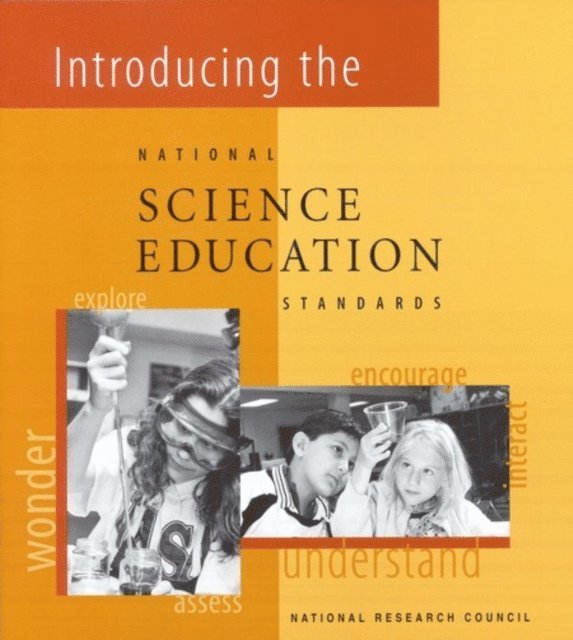
Introducing the National Science Education Standards is a booklet that provides an overview and background of the vision and principles of the National Science Education Standards. Each of the six types of standards is described: content, teaching, assessment, professional development, program, and system. Designed for a general audience, Introducing the National Science Education Standards clarifies what the Standards are and responds to typical questions about them. It helps readers determine how the Standards could be useful to them.
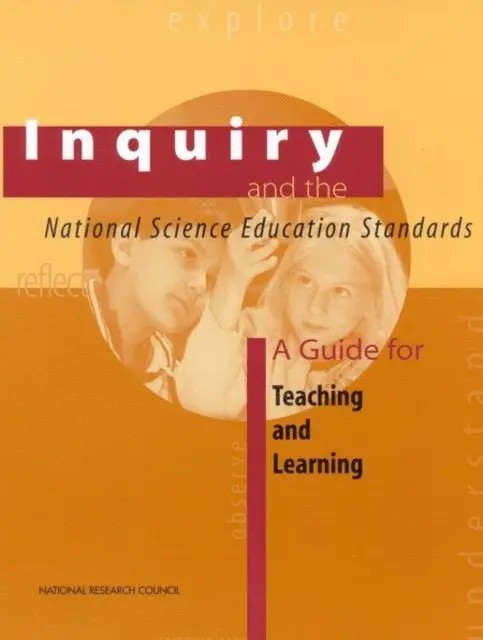
Inquiry and the National Science Education Standards
A Guide for Teaching and Learning
Häftad, Engelska, 2000
459 kr
Tillfälligt slut
Humans, especially children, are naturally curious. Yet, people often balk at the thought of learning science--the "eyes glazed over" syndrome. Teachers may find teaching science a major challenge in an era when science ranges from the hardly imaginable quark to the distant, blazing quasar. Inquiry and the National Science Education Standards is the book that educators have been waiting for--a practical guide to teaching inquiry and teaching through inquiry, as recommended by the National Science Education Standards. This will be an important resource for educators who must help school boards, parents, and teachers understand "why we can't teach the way we used to." "Inquiry" refers to the diverse ways in which scientists study the natural world and in which students grasp science knowledge and the methods by which that knowledge is produced. This book explains and illustrates how inquiry helps students learn science content, master how to do science, and understand the nature of science. This book explores the dimensions of teaching and learning science as inquiry for K-12 students across a range of science topics.Detailed examples help clarify when teachers should use the inquiry-based approach and how much structure, guidance, and coaching they should provide. The book dispels myths that may have discouraged educators from the inquiry-based approach and illuminates the subtle interplay between concepts, processes, and science as it is experienced in the classroom. Inquiry and the National Science Education Standards shows how to bring the standards to life, with features such as classroom vignettes exploring different kinds of inquiries for elementary, middle, and high school and Frequently Asked Questions for teachers, responding to common concerns such as obtaining teaching supplies. Turning to assessment, the committee discusses why assessment is important, looks at existing schemes and formats, and addresses how to involve students in assessing their own learning achievements. In addition, this book discusses administrative assistance, communication with parents, appropriate teacher evaluation, and other avenues to promoting and supporting this new teaching paradigm.
399 kr
Tillfälligt slut
Curriculum reform, performance assessment, standards, portfolios, and high stakes testing-what's next? What does this all mean for me in my classroom? Many teachers have asked such questions since mathematics led the way in setting standards with the publication of the Curriculum and Evaluation Standards for School Mathematics (National Council of Teachers of Mathematics [NCTM], 1989). This seminal document and others that followed served as catalysts for mathematics education reform, giving rise to new initiatives related to curriculum, instruction, and assessment over the past decade. In particular, approaches to classroom, school, and district-wide assessment have undergone a variety of changes as educators have sought to link classroom teaching to appropriate assessment opportunities. Since the publication of Everybody Counts (National Research Council [NRC], 1989), the Mathematical Sciences Education Board (MSEB) has dedicated its efforts to the improvement of mathematics education. A national summit on assessment led to the publication of For Good Measure (NRC, 1991).This statement of goals and objectives for assessment in mathematics was followed by Measuring Up (NRC, 1993a), which provided prototypical fourth-grade performance assessment tasks linked to the goals of the NCTM's Curriculum and Evaluation Standards. Measuring What Counts (NRC, 1993b) demonstrated the importance of mathematics content, learning, and equity as they relate to assessment. The MSEB is now prepared to present perspectives on issues in mathematics education assessment for those most directly engaged in implementing the reform initiatives on a daily basis-classroom teachers, school principals, supervisors, and others in school-based settings.
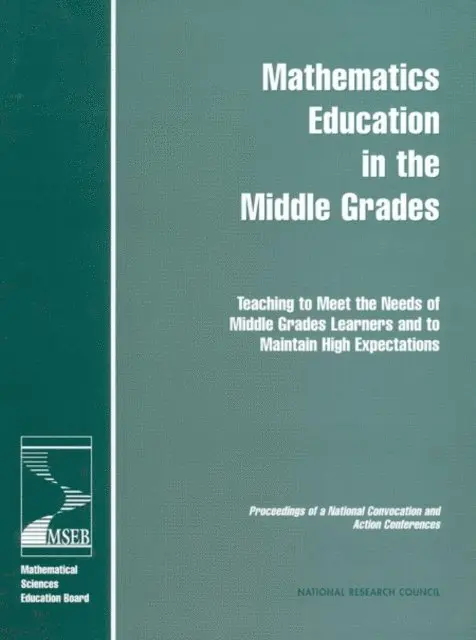
Mathematics Education in the Middle Grades
Teaching to Meet the Needs of Middle Grades Learners and to Maintain High Expectations: Proceedings of a National Convocation and Action Conferences
Häftad, Engelska, 2000
797 kr
Skickas
In September 1998, the Math Science Education Board National held a Convocation on Middle Grades Mathematics that was co-sponsored by the National Council of Teachers of Mathematics, the National Middle School Association, and the American Educational Research Association. The Convocation was structured to present the teaching of middle school mathematics from two points of view: teaching mathematics with a focus on the subject matter content or teaching mathematics with a focus on the whole child and whole curriculum. This book discusses the challenges before the nation's mathematical sciences community to focus its energy on the improvement of middle grades mathematics education and to begin an ongoing national dialogue on middle grades mathematics education.