Andrea Cavalletti - Böcker
Visar alla böcker från författaren Andrea Cavalletti. Handla med fri frakt och snabb leverans.
6 produkter
6 produkter
1 303 kr
Skickas inom 10-15 vardagar
Reading philosophy through the lens of Alfred Hitchcock's Vertigo, Andrea Cavalletti shows why, for two centuries, major philosophers have come to think of vertigo as intrinsically part of philosophy itself.Fear of the void, terror of heights: everyone knows what acrophobia is, and many suffer from it. Before Freud, the so-called "sciences of the mind" reserved a place of honor for vertigo in the domain of mental pathologies. The fear of falling—which is also the fear of giving in to the temptation to let oneself fall—has long been understood as a destabilizing yet intoxicating element without which consciousness itself was inconceivable. Some went so far as to induce it in patients through frightening rotational therapies.In a less cruel but no less radical way, vertigo also staked its claim in philosophy. If Montaigne and Pascal could still consider it a perturbation of reason and a trick of the imagination which had to be subdued, subsequent thinkers stopped considering it an occasional imaginative instability to be overcome. It came, rather, to be seen as intrinsic to reason, such that identity manifests itself as tottering, kinetic, opaque and, indeed, vertiginous.Andrea Cavalletti's stunning book sets this critique of stable consciousness beside one of Hitchcock's most famous thrillers, a drama of identity and its abysses. Hitchcock's brilliant combination of a dolly and a zoom to recreate the effect of falling describes that double movement of "pushing away and bringing closer" which is the habitual condition of the subject and of intersubjectivity. To reach myself, I must see myself from the bottom of the abyss, with the eyes of another. Only then does my "here" flee down there and, from there, attract me.From classical medicine and from the role of imagination in our biopolitical world to the very heart of philosophy, from Hollywood to Heidegger's "being-toward-death," Cavalletti brings out the vertiginous nature of identity.
357 kr
Skickas inom 7-10 vardagar
Reading philosophy through the lens of Alfred Hitchcock's Vertigo, Andrea Cavalletti shows why, for two centuries, major philosophers have come to think of vertigo as intrinsically part of philosophy itself.Fear of the void, terror of heights: everyone knows what acrophobia is, and many suffer from it. Before Freud, the so-called "sciences of the mind" reserved a place of honor for vertigo in the domain of mental pathologies. The fear of falling—which is also the fear of giving in to the temptation to let oneself fall—has long been understood as a destabilizing yet intoxicating element without which consciousness itself was inconceivable. Some went so far as to induce it in patients through frightening rotational therapies.In a less cruel but no less radical way, vertigo also staked its claim in philosophy. If Montaigne and Pascal could still consider it a perturbation of reason and a trick of the imagination which had to be subdued, subsequent thinkers stopped considering it an occasional imaginative instability to be overcome. It came, rather, to be seen as intrinsic to reason, such that identity manifests itself as tottering, kinetic, opaque and, indeed, vertiginous.Andrea Cavalletti's stunning book sets this critique of stable consciousness beside one of Hitchcock's most famous thrillers, a drama of identity and its abysses. Hitchcock's brilliant combination of a dolly and a zoom to recreate the effect of falling describes that double movement of "pushing away and bringing closer" which is the habitual condition of the subject and of intersubjectivity. To reach myself, I must see myself from the bottom of the abyss, with the eyes of another. Only then does my "here" flee down there and, from there, attract me.From classical medicine and from the role of imagination in our biopolitical world to the very heart of philosophy, from Hollywood to Heidegger's "being-toward-death," Cavalletti brings out the vertiginous nature of identity.
199 kr
Skickas inom 7-10 vardagar
In 1936, Walter Benjamin defined the revolutionary class as being in opposition to a dense and dangerous crowd, prone to fear of the foreign, and under the spell of anti-Semitic madness. Today, in formations great or small, that sad figure returns the hatred of minorities is rekindled and the pied-pipers of the crowd stand triumphant.Class, by Andrea Cavalletti, is a striking montage of diverse materials Marx and Jules Verne, Benjamin and Gabriel Tarde. In it, Cavalletti asks whether the untimely concept of class is once again thinkable. Faced with new pogroms and state racism, he challenges us to imagine a movement that would unsettle and eventually destroy the crowd.
241 kr
Skickas inom 7-10 vardagar
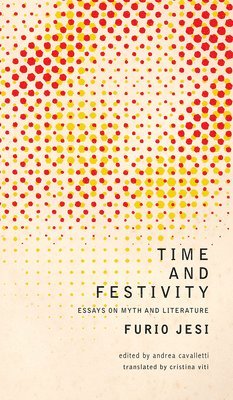
One of the foremost thinkers of his generation, Furio Jesi began to publish scholarly essays in academic journals at the age of fifteen. By the time of his early death in 1980, he had accumulated a body of work that astonishes with its abundance and diversity, its depth and scope, and, above all, for its unfailing rigor and brilliance. In Time and Festivity, Andrea Cavalletti collects Jesi’s finest essays, ranging from his groundbreaking work on myth and politics to his reflections on time, festivity, and revolt. He explores the significance of texts by Rimbaud, Rilke, Lukács, and Pavese and the mythological language of the biblical story of Susanna. Carefully annotated and referenced, and enriched by a first-person account of Jesi’s intellectual biography, Time and Festivity provides a precious guide to the methodology and approach at the core of Jesi’s thought, displaying how his personal, vitally intense via negativa might in fact originate from his early statement: “All I have ever written is poetry.”
1 314 kr
Kommande
A thought-provoking exploration of the fragility of bourgeois identity.Vienna, 1825. News of a sickly, listless boy is making the rounds. In broad daylight, he falls into deep sleep and his personality changes dramatically. While sleeping, he reads, writes, plays cards, challenges his doctors with amusement, and accomplishes the most astonishing of exercises with his eyes closed. A new subject has appeared, a second “I” has now supplanted the first.Andrea Cavalletti carefully registers the disquieting appearances of this second “I” in the literature and psychology of the past two centuries. In a context dominated by amnesia and somnambulism, hallucinations and wakeful dreams, the bourgeois subject, whose identity seemed so stable, turns out to be inhabited by masks that elude every grasp, at the mercy of a doubling that can no longer be recomposed. Personalities multiply and do battle, as even life and death exchange roles. And, ultimately, the identity of the Western subject reveals itself as a shade-like, constitutively double figure, that only lives in its weakness and forgetting, in its losses and distractions.
219 kr
Skickas inom 7-10 vardagar
A thought-provoking exploration of the fragility of bourgeois identity.Vienna, 1825. News of a sickly, listless boy is making the rounds. In broad daylight, he falls into deep sleep and his personality changes dramatically. While sleeping, he reads, writes, plays cards, challenges his doctors with amusement, and accomplishes the most astonishing of exercises with his eyes closed. A new subject has appeared, a second “I” has now supplanted the first.Andrea Cavalletti carefully registers the disquieting appearances of this second “I” in the literature and psychology of the past two centuries. In a context dominated by amnesia and somnambulism, hallucinations and wakeful dreams, the bourgeois subject, whose identity seemed so stable, turns out to be inhabited by masks that elude every grasp, at the mercy of a doubling that can no longer be recomposed. Personalities multiply and do battle, as even life and death exchange roles. And, ultimately, the identity of the Western subject reveals itself as a shade-like, constitutively double figure, that only lives in its weakness and forgetting, in its losses and distractions.