Andreas Birk - Böcker
Visar alla böcker från författaren Andreas Birk. Handla med fri frakt och snabb leverans.
3 produkter
3 produkter
538 kr
Skickas inom 10-15 vardagar
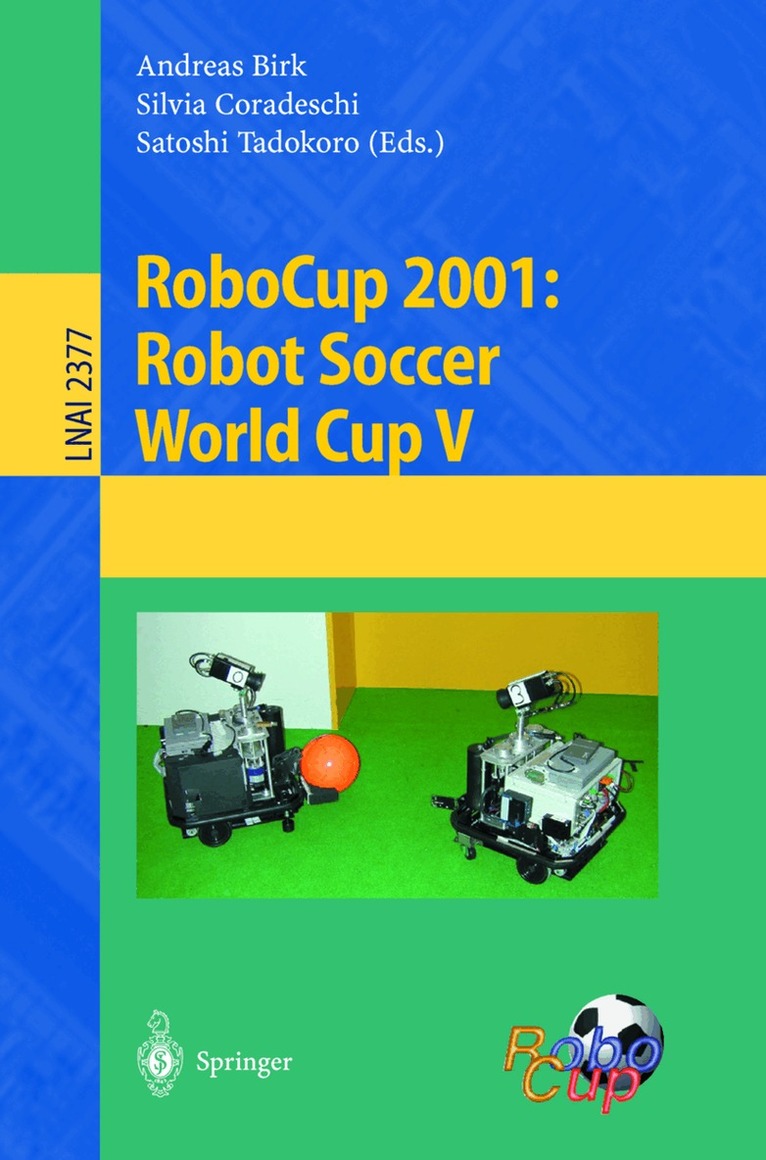
RoboCup 2001, the Fifth Robot World Cup Soccer Games and Conferences, was held from August 2-10, 2001, at the Washington State Convention and Trade Center in Seattle, USA. Like the previous international RoboCup events - RoboCup 97 in Nagoya, Japan; RoboCup 98 in Paris, France; RoboCup 99 in Stockholm, Sweden; and RoboCup 2000 in Melbourne, Australia - RoboCup 2001 included a symposium as well as several robotic competitions. Both parts, the symposium and the tournaments, are documented in this book. The symposium received over 80 submissions of which 18 were selected for full presentation, i. e. , a talk at the symposium and a 10-page contribution to this book, and 40 were selected as posters, i. e. , a poster presentation at the s- posium and a 6-page contribution to this book. Among the full presentations, ?ve were selected as ?nalists for the Scienti?c and the Engineering Challenge Awards. These ?ve papers are presented separately in the second chapter of this book. The Scienti?c Challenge Award went to the contribution "A Control Method for Humanoid Biped Walking with Limited Torque" by Fuminori - masaki, Ken Endo, Minoru Asada, and Hiroaki Kitano.The Engineering Ch- lenge Award was given to the paper "A Fast Vision System for Middle Size Robots in RoboCup" by M. Jamzad, B. S. Sadjad, V. S. Mirrokni, M. Kazemi, R. Ghorbani, A. Foroughnassiraei, H. Chitsaz, and A. Heydarnoori. The s- posium also featured an invited talk by Prof.
Learning Robots
6th European Workshop EWLR-6, Brighton, England, August 1-2, 1997 Proceedings
Häftad, Engelska, 1998
538 kr
Skickas inom 10-15 vardagar
This book constitutes the thoroughly refereed post-workshop proceedings of the 6th European Workshop Learning Robots, EWLR '96, held in Brighton, UK. The 12 revised full papers presented were carefully reviewed and selected during an iterated revision process. Besides the core areas of artificial intelligence and robotics, issues from cognitive science, mathematics, social sciences, neuroscience, biology, and electronic engineering are of importance for this interdisciplinary area. Among the topics covered are reinforcement learning, Q-learning, robot behavior, state space construction, autonomous robot, mobile robots, neural networks, robot perception, evolutionary learning, evolvable hardware.
Del 24 - World Scientific Series In Robotics And Intelligent Systems
Interdisciplinary Approaches To Robot Learning
Inbunden, Engelska, 2000
1 238 kr
Skickas inom 5-8 vardagar
Robots are being used in increasingly complicated and demanding tasks, often in environments that are complex or even hostile. Underwater, space and volcano exploration are just some of the activities that robots are taking part in, mainly because the environments that are being explored are dangerous for humans. Robots can also inhabit dynamic environments, for example to operate among humans, not just in factories, but also taking on more active roles. Recently, for instance, they have made their way into the home entertainment market. Given the variety of situations that robots will be placed in, learning becomes increasingly important.Robot learning is essentially about equipping robots with the capacity to improve their behaviour over time, based on their incoming experiences. The papers in this volume present a variety of techniques. Each paper provides a mini-introduction to a subfield of robot learning. Some also give a fine introduction to the field of robot learning as a whole. There is one unifying aspect to the work reported in the book, namely its interdisciplinary nature, especially in the combination of robotics, computer science and biology. This approach has two important benefits: first, the study of learning in biological systems can provide robot learning scientists and engineers with valuable insights into learning mechanisms of proven functionality and versatility; second, computational models of learning in biological systems, and their implementation in simulated agents and robots, can provide researchers of biological systems with a powerful platform for the development and testing of learning theories.