• Fri frakt över 249 kr
  • •
  • Snabba leveranser
  • •
  • Billiga böcker
Kundservice

Du är på sajten för privatpersoner.

Företag, bibliotek eller offentlig verksamhet?

Du handlar på classic.bokus.com, där alla dina funktioner finns intakta.
Till classic.bokus.com
Bokus logotyp. Gå till startsidan.
  • Erbjudanden
  • Student
  • Topplistor
  • Barn & ungdom
  • Bokus Play
  • E-böcker
  • Ljudböcker
  • Pocketböcker
  • Spel & pussel

10% rabatt på allt med kod NYSTART10 →

Sidfot

Mina sidor

    Hjälp

    • Kundservice
    • Vanliga frågor och svar
    • Frakt och leverans
    • Retur vid ångerrätt
    • Reklamera vara
    • Betalning
    • Köpvillkor
    • Allmänna villkor
    • Information om webbplatsens tillgänglighet

    Om Bokus

    • Om oss
    • Pressrum
    • För studenter
    • För företag
    • För bibliotek och offentlig verksamhet
    • För leverantörer
    • Hållbarhet

    Populärt

    • Aktuella erbjudanden
    • Presentkort
    • Studentlitteratur
    • Nya böcker
    • Topplistor
    • Signerade böcker
    • Engelska böcker

    Inspiration

    • Boktips
    • BookTok
    • Populära bokserier
    • Barnbokskaraktärer
    • Populära författare
    Logotyp för Bokus
    Följ oss på Facebook (extern länk)Följ oss på Instagram (extern länk)Följ oss på YouTube (extern länk)Följ oss på TikTok (extern länk)
    bokus @ CookiesAnpassa cookiesIntegritetspolicyKöpvillkor
    Till Citymail hemsida (extern länk)Till Budbee hemsida (extern länk)Till Postnord hemsida (extern länk)Till Schenker hemsida (extern länk)Till Early Bird hemsida (extern länk)Till Walleys hemsida (extern länk)
    1. Naturvetenskap och teknik
    2. Teknik och industri
    3. Elektronik och kommunikationer

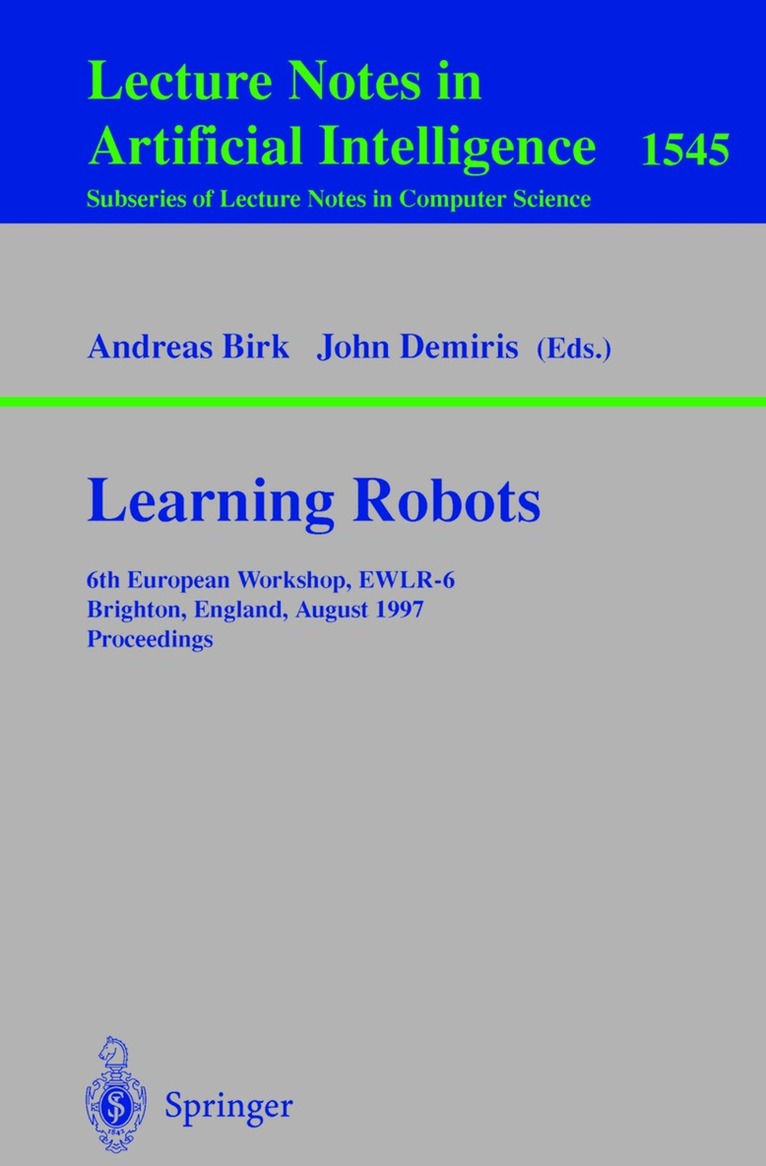
    Learning Robots

    6th European Workshop EWLR-6, Brighton, England, August 1-2, 1997 Proceedings

    AvAndreas Birk,John Demiris

    Häftad, Engelska, 1998

    Del i serien Lecture Notes in Computer Science

    546 kr

    Beställningsvara. Skickas inom 10-15 vardagar. Fri frakt över 249 kr.

    Beskrivning

    Robot learning is a broad and interdisciplinary area. This holds with regard to the basic interests and the scienti c background of the researchers involved, as well as with regard to the techniques and approaches used. The interests that motivate the researchers in this eld range from fundamental research issues, such as how to constructively understand intelligence, to purely application o- ented work, such as the exploitation of learning techniques for industrial robotics. Given this broad scope of interests, it is not surprising that, although AI and robotics are usually the core of the robot learning eld, disciplines like cog- tive science, mathematics, social sciences, neuroscience, biology, and electrical engineering have also begun to play a role in it. In this way, its interdisciplinary character is more than a mere fashion, and leads to a productive exchange of ideas. One of the aims of EWLR-6 was to foster this exchange of ideas and to f- ther boost contacts between the di erent scienti c areas involved in learning robots. EWLR is, traditionally, a \European Workshop on Learning Robots". Nevertheless, the organizers of EWLR-6 decided to open up the workshop to non-European research as well, and included in the program committee we- known non-European researchers. This strategy proved to be successful since there was a strong participation in the workshop from researchers outside - rope, especially from Japan, which provided new ideas and lead to new contacts.

    Produktinformation

    • Utgivningsdatum:1998-12-18
    • Mått:155 x 235 x 12 mm
    • Vikt:318 g
    • Format:Häftad
    • Språk:Engelska
    • Serie:Lecture Notes in Computer Science
    • Antal sidor:194
    • Upplaga:1998
    • Förlag:Springer-Verlag Berlin and Heidelberg GmbH & Co. KG
    • ISBN:9783540654803

    Utforska kategorier

    • Elektronik och kommunikationer inom Naturvetenskap och teknik
    • Artificiell intelligens inom Data och IT

    Innehållsförteckning

    • The construction and acquisition of visual categories.- Q-Learning with Adaptive State Space Construction.- Modular Reinforcement Learning: An Application to a Real Robot Task.- Analysis and Design of Robot’s Behavior: Towards a Methodology.- Vision Based State Space Construction for Learning Mobile Robots in Multi Agent Environments.- Transmitting Communication Skills Through Imitation in Autonomous Robots.- Continual Robot Learning with Constructive Neural Networks.- Robot Learning and Self-Sufficiency: What the energy-level can tell us about a robot’s performance.- Perceptual grounding in robots.- A Learning Mobile Robot: Theory, Simulation and Practice.- Learning Complex Robot Behaviours by Evolutionary Computing with Task Decomposition.- Robot Learning using Gate-Level Evolvable Hardware.