Anna Kyriazi - Böcker
Visar alla böcker från författaren Anna Kyriazi. Handla med fri frakt och snabb leverans.
3 produkter
3 produkter
1 953 kr
Skickas inom 10-15 vardagar
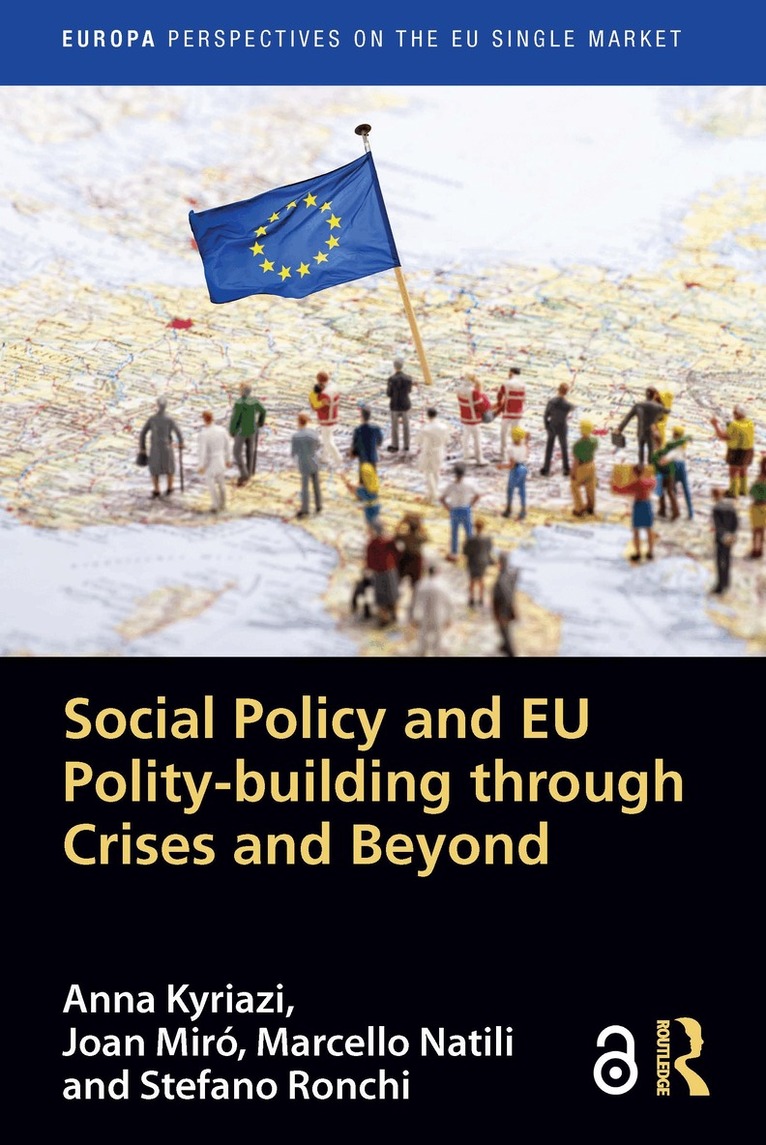
This volume sets out to explain the conditions that have favoured the expansion of the European social dimension during the turbulent decade of 2010–20, when Europe was confronting strong countervailing pressures, including the euro crisis, the refugee crisis and the COVID-19 pandemic.The study begins by diagnosing a widespread, although slow-burning, crisis across the European Union (EU) resulting from the cumulation of social problems and the systemic tension between EU market integration on the one hand and nationally bounded welfare states and the other. Eight in-depth case studies analyse the political dynamics behind a variety of EU social initiatives aimed at addressing the consequences of free movement of workers, youth unemployment, poverty, eroding wages, environment and climate change, and the COVID-19 pandemic. To identify the specific drivers of EU social policymaking empirically, the authors have reconstructed the struggles over concrete policy proposals as they unfolded in the European multilevel setting.The volume introduces a novel analytical framework for interpreting the transformation of the EU social dimension in times of crisis, when some degree of social co-ordination becomes crucial to bond deeply different (welfare) states together. This in-depth study offers an invaluable analysis for researchers, academics and professionals interested in the functioning of the European polity.The Open Access version of this book, available at www.taylorfrancis.com, has been made available under a Creative Commons [Attribution-Non Commercial-No Derivatives (CC-BY-NC-ND)] 4.0 license.
590 kr
Skickas inom 10-15 vardagar
This volume sets out to explain the conditions that have favoured the expansion of the European social dimension during the turbulent decade of 2010–20, when Europe was confronting strong countervailing pressures, including the euro crisis, the refugee crisis and the COVID-19 pandemic.The study begins by diagnosing a widespread, although slow-burning, crisis across the European Union (EU) resulting from the cumulation of social problems and the systemic tension between EU market integration on the one hand and nationally bounded welfare states and the other. Eight in-depth case studies analyse the political dynamics behind a variety of EU social initiatives aimed at addressing the consequences of free movement of workers, youth unemployment, poverty, eroding wages, environment and climate change, and the COVID-19 pandemic. To identify the specific drivers of EU social policymaking empirically, the authors have reconstructed the struggles over concrete policy proposals as they unfolded in the European multilevel setting.The volume introduces a novel analytical framework for interpreting the transformation of the EU social dimension in times of crisis, when some degree of social co-ordination becomes crucial to bond deeply different (welfare) states together. This in-depth study offers an invaluable analysis for researchers, academics and professionals interested in the functioning of the European polity.The Open Access version of this book, available at www.taylorfrancis.com, has been made available under a Creative Commons [Attribution-Non Commercial-No Derivatives (CC-BY-NC-ND)] 4.0 license.
1 295 kr
Kommande
Emigration of scale challenges states at the European periphery at their core. The book documents these struggles along their effects for politics and policy within their economic and welfare dimensions. The politics of emigration describe changing voter attitudes and behaviour pointing towards more support for nationalist and right-wing parties. The policies of emigration show state and local level efforts for the return of emigrant citizens. The welfare and economic dimensions explore the context for emigration and its effects for growth models and systems of health and care within the European single market. The book observes two types of state transformations: the re-emergent nation-state that re-discovers its core resource, the citizenry, as well as states that functionally and socially adapt to population loss.