Anna-Lisa Klages - Böcker
Visar alla böcker från författaren Anna-Lisa Klages. Handla med fri frakt och snabb leverans.
6 produkter
6 produkter
1 245 kr
Skickas inom 10-15 vardagar
This open access edited collection provides a long-overdue examination of a practice that is continuously involved in managing, regulating, and subordinating individuals and communities. While it is well established that neoliberal systems of population management are designed to target the “constructed other,” there is considerably less research examining how social work in particular interacts with the vestiges of colonialism to further this practice. Gathering social work scholars and practitioners from around the world, this collection offers a geographically diverse array of ambitious and insightful theoretical, conceptual, and practical discussions of how social work can perpetuate the afterlives of colonialism and of how this can be reversed. In so doing, this book not only provides in-depth, empirically grounded critiques of – and antidotes to – various policies for managing people at the margins of society, it also makes a compelling case for always keeping the complexity of colonial continuity in conversation with neoliberal systems of governance. As these chapters show, it is only by keeping the full complexity of such confluences in mind that social inequality and institutional racism can be understood and that possibilities for change can emerge.For its fundamental contributions to the literature on postcolonial social work, this is essential reading for social work researchers and postgraduates; and for its plainspoken tone and practical recommendations, it is a go-to source for social work practitioners eager to align their own everyday work with the demands of global justice.The ebook editions of this book are available open access under a CC BY-NC-ND 4.0 licence on bloomsburycollections.com. Open access was funded by the Bloomsbury Open Collections Library Collective.
499 kr
Kommande
This open access edited collection provides a long-overdue examination of a practice that is continuously involved in managing, regulating, and subordinating individuals and communities. While it is well established that neoliberal systems of population management are designed to target the “constructed other,” there is considerably less research examining how social work in particular interacts with the vestiges of colonialism to further this practice. Gathering social work scholars and practitioners from around the world, this collection offers a geographically diverse array of ambitious and insightful theoretical, conceptual, and practical discussions of how social work can perpetuate the afterlives of colonialism and of how this can be reversed. In so doing, this book not only provides in-depth, empirically grounded critiques of – and antidotes to – various policies for managing people at the margins of society, it also makes a compelling case for always keeping the complexity of colonial continuity in conversation with neoliberal systems of governance. As these chapters show, it is only by keeping the full complexity of such confluences in mind that social inequality and institutional racism can be understood and that possibilities for change can emerge.For its fundamental contributions to the literature on postcolonial social work, this is essential reading for social work researchers and postgraduates; and for its plainspoken tone and practical recommendations, it is a go-to source for social work practitioners eager to align their own everyday work with the demands of global justice.The ebook editions of this book are available open access under a CC BY-NC-ND 4.0 licence on bloomsburycollections.com. Open access was funded by the Bloomsbury Open Collections Library Collective.
Decolonial Methodologies in Social Work
Foregrounding Pluriversalism in Teaching and Research
Häftad, Engelska, 2026
499 kr
Kommande
This open access book offers an original exploration of how the notion of pluriversalism, an anti-colonial concept that resounds throughout many decolonial methodologies and pedagogies, underlies many current attempts to develop more just and equitable approaches to social work teaching and research.Despite its prominence in other fields, pluriversalism has never been foregrounded in any full-length study of social work. This co-edited volume does just that, and in so doing, it codifies a thriving, but otherwise diffuse, subcurrent of alternative, othered ways of researching and teaching social work. It foregrounds local knowledges while maintaining a global scope and empirically grounded perspective, and in so doing it shows how pluriversal approaches open new spaces around the world for teaching and talking about social work in a manner that is more just, culturally sensitive, and attuned to structural power relations. In that same self-critical spirit, the chapters gathered here also engage critically with the risks of cultural appropriation endemic to pluriversal approaches, themselves, appropriations that would ultimately reproduce the exploitation mechanisms they aim to resist. This is a must-read for social work students, researchers, and practitioners interested in development studies, decolonial studies, and Indigenous studies.The ebook editions of this book are available open access under a CC BY-NC-ND 4.0 licence on bloomsburycollections.com. Open access was funded by the Bloomsbury Open Collections Library Collective.
Decolonial Methodologies in Social Work
Foregrounding Pluriversalism in Teaching and Research
Inbunden, Engelska, 2025
1 177 kr
Skickas inom 10-15 vardagar
This open access book offers an original exploration of how the notion of pluriversalism, an anti-colonial concept that resounds throughout many decolonial methodologies and pedagogies, underlies many current attempts to develop more just and equitable approaches to social work teaching and research.Despite its prominence in other fields, pluriversalism has never been foregrounded in any full-length study of social work. This co-edited volume does just that, and in so doing, it codifies a thriving, but otherwise diffuse, subcurrent of alternative, othered ways of researching and teaching social work. It foregrounds local knowledges while maintaining a global scope and empirically grounded perspective, and in so doing it shows how pluriversal approaches open new spaces around the world for teaching and talking about social work in a manner that is more just, culturally sensitive, and attuned to structural power relations. In that same self-critical spirit, the chapters gathered here also engage critically with the risks of cultural appropriation endemic to pluriversal approaches, themselves, appropriations that would ultimately reproduce the exploitation mechanisms they aim to resist. This is a must-read for social work students, researchers, and practitioners interested in development studies, decolonial studies, and Indigenous studies.The ebook editions of this book are available open access under a CC BY-NC-ND 4.0 licence on bloomsburycollections.com. Open access was funded by the Bloomsbury Open Collections Library Collective.
Die Situationsanalyse als Forschungsprogramm
Theoretische Implikationen, Forschungspraxis und Anwendungsbeispiele
Häftad, Tyska, 2023
775 kr
Skickas inom 10-15 vardagar
Damit greift die Publikation offene Fragen und Weiterführungen des Clarke‘schen Theorie-Methoden-Pakets der Situationsanalyse auf und liefert so einen Beitrag zur Fortentwicklung einer Methodologie, die insbesondere für inter- und transdisziplinäre Forschungsprojekte vielfältige Impulse bietet.
Crafting Power
The Situatedness of Artistic Handicraft and Civic Engagement in Contemporary Uganda
Häftad, Engelska, 2025
787 kr
Skickas
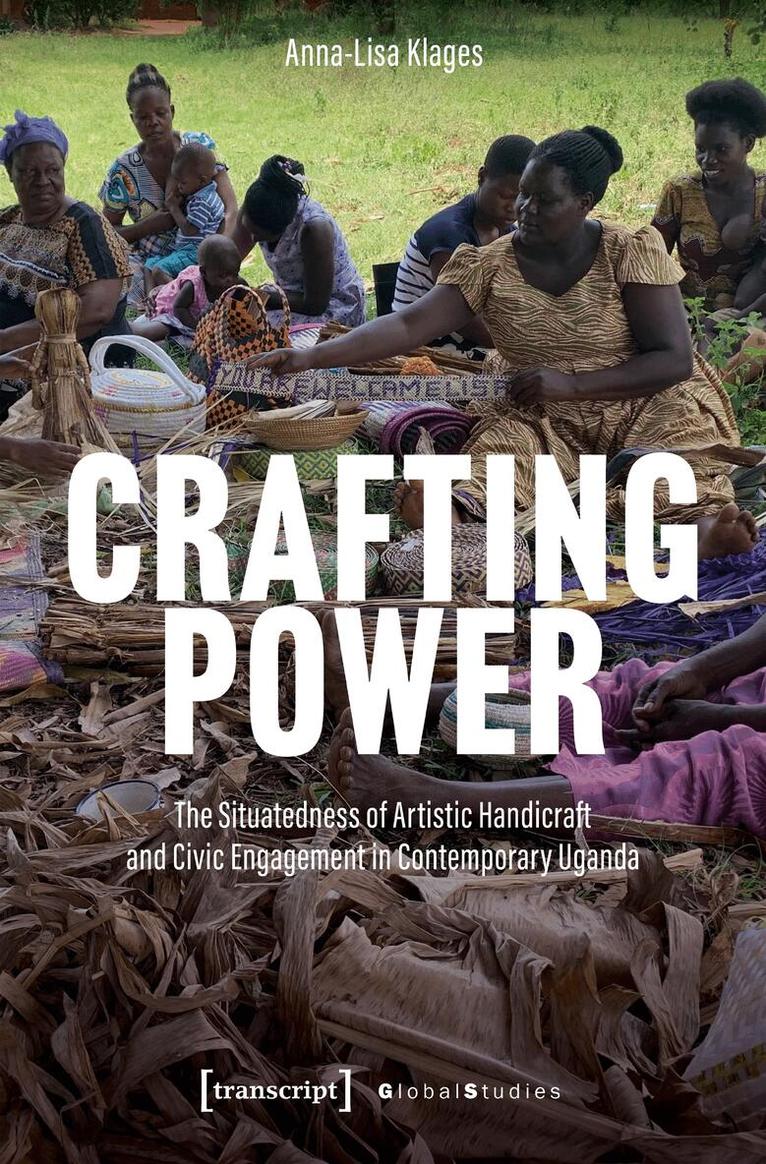
In contemporary Uganda, involved actors often associate artistic handicraft production with sustainable economic development and women empowerment. Others highlight its significance for the situated understandings of tangible and intangible cultural heritage, framing artistic handicrafts as indigenous art embedded into local knowledges. Anna-Lisa Klages examines artistic handicrafts through the lens of civic engagement. She reconstructs the negotiated meanings of handicrafts by showing how the actors and organizations involved shape its conceptualizations, which often renders the perspectives of artisans invisible. This study is an important read for those interested in international cooperation and power relations in the postcolonial era.