Anustup Basu – författare
Visar alla böcker från författaren Anustup Basu. Handla med fri frakt och snabb leverans.
11 produkter
Figurations in Indian Film
Av Meheli Sen, Anustup Basu m. fl.
Inbunden, 2013
584 kr
Lägg i varukorg
This volume brings together a series of essays that interrogate the notion of figuration in Indian cinemas. The essays collectively argue that the figures which exhibit maximum tenacity in Indian cinema often emerge in the interface of recognizable binaries: self/other, Indian/foreign, good/bad, …
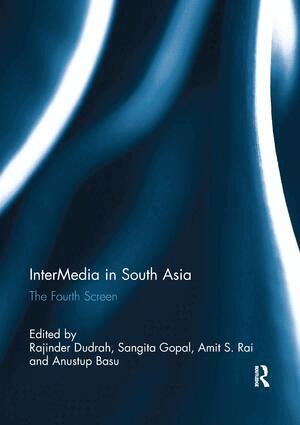
InterMedia in South Asia
The Fourth Screen
Av Rajinder Dudrah, Sangita Gopal m. fl.
Inbunden, 2012
2510 kr
Lägg i varukorg
The emergence of new media today in South Asia has signalled an event, the meaning of which remains obscure but whose reality is rapidly evolving along gradients of intensity and experience. Contemporary media in and from South Asia have come to sense a new arrangement of value, sensation, and …
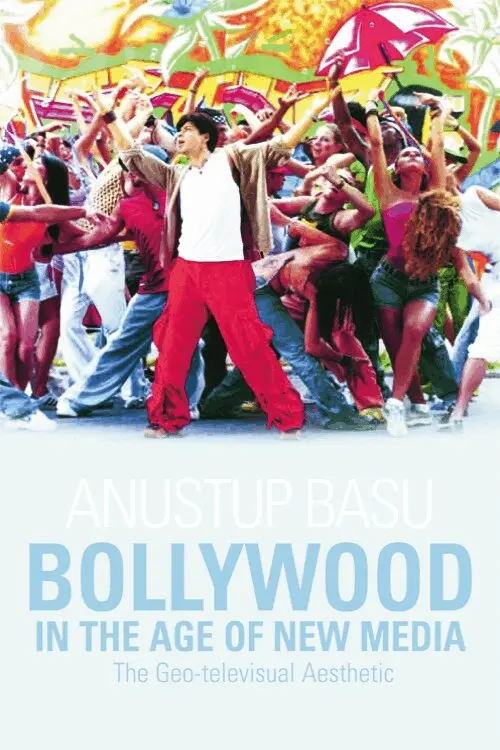
Bollywood in the Age of New Media
The Geo-televisual Aesthetic
Av Anustup Basu
Häftad, 2012
418 kr
Lägg i varukorg
This study of popular Indian cinema in an age of globalisation, new media, and metropolitan Hindu fundamentalism focuses on the period from 1991 to 2004. Popular Hindi cinema took a certain spectacular turn from the early nineties as a signature 'Bollywood style' evolved in the wake of …
InterMedia in South Asia
The Fourth Screen
Av Rajinder Dudrah, Sangita Gopal m. fl.
E-bok, 2013
433 kr
Lägg i varukorg
The emergence of new media today in South Asia has signalled an event, the meaning of which remains obscure but whose reality is rapidly evolving along gradients of intensity and experience. Contemporary media in and from South Asia have come to sense a new arrangement of value, sensation, and …
InterMedia in South Asia
The Fourth Screen
Av Rajinder Dudrah, Sangita Gopal m. fl.
E-bok, 2013
433 kr
Lägg i varukorg
The emergence of new media today in South Asia has signalled an event, the meaning of which remains obscure but whose reality is rapidly evolving along gradients of intensity and experience. Contemporary media in and from South Asia have come to sense a new arrangement of value, sensation, and …
Figurations in Indian Film
E-bok, 2013
779 kr
Lägg i varukorg
This volume brings together a series of essays that interrogate the notion of figuration in Indian cinemas. The essays collectively argue that the figures which exhibit maximum tenacity in Indian cinema often emerge in the interface of recognizable binaries: self/other, Indian/foreign, good/bad, …
InterMedia in South Asia
The Fourth Screen
Av Rajinder Dudrah, Sangita Gopal m. fl.
Häftad, 2017
371 kr
Lägg i varukorg
The emergence of new media today in South Asia has signalled an event, the meaning of which remains obscure but whose reality is rapidly evolving along gradients of intensity and experience. Contemporary media in and from South Asia have come to sense a new arrangement of value, sensation, and …
Figurations in Indian Film
Häftad, 2013
550 kr
Lägg i varukorg
This volume brings together a series of essays that interrogate the notion of figuration in Indian cinemas. The essays collectively argue that the figures which exhibit maximum tenacity in Indian cinema often emerge in the interface of recognizable binaries: self/other, Indian/foreign, good/bad, …
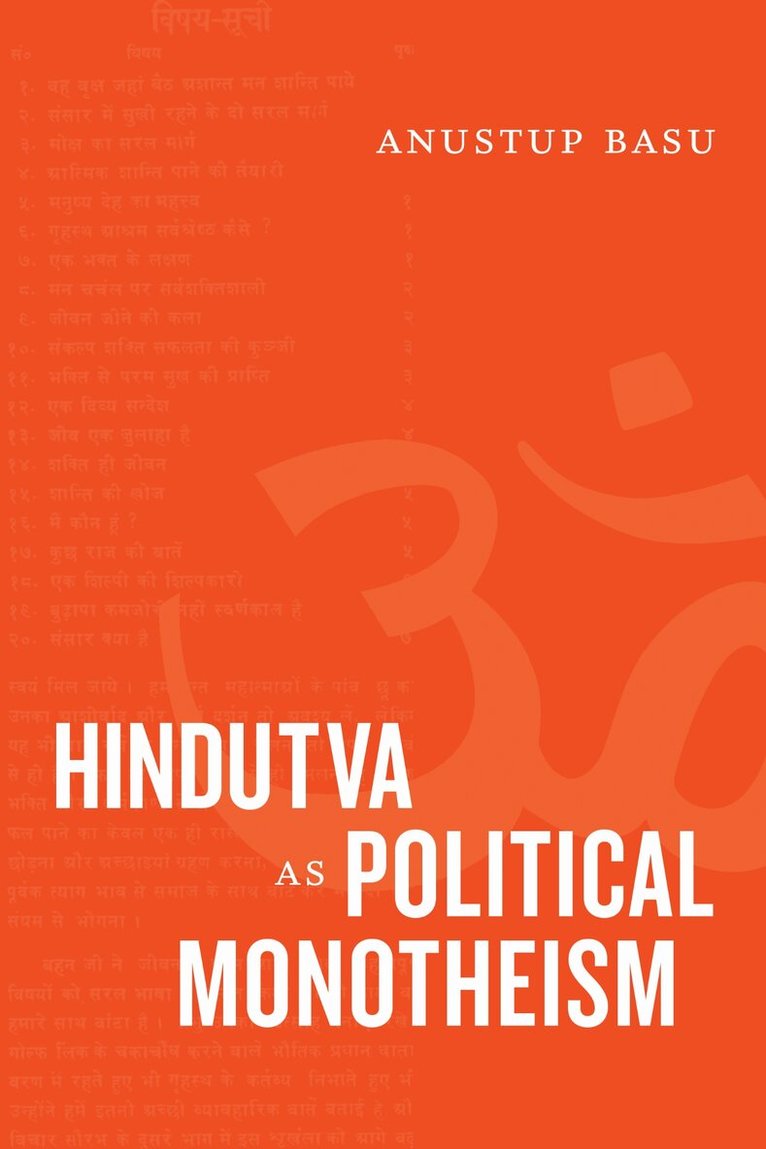
Hindutva As Political Monotheism
Av Anustup Basu
Inbunden, 2020
1573 kr
Lägg i varukorg
In Hindutva as Political Monotheism, Anustup Basu offers a genealogical study of Hindutva-Hindu right-wing nationalism-to illustrate the significance of Western anthropology and political theory to the idea of India as a Hindu nation. Connecting Nazi jurist Carl Schmitt's notion of political …
Hindutva As Political Monotheism
Av Anustup Basu
Häftad, 2020
386 kr
Lägg i varukorg
In Hindutva as Political Monotheism, Anustup Basu offers a genealogical study of Hindutva-Hindu right-wing nationalism-to illustrate the significance of Western anthropology and political theory to the idea of India as a Hindu nation. Connecting Nazi jurist Carl Schmitt's notion of political …
Hindutva as Political Monotheism
Av Anustup Basu
E-bok, 2020
570 kr
Lägg i varukorg
In Hindutva as Political Monotheism , Anustup Basu offers a genealogical study of Hindutva—Hindu right-wing nationalism—to illustrate the significance of Western anthropology and political theory to the idea of India as a Hindu nation. Connecting Nazi jurist Carl Schmitt''s notion of political …