Arthur E. Morgan - Böcker
Visar alla böcker från författaren Arthur E. Morgan. Handla med fri frakt och snabb leverans.
8 produkter
8 produkter
2 098 kr
Skickas inom 10-15 vardagar
In this age of large cities, mass culture, and ever more massive events, people must struggle against an overwhelming crowd of their own creations to maintain human integrity. In this manual for human survival, Arthur E. Morgan offers a solution: peaceful existence in the small, primary community where, more easily than anywhere else, people can find a way to live well. Ultimately striving to show that the small community is "the lifeblood of civilization," this volume examines the political organization, membership, economics, health, and ethics characteristics of small communities.Like Rousseau before him, Morgan observes that we have less control over our affairs than in the past. In increasing our control of the natural environment, human beings have built a social environment so out of scale that it becomes nearly impossible for people to maintain balance. The struggle now is less with the natural order than with the social order, and preserving human integrity against the plethora of our own creations is the core problem.The need to rediscover elementary forms of human existence has been accelerated by the efficiencies of centralized control and mass persuasion. In the face of this, small communities or intimate groups become the primary pattern in which human beings must live if the good life is to be a realistic goal. The timely nature of this volume has grown as the electronic displaces the mechanical as a moral rival to human community.
2 098 kr
Skickas inom 10-15 vardagar
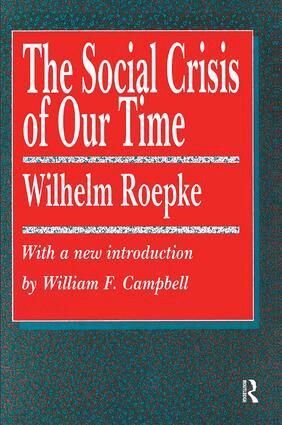
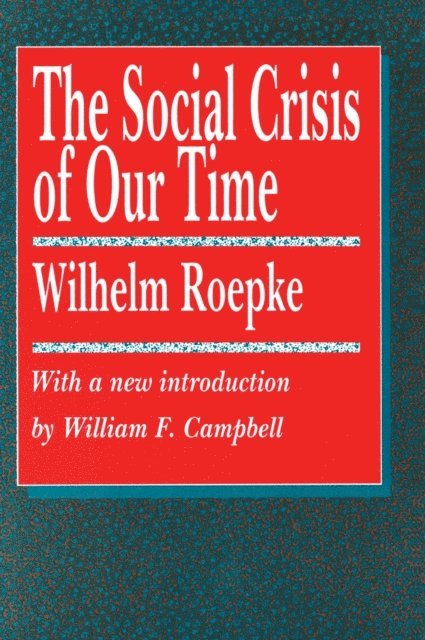
Roepke's The Social Crisis of Our Time is a series of blasts against the "malformations" of economics: the Nazi and Communist forms of collectivism both come in for severe criticism. Roepke shows the process by which the Western liberal tradition itself makes possible these rebellions against open economic systems. The drive toward social welfare, full employment policies, and the state management of fiscal fluctuations all lead away from free societies no less than market economies.
544 kr
Skickas inom 3-6 vardagar
401 kr
Skickas inom 3-6 vardagar
674 kr
Skickas inom 10-15 vardagar
In this age of large cities, mass culture, and ever more massive events, people must struggle against an overwhelming crowd of their own creations to maintain human integrity. In this manual for human survival, Arthur E. Morgan offers a solution: peaceful existence in the small, primary community where, more easily than anywhere else, people can find a way to live well. Ultimately striving to show that the small community is "the lifeblood of civilization," this volume examines the political organization, membership, economics, health, and ethics characteristics of small communities.Like Rousseau before him, Morgan observes that we have less control over our affairs than in the past. In increasing our control of the natural environment, human beings have built a social environment so out of scale that it becomes nearly impossible for people to maintain balance. The struggle now is less with the natural order than with the social order, and preserving human integrity against the plethora of our own creations is the core problem.The need to rediscover elementary forms of human existence has been accelerated by the efficiencies of centralized control and mass persuasion. In the face of this, small communities or intimate groups become the primary pattern in which human beings must live if the good life is to be a realistic goal. The timely nature of this volume has grown as the electronic displaces the mechanical as a moral rival to human community.
428 kr
Skickas inom 3-6 vardagar
631 kr
Skickas inom 3-6 vardagar
736 kr
Skickas inom 10-15 vardagar
Roepke's The Social Crisis of Our Time is a series of blasts against the "malformations" of economics: the Nazi and Communist forms of collectivism both come in for severe criticism. Roepke shows the process by which the Western liberal tradition itself makes possible these rebellions against open economic systems. The drive toward social welfare, full employment policies, and the state management of fiscal fluctuations all lead away from free societies no less than market economies.