Arthur W. Burks - Böcker
Visar alla böcker från författaren Arthur W. Burks. Handla med fri frakt och snabb leverans.
3 produkter
3 produkter
516 kr
Skickas inom 7-10 vardagar
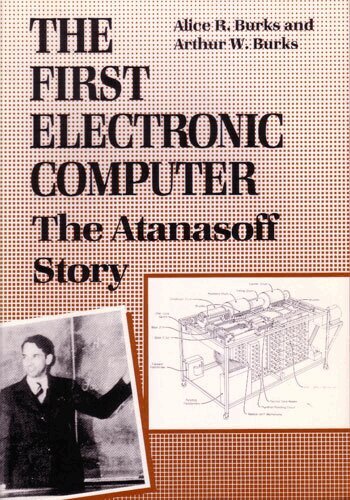
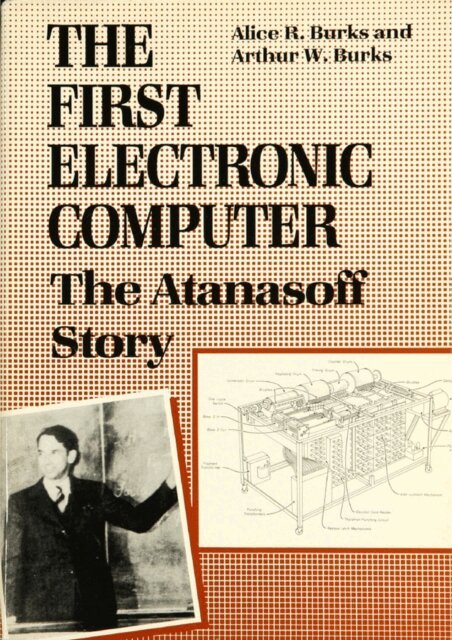
The First Electronic Computer is a groundbreaking historical and technical account of John Vincent Atanasoff’s revolutionary work on the world’s first electronic digital computer. Drawing upon years of meticulous research and firsthand experience, coauthors Alice and Arthur Burks trace the remarkable journey of Atanasoff—from his early life and education to his pivotal innovations at Iowa State College in the late 1930s and early 1940s. Atanasoff’s machine—the Atanasoff-Berry Computer (ABC)—proved the feasibility of electronic computation and introduced key concepts, such as electronic switching and regenerative memory, that became foundational to the digital computers that followed. The authors present detailed narratives of Atanasoff’s collaboration with graduate student Clifford Berry and recount the critical sequence of events that linked his invention to the famous ENIAC, commonly celebrated as the first general-purpose electronic computer. With depth and clarity, the book delves into the technical design, development, and operation of the ABC, while candidly addressing the major controversies surrounding computing history. The Burkses examine the intricate web of correspondence, personal interactions, and legal battles—especially the landmark Honeywell v. Sperry Rand patent case—culminating in the federal court’s recognition of Atanasoff’s precedence over ENIAC. Rich in technical detail and engaging historical narrative, The First Electronic Computer offers readers an unparalleled look at the origins of one of the most significant technological revolutions of the twentieth century, acknowledging Atanasoff’s contributions and clarifying his enduring legacy in computing history.
2 458 kr
Skickas inom 7-10 vardagar
The first six volumes of the Collected Papers of Charles Sanders Peirce included Peirce’s main writings in general philosophy, logic (deductive, inductive, and symbolic), pragmatism, and metaphysics. Volumes VII and VIII are a continuation of this series. Originally published as two separate volumes, they now appear in one book as part of the Belknap Press edition. Volume VII contains papers on experimental science, scientific method, and philosophy of mind. Volume VIII contains selections from Peirce’s reviews and correspondence and a bibliography of his published works, speeches and correspondence, and works by other authors which quote or describe manuscripts by Peirce which are not included in Volumes I–VIII of Collected Papers.As is true of the series as a whole, the material in these volumes is not readily accessible elsewhere. Many of the manuscripts have never been published before, and the previously published material which is included is widely scattered in a number of journals.Peirce’s work in experimental science played an important role in his life and in the formation of his philosophy, and Volume VII is designed to show how the principal focus of his attention shifted from this sphere to the methods of science and finally to speculative metaphysics. Thus it includes his only published article in experimental psychology and two short pieces on gravity as well as the most important part of “The Logic of 1873” (in which pragmatism was first formulated in writing); “The Logic of Drawing History from Ancient Documents,” discussion of the historical method; “Economy of Research” (1879), containing many pertinent reflections on scientific methodology of interest to research directors today; and much more.America’s first original philosopher and logician, and the founder of the philosophy of pragmatism, Peirce was also influential in shaping the thinking of such figures as William James and John Dewey. The reviews and correspondence contained in Volume VIII show his attitude toward these philosophies and illustrate the nature of his relationships with the great thinkers of his day.The bibliography in Volume VIII lists chronologically all of Peirce’s known published works, giving a clear picture of the development of his thought from 1860 through 1911. It is more complete than any published so far in that many new items are included and items previously listed in different sources are here brought together.These volumes will be of great value to all persons interested in philosophy, scientific method, psychology, the methodology of history, and American studies in general.
288 kr
Skickas inom 5-8 vardagar