Barbara F. Walter - Böcker
Visar alla böcker från författaren Barbara F. Walter. Handla med fri frakt och snabb leverans.
8 produkter
8 produkter
122 kr
Skickas
Sunday Times Smart Thinking Book of the Year 2022 • New York Times Bestseller• WINNER OF THE GLOBAL POLICY INSTITUTE AWARD • BOOKS OF THE YEAR: Financial Times, The Times, Esquire, Prospect'When one of the world's leading scholars of civil war tells us that a country is on the brink of violent conflict, we should pay attention. This is an important book' Steven Levitsky and Daniel Ziblatt, authors of How Democracies DieCivil wars are the biggest danger to world peace today - this book shows us why they happen, and how to avoid them.We are now living in the world's greatest era of civil wars. While violence has declined worldwide, major civil wars are now being fought in countries including Iraq, Syria and Libya, and smaller civil wars are being fought in India and Malaysia. Even countries we thought could never experience another civil war - such as the USA, Sweden and Ireland - are showing signs of unrest. So how can we stop them?In How Civil Wars Start, acclaimed expert Professor Barbara F. Walter, who has advised on political violence everywhere from the CIA to the U.S. Senate to the United Nations, explains the rise of civil wars and the conditions that create them - not least when countries are not quite democratic. As democracies across the world backslide and citizens become more polarised, civil wars will become even more widespread and last longer than they have in the past - but this urgent and important book shows us a path back toward peace.
507 kr
Skickas inom 7-10 vardagar
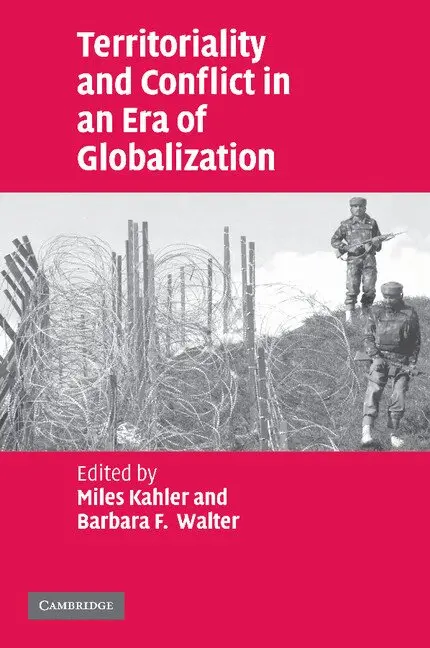
Predictions that globalization would undermine territorial attachments and weaken the sources of territorial conflict have not been realized in recent decades. Globalization may have produced changes in territoriality and the functions of borders, but it has not eliminated them. The contributors to this volume examine this relationship, arguing that much of the change can be attributed to sources other than economic globalization. Bringing the perspectives of law, political science, anthropology, and geography to bear on the complex causal relations among territoriality, conflict, and globalization, leading contributors examine how territorial attachments are constructed, why they have remained so powerful in the face of an increasingly globalized world, and what effect continuing strong attachments may have on conflict. They argue that territorial attachments and people's willingness to fight for territory depends upon the symbolic role it plays in constituting people's identities, and producing a sense of belonging in an increasingly globalized world.
428 kr
Skickas inom 7-10 vardagar
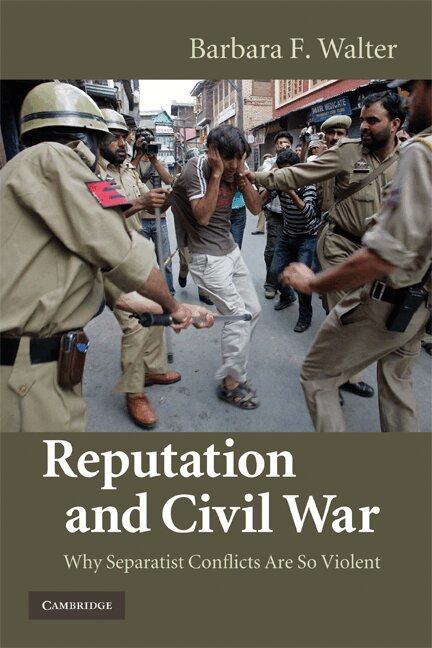
Of all the different types of civil war, disputes over self-determination are the most likely to escalate into war and resist compromise settlement. Reputation and Civil War argues that this low rate of negotiation is the result of reputation building, in which governments refuse to negotiate with early challengers in order to discourage others from making more costly demands in the future. Jakarta's wars against East Timor and Aceh, for example, were not designed to maintain sovereignty but to signal to Indonesia's other minorities that secession would be costly. Employing data from three different sources - laboratory experiments on undergraduates, statistical analysis of data on self-determination movements, and qualitative analyses of recent history in Indonesia and the Philippines - Barbara F. Walter provides some of the first systematic evidence that reputation strongly influences behavior, particularly between governments and ethnic minorities fighting over territory.
1 245 kr
Skickas inom 7-10 vardagar
Of all the different types of civil war, disputes over self-determination are the most likely to escalate into war and resist compromise settlement. Reputation and Civil War argues that this low rate of negotiation is the result of reputation building, in which governments refuse to negotiate with early challengers in order to discourage others from making more costly demands in the future. Jakarta's wars against East Timor and Aceh, for example, were not designed to maintain sovereignty but to signal to Indonesia's other minorities that secession would be costly. Employing data from three different sources - laboratory experiments on undergraduates, statistical analysis of data on self-determination movements, and qualitative analyses of recent history in Indonesia and the Philippines - Barbara F. Walter provides some of the first systematic evidence that reputation strongly influences behavior, particularly between governments and ethnic minorities fighting over territory.
1 390 kr
Skickas inom 7-10 vardagar
Predictions that globalization would undermine territorial attachments and weaken the sources of territorial conflict have not been realized in recent decades. Globalization may have produced changes in territoriality and the functions of borders, but it has not eliminated them. The contributors to this volume examine this relationship, arguing that much of the change can be attributed to sources other than economic globalization. Bringing the perspectives of law, political science, anthropology, and geography to bear on the complex causal relations among territoriality, conflict, and globalization, leading contributors examine how territorial attachments are constructed, why they have remained so powerful in the face of an increasingly globalized world, and what effect continuing strong attachments may have on conflict. They argue that territorial attachments and people's willingness to fight for territory depends upon the symbolic role it plays in constituting people's identities, and producing a sense of belonging in an increasingly globalized world.
127 kr
Skickas inom 3-6 vardagar
NEW YORK TIMES BESTSELLER • A leading political scientist examines the dramatic rise in violent extremism around the globe and sounds the alarm on the increasing likelihood of a second civil war in the United States“Required reading for anyone invested in preserving our 246-year experiment in self-government.”—The New York Times Book Review (Editors’ Choice)WINNER OF THE GLOBAL POLICY INSTITUTE AWARD • THE SUNDAY TIMES BOOK OF THE YEAR • ONE OF THE BEST BOOKS OF THE YEAR: Financial Times, The Times (UK), Esquire, Prospect (UK)Political violence rips apart several towns in southwest Texas. A far-right militia plots to kidnap the governor of Michigan and try her for treason. An armed mob of Trump supporters and conspiracy theorists storms the U.S. Capitol. Are these isolated incidents? Or is this the start of something bigger? Barbara F. Walter has spent her career studying civil conflict in places like Iraq, Ukraine, and Sri Lanka, but now she has become increasingly worried about her own country.Perhaps surprisingly, both autocracies and healthy democracies are largely immune from civil war; it’s the countries in the middle ground that are most vulnerable. And this is where more and more countries, including the United States, are finding themselves today.Over the last two decades, the number of active civil wars around the world has almost doubled. Walter reveals the warning signs—where wars tend to start, who initiates them, what triggers them—and why some countries tip over into conflict while others remain stable. Drawing on the latest international research and lessons from over twenty countries, Walter identifies the crucial risk factors, from democratic backsliding to factionalization and the politics of resentment. A civil war today won’t look like America in the 1860s, Russia in the 1920s, or Spain in the 1930s. It will begin with sporadic acts of violence and terror, accelerated by social media. It will sneak up on us and leave us wondering how we could have been so blind.In this urgent and insightful book, Walter redefines civil war for a new age, providing the framework we need to confront the danger we now face—and the knowledge to stop it before it’s too late.
414 kr
Skickas inom 7-10 vardagar
Why do some civil wars end in successfully implemented peace settlements while others are fought to the finish? Numerous competing theories address this question. Yet not until now has a study combined the historical sweep, empirical richness, and conceptual rigor necessary to put them thoroughly to the test and draw lessons invaluable to students, scholars, and policymakers. Using data on every civil war fought between 1940 and 1992, Barbara Walter details the conditions that lead combatants to partake in what she defines as a three-step process--the decision on whether to initiate negotiations, to compromise, and, finally, to implement any resulting terms. Her key finding: rarely are such conflicts resolved without active third-party intervention. Walter argues that for negotiations to succeed it is not enough for the opposing sides to resolve the underlying issues behind a civil war. Instead the combatants must clear the much higher hurdle of designing credible guarantees on the terms of agreement--something that is difficult without outside assistance.Examining conflicts from Greece to Laos, China to Columbia, Bosnia to Rwanda, Walter confirms just how crucial the prospect of third-party security guarantees and effective power-sharing pacts can be--and that adversaries do, in fact, consider such factors in deciding whether to negotiate or fight. While taking many other variables into account and acknowledging that third parties must also weigh the costs and benefits of involvement in civil war resolution, this study reveals not only how peace is possible, but probable.
308 kr
Skickas inom 3-6 vardagar