Ben Vinson - Böcker
Visar alla böcker från författaren Ben Vinson. Handla med fri frakt och snabb leverans.
5 produkter
5 produkter
896 kr
Skickas
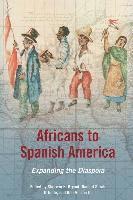
Africans to Spanish America expands the Diaspora framework that has shaped much of the recent scholarship on Africans in the Americas to include Mexico, Peru, Ecuador, and Cuba, exploring the connections and disjunctures between colonial Latin America and the African Diaspora in the Spanish empires. While a majority of the research on the colonial Diaspora focuses on the Caribbean and Brazil, analysis of the regions of Mexico and the Andes opens up new questions of community formation that incorporated Spanish legal strategies in secular and ecclesiastical institutions as well as articulations of multiple African identities. Editors Sherwin K. Bryant, Rachel Sarah O'Toole, and Ben Vinson III arrange the volume around three themes: identity construction in the Americas; the struggle by enslaved and free people to present themselves as civilized, Christian, and resistant to slavery; and issues of cultural exclusion and inclusion. Across these broad themes, contributors offer probing and detailed studies of the place and roles of people of African descent in the complex realities of colonial Spanish America. Contributors are Joan C. Bristol, Nancy E. van Deusen, Leo J. Garofalo, Herbert S. Klein, Charles Beatty-Medina, Karen Y. Morrison, Rachel Sarah O'Toole, Frank "Trey" Proctor III, and Michele Reid-Vazquez.
320 kr
Skickas inom 7-10 vardagar
Africans to Spanish America expands the Diaspora framework that has shaped much of the recent scholarship on Africans in the Americas to include Mexico, Peru, Ecuador, and Cuba, exploring the connections and disjunctures between colonial Latin America and the African Diaspora in the Spanish empires. While a majority of the research on the colonial Diaspora focuses on the Caribbean and Brazil, analysis of the regions of Mexico and the Andes opens up new questions of community formation that incorporated Spanish legal strategies in secular and ecclesiastical institutions as well as articulations of multiple African identities. Editors Sherwin K. Bryant, Rachel Sarah O'Toole, and Ben Vinson III arrange the volume around three themes: identity construction in the Americas; the struggle by enslaved and free people to present themselves as civilized, Christian, and resistant to slavery; and issues of cultural exclusion and inclusion. Across these broad themes, contributors offer probing and detailed studies of the place and roles of people of African descent in the complex realities of colonial Spanish America. Contributors are Joan C. Bristol, Nancy E. van Deusen, Leo J. Garofalo, Herbert S. Klein, Charles Beatty-Medina, Karen Y. Morrison, Rachel Sarah O'Toole, Frank "Trey" Proctor III, and Michele Reid-Vazquez.
1 332 kr
Skickas inom 10-15 vardagar
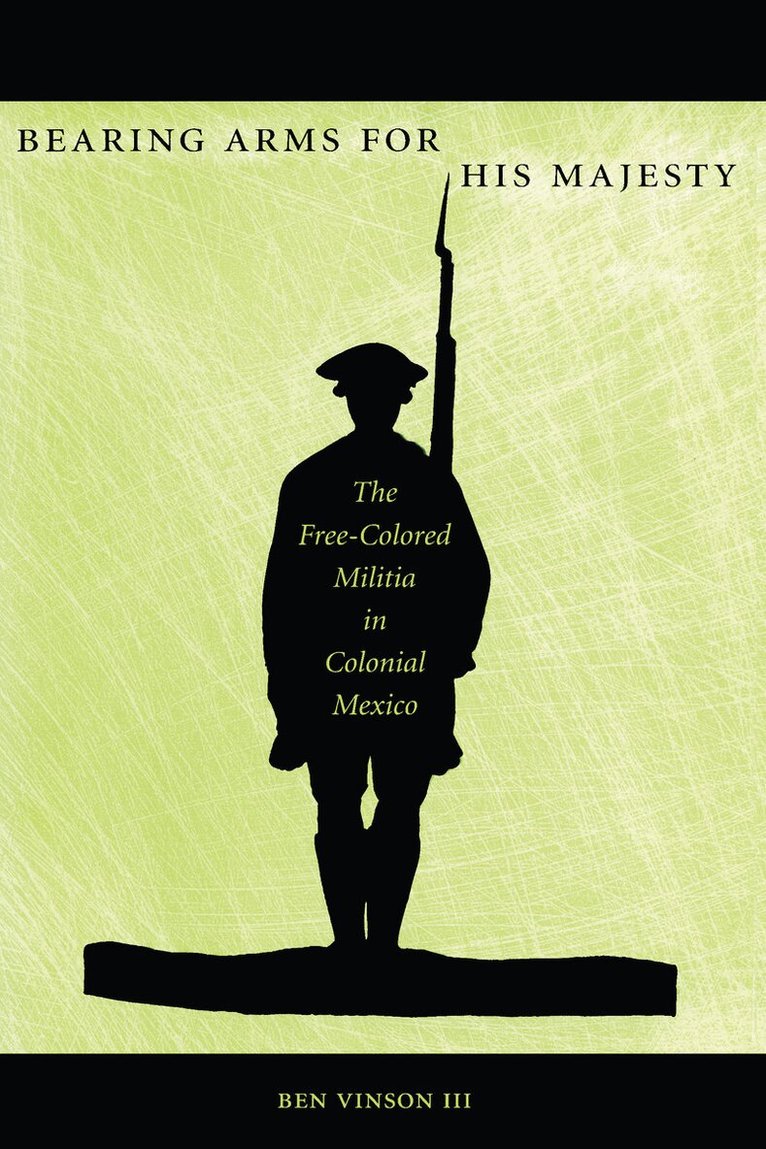
This study uses the participation of free colored men, whether mulatos, pardos, or morenos (i.e., Afro-Spaniards, Afro-Indians, or "pure blacks"), in New Spain's militias as a prism for examining race relations, racial identity, racial categorization, and issues of social mobility for racially stigmatized groups in colonial Mexico. By 1793, nearly 10 percent of New Spain's population was made up of people who could trace some African ancestry—people subject to more legal disabilities and social discrimination than mestizos, who in turn fell below white creoles, who in turn fell below the Spanish-born, in the stratified and caste-like society of colonial Spanish America.The originality of this study lies in approaching race via a single, important institution, the military, rather than via abstractions or examples taken from particular regions or single runs of legal documents. By exploring the lives of tens of thousands of part-time and full-time free colored soldiers, who served the colony as volunteers or conscripts, and by adopting a multi-regional approach, the author is able not only to show how military institutions evolved with reference to race and vice versa, but to do so in a manner that reveals discontinuities and regional differences as well as historical trends. He also is able to examine black lives beyond the institution of slavery and to achieve a more nuanced impression of the meaning of freedom in colonial times.From the 1550s on, free colored forces figured prominently in the colony's military forces, and units of free colored soldiers evolved with increasing autonomy in the seventeenth and eighteenth centuries. The author concludes, however, that the Bourbon reforms of the 1760s—which clearly expanded the military establishment and the role of Spanish soldiers born in the New World—came at the expense of free colored companies, which experienced a reduction in both numbers and institutional privileges.
320 kr
Skickas inom 7-10 vardagar
This study uses the participation of free colored men, whether mulatos, pardos, or morenos (i.e., Afro-Spaniards, Afro-Indians, or "pure blacks"), in New Spain's militias as a prism for examining race relations, racial identity, racial categorization, and issues of social mobility for racially stigmatized groups in colonial Mexico. By 1793, nearly 10 percent of New Spain's population was made up of people who could trace some African ancestry—people subject to more legal disabilities and social discrimination than mestizos, who in turn fell below white creoles, who in turn fell below the Spanish-born, in the stratified and caste-like society of colonial Spanish America.The originality of this study lies in approaching race via a single, important institution, the military, rather than via abstractions or examples taken from particular regions or single runs of legal documents. By exploring the lives of tens of thousands of part-time and full-time free colored soldiers, who served the colony as volunteers or conscripts, and by adopting a multi-regional approach, the author is able not only to show how military institutions evolved with reference to race and vice versa, but to do so in a manner that reveals discontinuities and regional differences as well as historical trends. He also is able to examine black lives beyond the institution of slavery and to achieve a more nuanced impression of the meaning of freedom in colonial times.From the 1550s on, free colored forces figured prominently in the colony's military forces, and units of free colored soldiers evolved with increasing autonomy in the seventeenth and eighteenth centuries. The author concludes, however, that the Bourbon reforms of the 1760s—which clearly expanded the military establishment and the role of Spanish soldiers born in the New World—came at the expense of free colored companies, which experienced a reduction in both numbers and institutional privileges.
534 kr
Skickas inom 3-6 vardagar
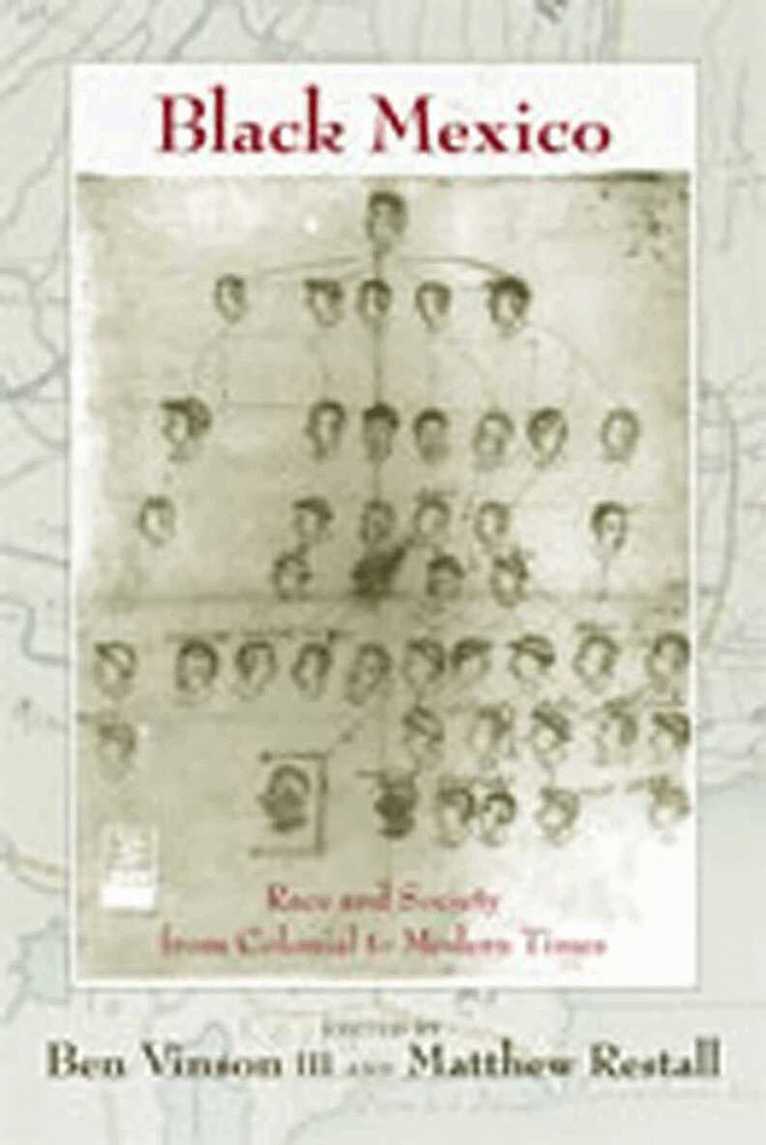
The essays in this collection build upon a series of conversations and papers that resulted from 'New Directions in North American Scholarship on Afro-Mexico', a symposium conducted at Pennsylvania State University in 2004. The issues addressed include contested historiography, social and economic contributions of Afro-Mexicans, social construction of race and ethnic identity, forms of agency and resistance, and contemporary inquiry into ethnographic work on Afro-Mexican communities. Comprised of a core set of chapters that examine the colonial period and a shorter epilogue addressing the modern era, this volume allows the reader to explore ideas of racial representation from the sixteenth century into the twenty-first.