Bernd Waas – författare
3 480 kr
Läs direkt efter köp
3 480 kr
Läs direkt efter köp
3 211 kr
Skickas inom 10-15 vardagar
3 132 kr
Läs direkt efter köp
3 132 kr
Läs direkt efter köp
2 891 kr
Skickas inom 10-15 vardagar
International Framework Agreements
Hintergrund, Rechtsnatur und Justiziabilitaet
721 kr
Skickas inom 5-8 vardagar
gesetzliche Mindestlohn in Deutschland und im Vereinigten Koenigreich
Eine rechtsvergleichende Untersuchung
756 kr
Skickas inom 5-8 vardagar
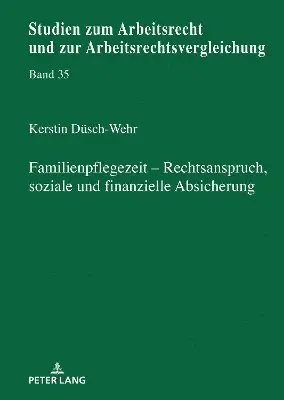
Familienpflegezeit - Rechsanspruch, soziale und finanzielle Absicherung
549 kr
Skickas inom 5-8 vardagar
634 kr
Skickas inom 5-8 vardagar
554 kr
Skickas inom 3-6 vardagar
2 690 kr
Läs direkt efter köp
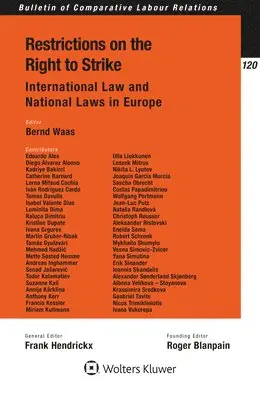
The right of workers to 舖strike舗 舒 to refuse to work pending the outcome of employer-employee negotiations concerning specified demands 舒 is legally recognized virtually worldwide. Yet national laws on strike action vary enormously, both in terms of the extent of state regulation and of specific procedural rules. The importance of strike law becomes obvious when taking the enormous economic and financial consequences of strikes into account. Considering how many people and businesses are affected by strike actions 舒 particularly with the globalization of industry 舒 the value of a comparative assessment of the right to strike becomes very clear.
1 906 kr
Läs direkt efter köp
The ''full-time job'' is no longer an option for many people seeking employment. It has been replaced by an ever-expanding plethora of ''atypical'' employment relationships designed by employers to streamline their operations and/or take advantage of information communications technology. Numerous labour law issues arise, demanding urgent attention. How should law and policy best address these challenges? This incomparable and timely book explores this contentious topic in depth, presenting ten penetrating essays on aspects of the topic by leading European authorities followed by reports on new forms of employment in thirty-five European countries
Full-scale analysis of new forms of employment, their characteristics, and their effects on working conditions and the labour market includes such issues as the following:
- employment relationships with more than one employer;- discontinuous and/or intermittent work;- work based on networking arrangements;- labour pooling;- crowdworking and crowsourcing;- lack of worker representation;- rights for vulnerable migrant workers;- removal of wage and hours threshold;- false self-employment;- non-payment of ''small'' amounts (e.g., holiday pay);- portage salarial;- voucher-based work;- ICT-based mobile work;- organizations offering specific administrative services;- need for safety nets for workers; and- existing and potential monitoring and control mechanisms.
Relevant EU Directives and national legal frameworks regarding new forms of employment are fully discussed, with an emphasis on recent trends and proposed solutions.
This volume raises awareness of the problems generated by new emerging forms of employment and provides some answers and insights, including lessons to be learned from current developments. In particular, the authors'' bringing to light of issues that have not been sufficiently addressed so far under European law will be welcomed by labour law practitioners, company legal counsel, human resources professionals, and academics in the field.
The proportionality principle in German and European rules of industrial conflict
67 kr
Skickas inom 5-8 vardagar
1 668 kr
Skickas inom 5-8 vardagar
1 415 kr
Läs direkt efter köp
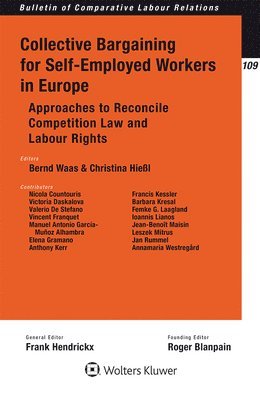
Collective Bargaining for Self-Employed Workers in Europe
Approaches to Reconcile Competition Law and Labour Rights
Founding Editor: Roger Blanpain
General Editor: Frank Hendrickx
Edited by Bernd Waas & Christina Hießl
The increase in the number of self-employed workers, partially in response to the advent of the platform economy, has raised the spectre of horizontal price-fixing by self-employed members of a profession. This perception, however, is at odds with international labour standards, under which self-employed persons should also be able to conclude collective agreements to some extent. It is now commonplace for companies to offer various forms of non-standard employment that shift risk from the labour engager to the labour provider – which may increase the likelihood of those workers to fall outside the legal concept of ‘employee’ and because of that affects their legal protection. Legal practitioners may then face a dilemma: what may be required under labour law may be prohibited under antitrust law.
In the first comprehensive analysis of these intensely debated issues, the authors argue that there is an urgent need to address the current legal puzzle, including through regulatory measures. This must include, in particular, the existing regulation at the level of the European Union (EU), which dominates competition law in the Member States.
The book combines an analysis of the supranational framework by experts in labour law as well as competition law with in-depth country reports from Member States of the EU in which regulations and/or practices of collective bargaining for the self-employed exist.
Among the many issues discussed in this book are the following:
collective bargaining and international labour rights; self-employed individuals and the concept of undertaking in EU competition law; the concept of ‘social dumping’; the importance of the case law of the European Court of Justice; the concept of ‘vulnerability’; competition authorities’ enforcement strategies and priorities; the concept of ‘false self-employed’; and the possible introduction of exemptions, presumptions, safe harbours, or smart regulation solutions in competition law.The book gives an insight into the legal situation in Austria, Belgium, France, Germany, Ireland, Italy, the Netherlands, Poland, Slovenia, Spain, and Sweden. These reports discuss the current practice of collective bargaining and how the current law is reflected in the academic discourse on the right of self-employed people to bargain collectively.
This important book, in its presentation of legally sound and effective ways to shape the application of the right to bargain collectively that are attuned to the business and technological realities of the twenty-first century, promotes an understanding of the consequences for current law and practice and offers a basis for a discussion of regulatory measures addressing existing challenges. Practitioners of labour law and competition law, national competition authorities, and other interested parties will benefit from the detailed analysis and extensive findings.
1 415 kr
Läs direkt efter köp
Collective Bargaining for Self-Employed Workers in Europe
Approaches to Reconcile Competition Law and Labour Rights
Founding Editor: Roger Blanpain
General Editor: Frank Hendrickx
Edited by Bernd Waas & Christina Hießl
The increase in the number of self-employed workers, partially in response to the advent of the platform economy, has raised the spectre of horizontal price-fixing by self-employed members of a profession. This perception, however, is at odds with international labour standards, under which self-employed persons should also be able to conclude collective agreements to some extent. It is now commonplace for companies to offer various forms of non-standard employment that shift risk from the labour engager to the labour provider – which may increase the likelihood of those workers to fall outside the legal concept of ‘employee’ and because of that affects their legal protection. Legal practitioners may then face a dilemma: what may be required under labour law may be prohibited under antitrust law.
In the first comprehensive analysis of these intensely debated issues, the authors argue that there is an urgent need to address the current legal puzzle, including through regulatory measures. This must include, in particular, the existing regulation at the level of the European Union (EU), which dominates competition law in the Member States.
The book combines an analysis of the supranational framework by experts in labour law as well as competition law with in-depth country reports from Member States of the EU in which regulations and/or practices of collective bargaining for the self-employed exist.
Among the many issues discussed in this book are the following:
collective bargaining and international labour rights; self-employed individuals and the concept of undertaking in EU competition law; the concept of ‘social dumping’; the importance of the case law of the European Court of Justice; the concept of ‘vulnerability’; competition authorities’ enforcement strategies and priorities; the concept of ‘false self-employed’; and the possible introduction of exemptions, presumptions, safe harbours, or smart regulation solutions in competition law.The book gives an insight into the legal situation in Austria, Belgium, France, Germany, Ireland, Italy, the Netherlands, Poland, Slovenia, Spain, and Sweden. These reports discuss the current practice of collective bargaining and how the current law is reflected in the academic discourse on the right of self-employed people to bargain collectively.
This important book, in its presentation of legally sound and effective ways to shape the application of the right to bargain collectively that are attuned to the business and technological realities of the twenty-first century, promotes an understanding of the consequences for current law and practice and offers a basis for a discussion of regulatory measures addressing existing challenges. Practitioners of labour law and competition law, national competition authorities, and other interested parties will benefit from the detailed analysis and extensive findings.
1 749 kr
Skickas inom 5-8 vardagar
1 485 kr
Läs direkt efter köp
1 485 kr
Läs direkt efter köp
Von Der Bereichsausnahme Zur Bereichseinschraenkung
Grundfragen Der Dogmatischen Integration Des Individualarbeitsrechts in Das Recht Der Allgemeinen Geschaeftsbedingungen
984 kr
Tillfälligt slut
Die Befristung Von Arbeitsverhaeltnissen in Deutschland Und Frankreich
Eine Rechtsvergleichende Betrachtung
588 kr
Tillfälligt slut
Schadensersatz Und Entschaedigung in Folge Von Diskriminierung Im Deutschen Und Englischen Arbeitsrecht
Eine Rechtsvergleichende Studie Unter Beruecksichtigung Des Europarechts
539 kr
Tillfälligt slut
2 285 kr
Tillfälligt slut