Bhaskar Nath - Böcker
Visar alla böcker från författaren Bhaskar Nath. Handla med fri frakt och snabb leverans.
7 produkter
7 produkter
Environmental Management in Practice: Vol 1
Instruments for Environmental Management
Inbunden, Engelska, 1998
4 812 kr
Skickas inom 10-15 vardagar
Focuses on the instruments and tools currently available to the environmental manager. A theoretical background to the instruments is given together with an overview of those instruments that are in common use today, with particular attention to the physical, economic, legislative and communication instruments.
Environmental Management in Practice: Vol 2
Compartments, Stressors and Sectors
Inbunden, Engelska, 1999
4 673 kr
Skickas inom 10-15 vardagar
Volume 2: Compartments, Stressors and Sectors, deals with the problems that occur in the three 'compartments' of the environment, namely air, water and soil. The contributors also address the socio-economic sectors of industry, traffic, energy, agriculture and tourism.
5 687 kr
Skickas inom 10-15 vardagar
Volume 3: Managing the Ecosystem focuses on those ecosystems in which human intervention has been or continues to be predominant, specifically within cities and rural areas.
Del 75 - NATO Science Partnership Subseries: 2
Sustainable Solid Waste Management in the Southern Black Sea Region
Inbunden, Engelska, 2000
1 064 kr
Skickas inom 10-15 vardagar
For historical and socio-economic reasons, the countries of the southern Black Sea region are facing mounting and apparently intractable problems in managing their solid waste, with increasingly serious implications for public health and quality of life, as well as the wider socio-economic development of the region. Hitherto, no comprehensive, systematic study of the problem seems to have been conducted, to determine the underlying causes and suggesting how it might be alleviated in socially and economically viable ways, aiming at sustainability. This book, the proceedings of a NATO Advanced Research Workshop based in Sofia, Bulgaria, analyzes the causes of the poor state of solid waste management in the region, identifying feasible modalities with which at least a degree of sustainability could be achieved in the management of the region's solid waste.
1 064 kr
Skickas inom 10-15 vardagar
For historical and socio-economic reasons, the countries of the southern Black Sea region are facing mounting and apparently intractable problems in managing their solid waste, with increasingly serious implications for public health and quality of life, as well as the wider socio-economic development of the region. Hitherto, no comprehensive, systematic study of the problem seems to have been conducted, to determine the underlying causes and suggesting how it might be alleviated in socially and economically viable ways, aiming at sustainability. This book, the proceedings of a NATO Advanced Research Workshop based in Sofia, Bulgaria, analyzes the causes of the poor state of solid waste management in the region, identifying feasible modalities with which at least a degree of sustainability could be achieved in the management of the region's solid waste.
1 593 kr
Skickas inom 10-15 vardagar
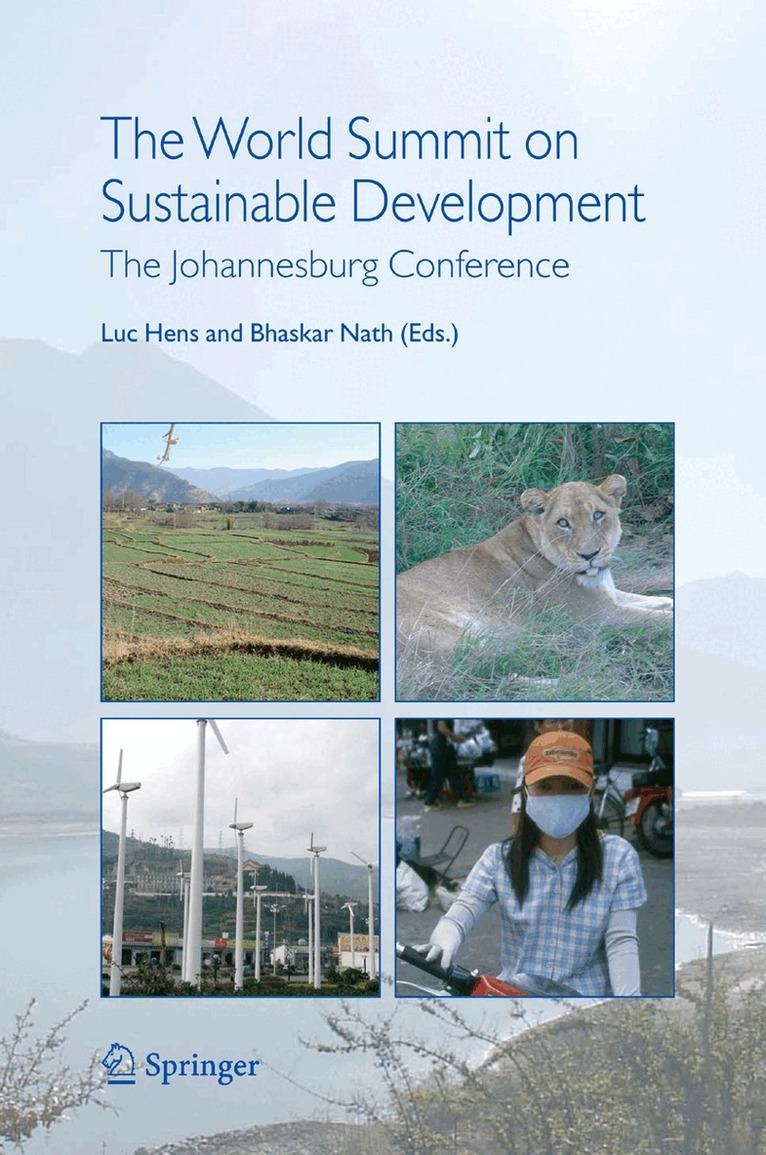
The Johannesburg Earth Summit, which took place in the summer of 2002, confirmed the irreversible nature of the process that is founded upon the concept of Sustainable Development initially given form at Rio de Janeiro ten years earlier. This process is to be welcomed, while at the same time recognising the tremendous work that has taken place in converting this concept into a more concrete vision. The Sustainable Development concept relates to every human activity, covering the social, economic and ecological dimensions, which are often in conflict. Consequently, it is most important to include in research programmes some thought of the way people behave. In theory, the general elements of this inclusion are relatively easily defined. However, assessing the effects of one or another decision on all the interactions between the social, economic and ecological dimensions involves significant difficulties. All the more since we have to recognise, in all modesty, that humanity has not always excelled in the art of forward studies. In fact, the Precautionary Principle was introduced partly as a reaction to the sometimes blind confidence in technology and logic (even if it is sometimes invoked in an exaggerated manner). Nevertheless, the duty to act for the sake of present and future generations is pressing. Throughout history mankind has had to adapt and to innovate. Now, at st the beginning of the 21 century the urgent need for such adaptations is obvious.
1 564 kr
Skickas inom 5-8 vardagar
The Johannesburg Earth Summit, which took place in the summer of 2002, confirmed the irreversible nature of the process that is founded upon the concept of Sustainable Development initially given form at Rio de Janeiro ten years earlier. This process is to be welcomed, while at the same time recognising the tremendous work that has taken place in converting this concept into a more concrete vision. The Sustainable Development concept relates to every human activity, covering the social, economic and ecological dimensions, which are often in conflict. Consequently, it is most important to include in research programmes some thought of the way people behave. In theory, the general elements of this inclusion are relatively easily defined. However, assessing the effects of one or another decision on all the interactions between the social, economic and ecological dimensions involves significant difficulties. All the more since we have to recognise, in all modesty, that humanity has not always excelled in the art of forward studies. In fact, the Precautionary Principle was introduced partly as a reaction to the sometimes blind confidence in technology and logic (even if it is sometimes invoked in an exaggerated manner). Nevertheless, the duty to act for the sake of present and future generations is pressing. Throughout history mankind has had to adapt and to innovate. Now, at st the beginning of the 21 century the urgent need for such adaptations is obvious.