Blaine J. Fowers - Böcker
Visar alla böcker från författaren Blaine J. Fowers. Handla med fri frakt och snabb leverans.
7 produkter
7 produkter
896 kr
Kommande
Human friendship has been millions of years in the making, and evolutionary science richly reveals that deep history. Yet close friendship is a puzzle to evolutionary scientists because they misconstrue close relationships in strictly means-ends terms. Although social science offers sophisticated methods, it is limited by impoverished theory imbued with the unacknowledged assumptions of individualism and instrumentalism. In this book, Blaine Fowers argues that such egocentric and instrumental portrayals are not only erroneous--they also undermine good relationships.Flourishing and Friendship presents an interdisciplinary theory of friendship that draws on psychological science, Aristotle's theory, evolutionary science, attachment science, and identity theory. It is informed by historical, cultural, and philosophical perspectives on close relationships. Aristotle's concept of virtue friendship offers theoretically rich solutions to the difficulties plaguing social scientists today, but his conceptual framework can be significantly enhanced with the ample content of evolutionary science, attachment science, and identity theory, as well as the powerful methods of social science. For example, evolutionary and attachment sciences bolster the nature fulfillment basis of Aristotle's ethics. Friendship can be fruitfully framed as a type of attachment. Identity theory contextualizes friendships in social networks and cultures.Fowers put these various perspectives into conversation to produce an integrated theory of friendship. This theory recasts the too familiar and inadequate contemporary Western concept of friendship into a uniquely evolved capacity for inherently valuable and shared activity in the service of a good human life.
875 kr
Skickas inom 7-10 vardagar
In many ways, the virtue of courage seems to be one of the most ubiquitous and simple virtues, and that apparent simplicity may result in courage garnering less attention than many other virtues. Another reason could be the ancient focus on courage as a masculine and martial virtue, which brings into question its relevance in contemporary society. However, the contributors to this volume show, in vibrant and compelling ways, that all these presumptions are invalid. They demonstrate that courage is anything but simple, as important to women as to men, far broader than the martial realm, and that it has great relevance to many contemporary concerns.The Aristotelian perspective is the most well-known philosophical approach to virtues. According to this approach, courage is flanked by the vices of deficiency (cowardice) and excess (rashness) and can be understood in terms of the values it maintains or protects, with greater risks justified by greater importance of the value at stake. But this is not the only way to understand courage: While some chapters follow a neo-Aristotelian line in their presentation, others also offer Stoic, Confucian, Christian or Thomist, Jewish, and African perspectives, which bring other important insights about courage in personal, political, and spiritual realms to the fore-such as the communal, ethnic, and religious elements of courage. Other chapters ask what place courage has in healthcare or contemporary career development, and how courage might be applied to ordinary citizens as well as leaders in contemporary liberal democracies. These essays make it clear that reflections on courage are highly salient in the wake of the recent COVID-19 pandemic, ongoing global political unrest, and profound uncertainty about the future, as it is courage that enables people to advance and protect so many human values, whether the risks are physical, psychological, or social.
319 kr
Skickas inom 5-8 vardagar
In many ways, the virtue of courage seems to be one of the most ubiquitous and simple virtues, and that apparent simplicity may result in courage garnering less attention than many other virtues. Another reason could be the ancient focus on courage as a masculine and martial virtue, which brings into question its relevance in contemporary society. However, the contributors to this volume show, in vibrant and compelling ways, that all these presumptions are invalid. They demonstrate that courage is anything but simple, as important to women as to men, far broader than the martial realm, and that it has great relevance to many contemporary concerns.The Aristotelian perspective is the most well-known philosophical approach to virtues. According to this approach, courage is flanked by the vices of deficiency (cowardice) and excess (rashness) and can be understood in terms of the values it maintains or protects, with greater risks justified by greater importance of the value at stake. But this is not the only way to understand courage: While some chapters follow a neo-Aristotelian line in their presentation, others also offer Stoic, Confucian, Christian or Thomist, Jewish, and African perspectives, which bring other important insights about courage in personal, political, and spiritual realms to the fore-such as the communal, ethnic, and religious elements of courage. Other chapters ask what place courage has in healthcare or contemporary career development, and how courage might be applied to ordinary citizens as well as leaders in contemporary liberal democracies. These essays make it clear that reflections on courage are highly salient in the wake of the recent COVID-19 pandemic, ongoing global political unrest, and profound uncertainty about the future, as it is courage that enables people to advance and protect so many human values, whether the risks are physical, psychological, or social.
706 kr
Skickas inom 5-8 vardagar
In the twentieth century, the practice of psychology has usually been based on a scientific or objective theory of human behavior. Today, an influential countermovement, often called social constructionism, argues that there is no basis for our beliefs or values beyond the swirl of meanings and practices in a particular community or era. Re-envisioning Psychology examines the increasing dissatisfaction with both scientific and social constructionist viewpoints and presents a sweeping new vision of theory and practice in psychology. "Re-envisioning Psychology is a breath of fresh air, a clear and resounding voice that provides an intellectual and moral direction that, if heeded and built upon, could lead psychology out of the confusion and political collusion in which it is currently mired. Richardson, Fowers, and Guignon have imaginatively applied interpretive and dialogic concepts to the most troubling aspects of theory and practice. If psychology is going to be saved from its own worst tAndencies, this book will be an indispensable element in its turning."--Philip Cushman, associate professor, California School of Professional Psychology and author of Constructing the Self, Constructing America: A Cultural History of Psychotherapy
Beyond the Myth of Marital Happiness
How Embracing the Virtues of Loyalty, Generosity, Justice, and Courage Can Strengthen Your Relationship
Häftad, Engelska, 2000
282 kr
Skickas inom 5-8 vardagar
According to psychologist Blaine Fowers, the myth of marital happiness-that good communication, emotional gratification, and intimacy result in a healthy relationship-has made marriages more fragile than ever before and we must let it go. Does this mean that we should give up on love, satisfaction, intimacy, emotional support, good communication, and good sex in marriage? That marriage must be continued solely on the basis of grim commitment? That no one should divorce? Not at all. Instead, Dr. Fowers shows how we can re-envision marriage as a wonderful opportunity to practice the virtues of friendship, loyalty, generosity, and justice in the shared pursuit of our deepest ideals.
1 158 kr
Skickas inom 7-10 vardagar
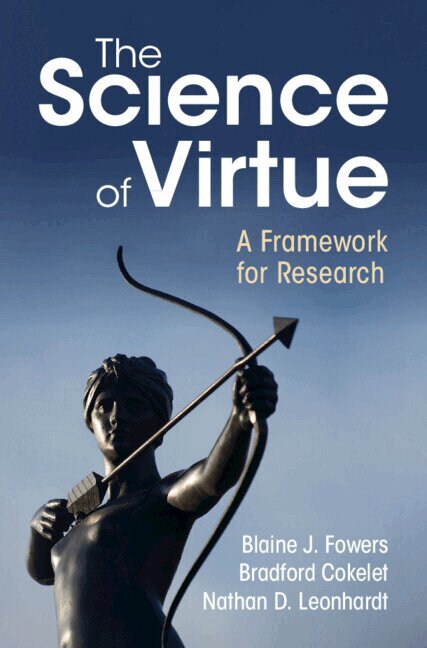
Integrating psychological and philosophical research on virtue and moral development, this book presents a real-world program for virtue science. Offering empirically testable hypotheses, the chapters deliver theoretical and methodological guidance that shows how existing research can become a cohesive and truly interdisciplinary science of virtue. The authors' unique 'STRIVE-4 Model' defines a unifying conceptual framework, making the book an indispensable resource for a new generation of scholars and students. This empirically tested model provides the much-needed foundation that can put to rest traditional worries about moral science. While mapping out the relevant areas of psychology and value-focused inquiry, the book lays out an interdisciplinary approach to many questions, including the problem of knowledge about character. Written for those researching virtue drawing on personality, developmental, moral, and positive psychology, as well as moral philosophy and character education, the book demonstrates the importance and applications of studying virtues empirically.
374 kr
Skickas inom 7-10 vardagar
Integrating psychological and philosophical research on virtue and moral development, this book presents a real-world program for virtue science. Offering empirically testable hypotheses, the chapters deliver theoretical and methodological guidance that shows how existing research can become a cohesive and truly interdisciplinary science of virtue. The authors' unique 'STRIVE-4 Model' defines a unifying conceptual framework, making the book an indispensable resource for a new generation of scholars and students. This empirically tested model provides the much-needed foundation that can put to rest traditional worries about moral science. While mapping out the relevant areas of psychology and value-focused inquiry, the book lays out an interdisciplinary approach to many questions, including the problem of knowledge about character. Written for those researching virtue drawing on personality, developmental, moral, and positive psychology, as well as moral philosophy and character education, the book demonstrates the importance and applications of studying virtues empirically.