Brad S Gregory - Böcker
Visar alla böcker från författaren Brad S Gregory. Handla med fri frakt och snabb leverans.
6 produkter
6 produkter
Rebel in the Ranks
Martin Luther, the Reformation, and the Conflicts That Continue to Shape Our World
Häftad, Engelska, 2018
169 kr
Skickas inom 5-8 vardagar
397 kr
Skickas inom 10-15 vardagar
While religious history and intellectual history are both active, dynamic fields of contemporary historical inquiry, historians of ideas and historians of religion have too often paid little attention to one another's work. The intellectual historian Quentin Skinner urged scholars to attend to the contexts as well as the texts of authors, in order to 'see things their way.' Where religion is concerned, however, historians have often failed to heed this good advice; this book helps to remedy that failure. The editors and contributors urge intellectual historians to explore the religious dimensions of ideas and at the same time commend the methods of intellectual history to historians of religion. The introduction is followed by an essay by Brad Gregory reflecting on issues related to the study of the history of religious ideas. Subsequent essays by John Coffey, Anna Sapir Abulafia, Howard Hotson, Richard A. Muller, and Willem J. van Asselt explore the importance of religion in the intellectual history of Great Britain and Europe in the medieval and early modern periods. James Bradley shifts forward with his essay on religious ideas in Enlightenment England. Mark Noll and Alister Chapman deal respectively with British influence on the writing of religious history in America and with the relationship between intellectual history and religion in modern Britain. David Bebbington provides a concluding reflection on the challenges inherent in restoring the centrality of religion to intellectual history.
Journeys of Faith
Evangelicalism, Eastern Orthodoxy, Catholicism, and Anglicanism
Häftad, Engelska, 2012
235 kr
Skickas inom 5-8 vardagar
Research indicates that, on average, Americans change their religious affiliation at least once during their lives. Journeys of Faith examines the movement between four Christian traditions and what led believers to make a shift. Four prominent converts to Eastern Orthodoxy, Catholicism, Evangelicalism and Anglicanism describe their new faith traditions and doctrines and their spiritual journeys into them. Response chapters offer respectful critiques.Contributors include:Wilbur Ellsworth (Eastern Orthodoxy), with a response by Craig BlaisingFrancis J. Beckwith (Roman Catholicism), with Gregg Allison respondingChris Castaldo (Evangelicalism) and Brad S. Gregory's Catholic responseLyle W. Dorsett (Anglicanism), with a response by Robert A. Peterson.This book provides you with a series of first-hand accounts of thoughtful Christians changing religious affiliation or remaining true to the traditions they have always known and their rationale for those decisions. Gain a wealth of insight into the attractions of each of the represented denominations and an understanding of the current faith migration within the church today.
Del 134 - Harvard Historical Studies
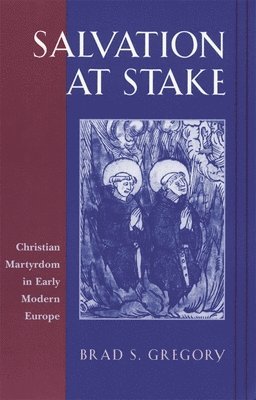
Salvation at Stake
Christian Martyrdom in Early Modern Europe
Häftad, Engelska, 2001
311 kr
Skickas inom 7-10 vardagar
Thousands of men and women were executed for incompatible religious views in sixteenth-century Europe. The meaning and significance of those deaths are studied here comparatively for the first time, providing a compelling argument for the importance of martyrdom as both a window onto religious sensibilities and a crucial component in the formation of divergent Christian traditions and identities.Brad S. Gregory explores Protestant, Catholic, and Anabaptist martyrs in a sustained fashion, addressing the similarities and differences in their self-understanding. He traces the processes and impact of their memorialization by co-believers, and he reconstructs the arguments of the ecclesiastical and civil authorities responsible for their deaths. In addition, he assesses the controversy over the meaning of executions for competing views of Christian truth, and the intractable dispute over the distinction between true and false martyrs. He employs a wide range of sources, including pamphlets, martyrologies, theological and devotional treatises, sermons, songs, woodcuts and engravings, correspondence, and legal records. Reconstructing religious motivation, conviction, and behavior in early modern Europe, Gregory shows us the shifting perspectives of authorities willing to kill, martyrs willing to die, martyrologists eager to memorialize, and controversialists keen to dispute.
379 kr
Tillfälligt slut
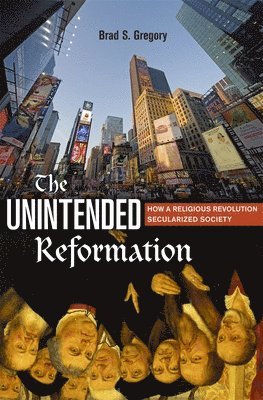
In a work that is as much about the present as the past, Brad Gregory identifies the unintended consequences of the Protestant Reformation and traces the way it shaped the modern condition over the course of the following five centuries. A hyperpluralism of religious and secular beliefs, an absence of any substantive common good, the triumph of capitalism and its driver, consumerism—all these, Gregory argues, were long-term effects of a movement that marked the end of more than a millennium during which Christianity provided a framework for shared intellectual, social, and moral life in the West.Before the Protestant Reformation, Western Christianity was an institutionalized worldview laden with expectations of security for earthly societies and hopes of eternal salvation for individuals. The Reformation’s protagonists sought to advance the realization of this vision, not disrupt it. But a complex web of rejections, retentions, and transformations of medieval Christianity gradually replaced the religious fabric that bound societies together in the West. Today, what we are left with are fragments: intellectual disagreements that splinter into ever finer fractals of specialized discourse; a notion that modern science—as the source of all truth—necessarily undermines religious belief; a pervasive resort to a therapeutic vision of religion; a set of smuggled moral values with which we try to fertilize a sterile liberalism; and the institutionalized assumption that only secular universities can pursue knowledge.The Unintended Reformation asks what propelled the West into this trajectory of pluralism and polarization, and finds answers deep in our medieval Christian past.
223 kr
Skickas inom 7-10 vardagar
In a work that is as much about the present as the past, Brad Gregory identifies the unintended consequences of the Protestant Reformation and traces the way it shaped the modern condition over the course of the following five centuries. A hyperpluralism of religious and secular beliefs, an absence of any substantive common good, the triumph of capitalism and its driver, consumerism—all these, Gregory argues, were long-term effects of a movement that marked the end of more than a millennium during which Christianity provided a framework for shared intellectual, social, and moral life in the West.Before the Protestant Reformation, Western Christianity was an institutionalized worldview laden with expectations of security for earthly societies and hopes of eternal salvation for individuals. The Reformation’s protagonists sought to advance the realization of this vision, not disrupt it. But a complex web of rejections, retentions, and transformations of medieval Christianity gradually replaced the religious fabric that bound societies together in the West. Today, what we are left with are fragments: intellectual disagreements that splinter into ever finer fractals of specialized discourse; a notion that modern science—as the source of all truth—necessarily undermines religious belief; a pervasive resort to a therapeutic vision of religion; a set of smuggled moral values with which we try to fertilize a sterile liberalism; and the institutionalized assumption that only secular universities can pursue knowledge.The Unintended Reformation asks what propelled the West into this trajectory of pluralism and polarization, and finds answers deep in our medieval Christian past.