Byron Ellsworth Hamann - Böcker
Visar alla böcker från författaren Byron Ellsworth Hamann. Handla med fri frakt och snabb leverans.
4 produkter
4 produkter
Bad Christians, New Spains
Muslims, Catholics, and Native Americans in a Mediterratlantic World
Inbunden, Engelska, 2019
2 113 kr
Skickas inom 10-15 vardagar
This book centers on two inquisitorial investigations, both of which began in the 1540s. One involved relations of Europeans and Native Americans in the Oaxacan town of Yanhuitlán (in New Spain, today’s Mexico). The other involved relations of Moriscos (recent Muslim converts to Catholicism) and Old Christians (people with deep Catholic ancestries) in the Mediterranean kingdom of Valencia (in the "old" Spain).Although separated by an ocean, the social worlds preserved in these inquisitorial files share many things. By bringing the two inquisitions together, Hamann reveals how very local practices and debates had long-distance parallels, parallels that reveal larger entanglements of the early modern world. Through a dialogue of two microhistories, he presents a macrohistory of large-scale social transformation. We see how attempts in both places to turn old worlds into new ones were centered on struggles over materiality and temporality. By paying close attention to theories (and practices) of reduction and conversion, Hamann suggests we can move beyond anachronistic models of social change as colonization, and place early modern concepts of time and history at the center of our understandings of the sixteenth-century past. Overall, this project intervenes in major debates from both history and anthropology: about the writing of global histories, our conceptualizations of the colonial, the nature of religious and cultural change, and the roles of material things in social life and the imagination of time.
Bad Christians, New Spains
Muslims, Catholics, and Native Americans in a Mediterratlantic World
Häftad, Engelska, 2021
632 kr
Skickas inom 10-15 vardagar
This book centers on two inquisitorial investigations, both of which began in the 1540s. One involved relations of Europeans and Native Americans in the Oaxacan town of Yanhuitlán (in New Spain, today’s Mexico). The other involved relations of Moriscos (recent Muslim converts to Catholicism) and Old Christians (people with deep Catholic ancestries) in the Mediterranean kingdom of Valencia (in the "old" Spain).Although separated by an ocean, the social worlds preserved in these inquisitorial files share many things. By bringing the two inquisitions together, Hamann reveals how very local practices and debates had long-distance parallels, parallels that reveal larger entanglements of the early modern world. Through a dialogue of two microhistories, he presents a macrohistory of large-scale social transformation. We see how attempts in both places to turn old worlds into new ones were centered on struggles over materiality and temporality. By paying close attention to theories (and practices) of reduction and conversion, Hamann suggests we can move beyond anachronistic models of social change as colonization, and place early modern concepts of time and history at the center of our understandings of the sixteenth-century past. Overall, this project intervenes in major debates from both history and anthropology: about the writing of global histories, our conceptualizations of the colonial, the nature of religious and cultural change, and the roles of material things in social life and the imagination of time.
Invention of the Colonial Americas
Data, Architecture, and the Archive of the Indies, 1781-1844
Inbunden, Engelska, 2022
517 kr
Skickas inom 7-10 vardagar
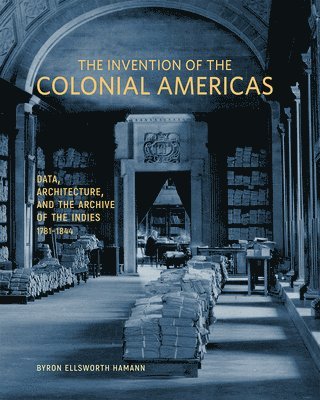
The Invention of the Colonial Americas is an architectural history and media-archaeological study of changing theories and practices of government archives in Enlightenment Spain. It centers on an archive created in Seville for storing Spain's pre-1760 documents about the New World. To fill this new archive, older archives elsewhere in Spain-spaces in which records about American history were stored together with records about European history-were dismembered. The Archive of the Indies thus constructed a scholarly apparatus that made it easier to imagine the history of the Americas as independent from the history of Europe, and vice versa. In this meticulously researched book, Byron Ellsworth Hamann explores how building layouts, systems of storage, and the arrangement of documents were designed to foster the creation of new knowledge. He draws on a rich collection of eighteenth-century architectural plans, descriptions, models, document catalogs, and surviving buildings to present a literal, materially precise account of archives as assemblages of spaces, humans, and data-assemblages that were understood circa 1800 as capable of actively generating scholarly innovation.
Translations of Nebrija
Language, Culture, and Circulation in the Early Modern World
Häftad, Engelska, 2015
347 kr
Skickas inom 7-10 vardagar
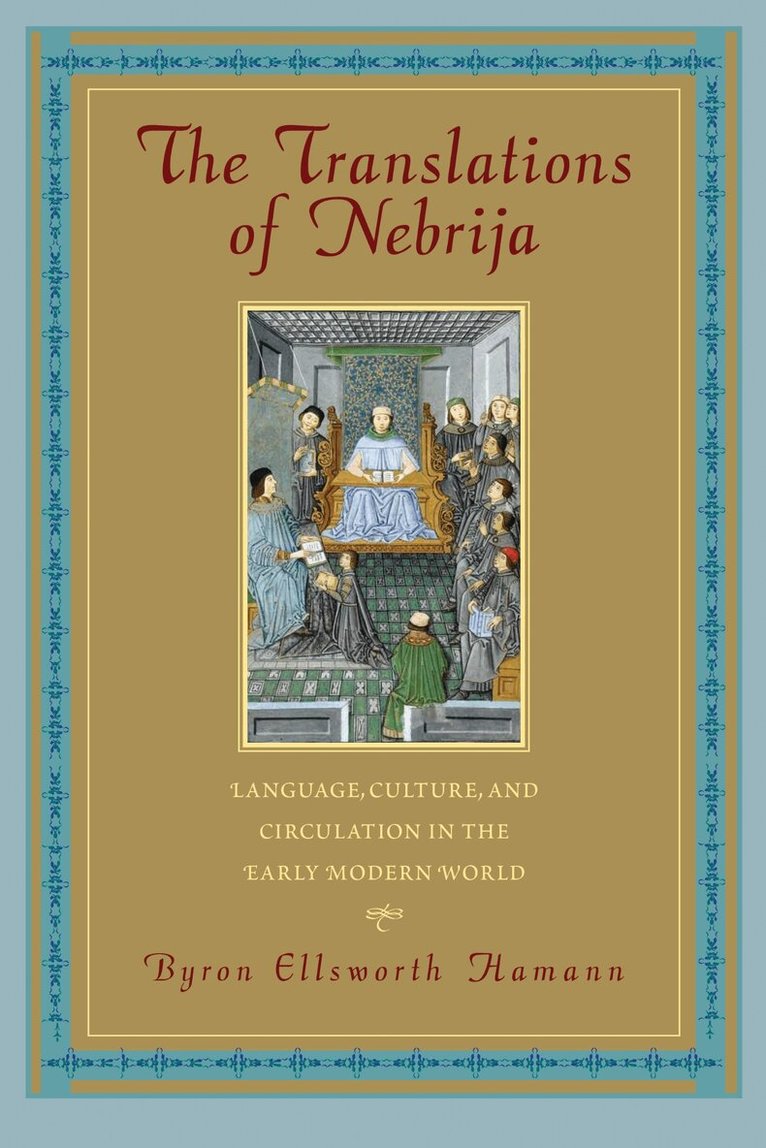
In 1495, the Spanish humanist Antonio de Nebrija published a Spanish-to-Latin dictionary that became a best seller. Over the next century it was revised dozens of times, in nine European cities. As these dictionaries made their way around the globe in this age of encounters, their lists of Spanish words became frameworks for dictionaries of non-Latin languages. What began as Spanish to Latin became Spanish to Arabic, French, English, Tuscan, Nahuatl, Mayan, Quechua, Aymara, Tagalog, and more.Tracing the global influence of Nebrija's dictionary, Byron Ellsworth Hamann, in this interdisciplinary, deeply researched book, connects pagan Rome, Muslim Spain, Aztec Tenochtitlan, Elizabethan England, the Spanish Philippines, and beyond, revealing new connections in world history. The Translations of Nebrija re-creates the travels of people, books, and ideas throughout the early modern world and reveals the adaptability of Nebrija's text, tracing the ways heirs and pirate printers altered the dictionary in the decades after its first publication. It reveals how entries in various editions were expanded to accommodate new concepts, such as for indigenous languages in the Americas -- a process with profound implications for understanding pre-Hispanic art, architecture, and writing. It shows how words written in the margins of surviving dictionaries from the Americas shed light on the writing and researching of dictionaries across the early modern world.Exploring words and the dictionaries that made sense of them, this book charts new global connections and challenges many assumptions about the early modern world.