C. de Loore - Böcker
Visar alla böcker från författaren C. de Loore. Handla med fri frakt och snabb leverans.
10 produkter
10 produkter
Del 179 - Astrophysics and Space Science Library
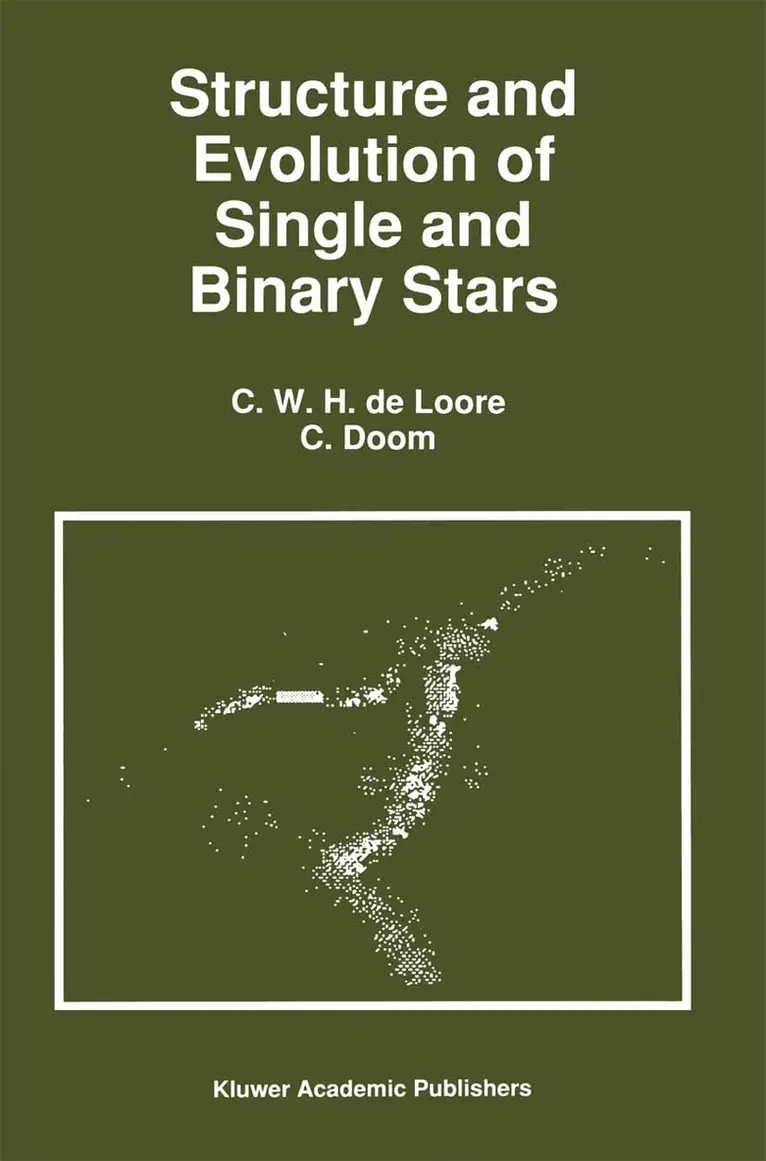
Structure and Evolution of Single and Binary Stars
Inbunden, Engelska, 1992
2 101 kr
Skickas inom 10-15 vardagar
Classical stellar evolution theories have undergone some drastic changes in recent decades. New insights into the development of stellar interiors were obtained from studying stars in various stages of thei lives, as well as with the help of fast computers, which gave the boost to the branch of numerical modelling of stellar structure and evolution. This book is divided into two parts. The first part deals with the general aspects of stellar structure and evolution including information on numerical modelling. The second part deals with specific evolutionary aspects of single and binary stars with a variety of masses. The last chapter gives several models of stars with specific masses. The text is intended as an introduction to students as well as a reference to researchers.
Del 179 - Astrophysics and Space Science Library
Structure and Evolution of Single and Binary Stars
Häftad, Engelska, 1992
2 101 kr
Skickas inom 10-15 vardagar
Classical stellar evolution theories have undergone some drastic changes in recent decades. New insights into the development of stellar interiors were obtained from studying stars in various stages of their lives, as well as with the help of fast computers, which gave the boost to the branch of numerical modelling of stellar structure and evolution. This book is divided into two parts. The first part deals with the general aspects of stellar structure and evolution including infomation on numerical modelling. The second part deals with specific evolutionary aspects of single and binary stars with a variety of masses. The last chapter gives several models of stars with specific masses. The text is intended as an introduction to students as well as a reference to researchers.
536 kr
Skickas inom 10-15 vardagar
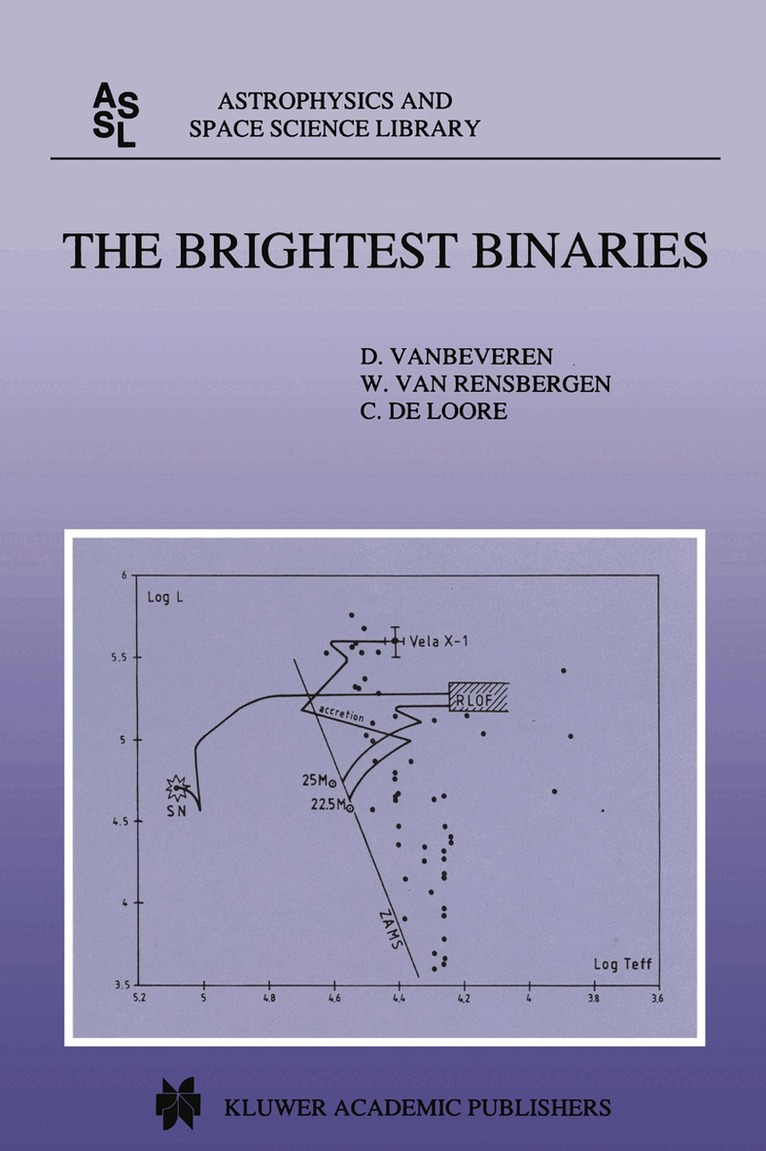
The evolution of galaxies is governed mainly by the evolution of massive stars whereas the evolution of a massive star depends primarily on its mass, chemical composition and on whether or not the star is a Single object or a binary component. To study the evolution of galaxies, it is therefore essential to know how stellar masses are distributed at birth, how many stars are formed in binaries, and what the mass ratio and orbital period distribution of binaries look like. Massive stars are intrinsically the brightest stars, so that it may be possible to discover their properties in distant groups prOvided that large telescopes can be used for basic stellar observations. However, until now the observations of massive stars have been reasonably complete only for a small region of our own Galaxy (~ 3 kpc from the Sun). One hopes that the conclusions resulting from these observations hold for the whole Galaxy, for the whole cosmos. With 'The Brightest Stars' of De Jager (1980) in mind, the present monograph is an addendum and an update in which we discuss the observations of 'The Brightest Binaries' in the framework of stellar evolution. A small or intermediate mass star close to the Sun may look brighter than a massive one far away. However, within volume limited star samples, the massive stars are on average also the brightest ones. In the present monograph (similarly as in the work of De Jager), bright means massive. The book consists of four main chapters.
536 kr
Skickas inom 10-15 vardagar
The Proceedings of the 17th International Cosmic Ray Conference held in Paris, July 15 to 25, 1981, appear in two sets. The Regular Volumes, 1 to 8, contain contributed papers received at the Secretariat by April 1st, 1981. They were issued at the opening of the Conference. The Late Volumes, 9 to 14, contain contributed papers received after that date, Invited and Rapporteur Talks, and the General Index. The assiduous reader will notice several changes with respect to the well-established traditions of the Conference. 1/ Following a recommendation of the Commission an Cosmic Rays of IUPAP, and although an increase in the total number of papers submitted was noticed as compared to the 16th ICRC (Kyoto, 1979), the total number of pages has been significantly reduced, thanks to introduction of three new rules for publication. (i) None of the first "Preliminary" Abstracts was published. These abstracts had to be confirmed, either by a new "Confirming Abstract" or by a Full Paper. The Confirming Abstracts are included in the Proceedings. (ii) The sum of the "fractional" contributions of each author should not exceed 3 papers, and each author should not appear in more than 10 papers. (iii) The maximum number of pages per paper was reduced from 6 to 4. The Organizing Committee thanks all authors who have, in their vast majority, very efficiently cooperated by kindly complying with these new rules. The papers we selected an the basis of the Preliminary Abstracts.
536 kr
Skickas inom 10-15 vardagar
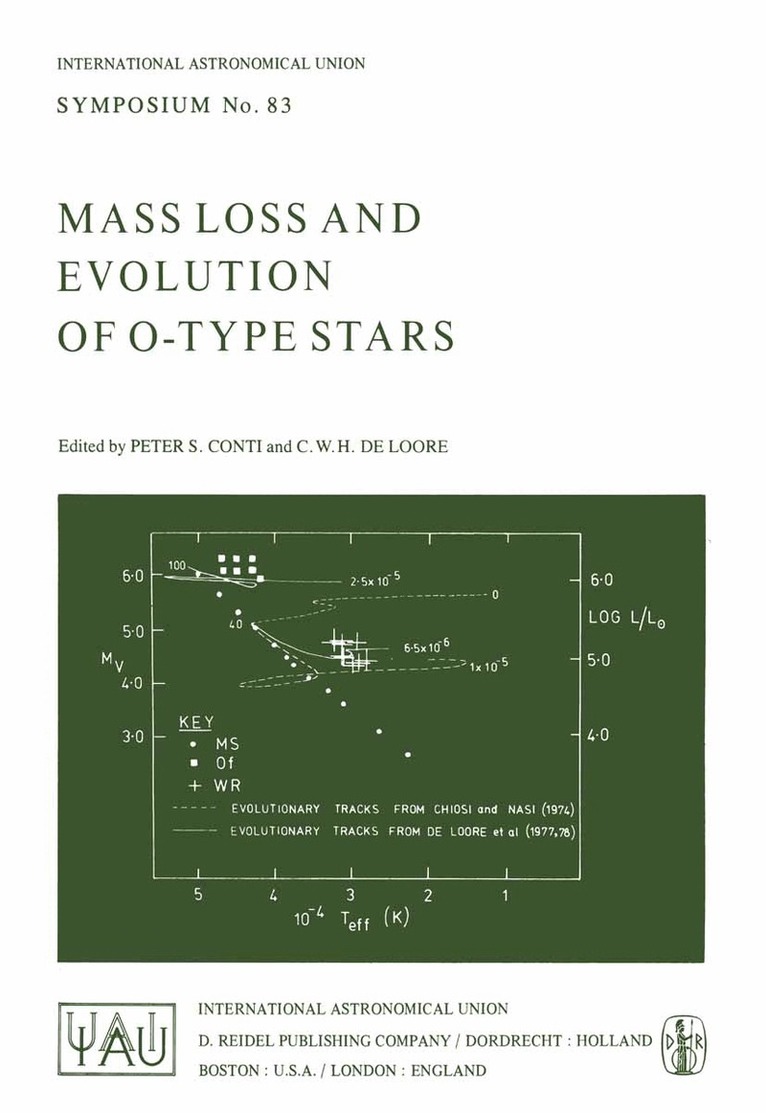
The organization of this Symposium had its beginnings at the International Astronomical Union General Assembly in Grenoble in 1976. The initial "rounding up" of the Scienti fic Organizing Committee was begun by Drs. Snow and Swings; most of us who became the eventual organizing committee met a few times during the Assembly and formulated the essential outlines of the meeting. Extensive correspondence with all the committee subsequently established the program. The idea was to bring together both observers and theoreticians to discuss the stellar winds and mass loss rates and their effects on evolutions of O-type stars. On the observational side, there are now spectroscopic data from the far UV to the near IR regions concerning the stellar winds. There is also information about the free-free emission in the wind from the IR and radio portions of the spectrum. Fortunately, these different detection methods give more or less the same mass loss rate for the one star, s Pup" which has been observed at all wavelengths. One of the intents of the first three sessions of this Symposium is to outline the eXisting data on mass loss rates as it per tains to the O-type stars.
1 064 kr
Skickas inom 10-15 vardagar
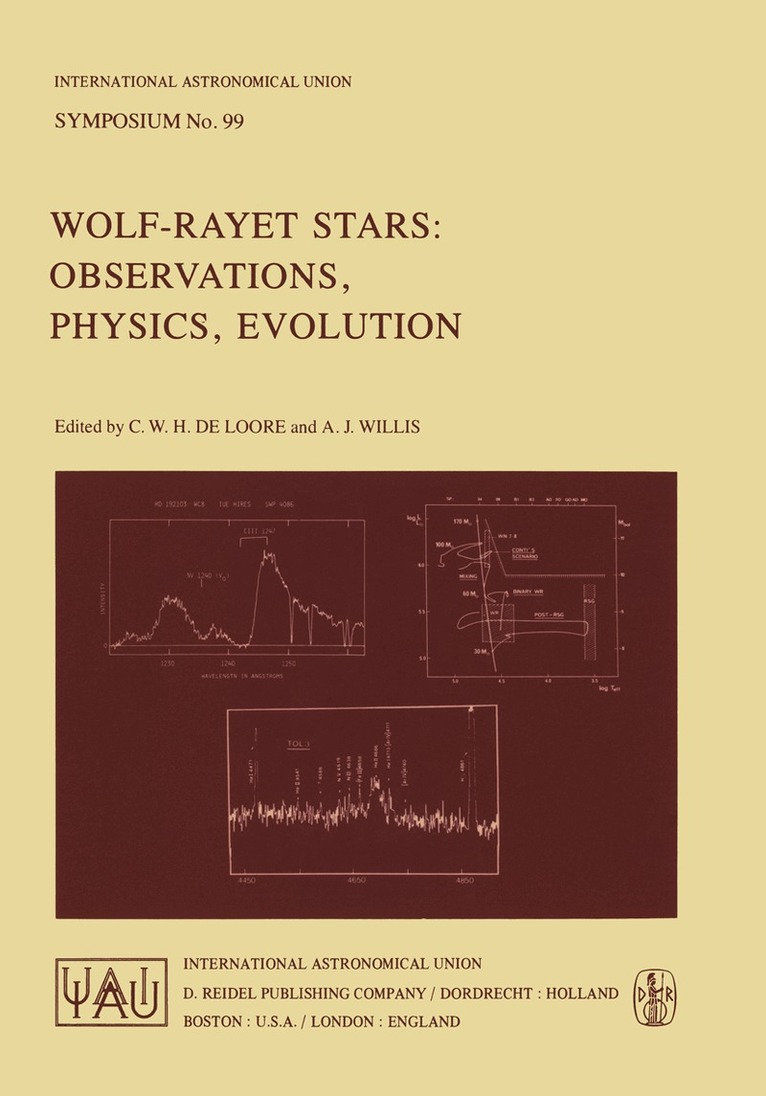
The formative ideas for this symposium originated in 1978 at the IAU Symposium No. 83 on "Mass Loss and Evolution of O-type Stars" held at Qualicum Beach, Vancouver Island, Canada - WR stars generally figure prominently in O-star meetings and vice versa! Following general appro val by the IAU Executive Committee the initial ideas were cemented at a subsequent meeting, IAU Colloquium No. 59 on "The Effects of Mass Loss on Stellar Evolution", held at Miramare, Trieste, Italy in 1980, which was attended by the ma,jority of the present Scientific Organising Committee and at which meeting the outline programme for this symposium was formulated. 1981 was considered an appropriate year in which to hold a meeting on WR stars, since the last IAU Symposium devoted to this stellar class had been held a decade earlier, in Buenos Aires (IAU Sym posium No. 49), and during this intervening period a wealth of new observational material had been obtained for WR stars together with significant advances on the theoretical front. The venue for this sym posium was chosen from the requirement, which can be inferred from the above, that a meeting on 'hot' stars take place in an appropriate, sunny climate and followed upon the excellent suggestion of Dr. C. Firmani to hold the symposium in Mexico.
2 101 kr
Skickas inom 10-15 vardagar
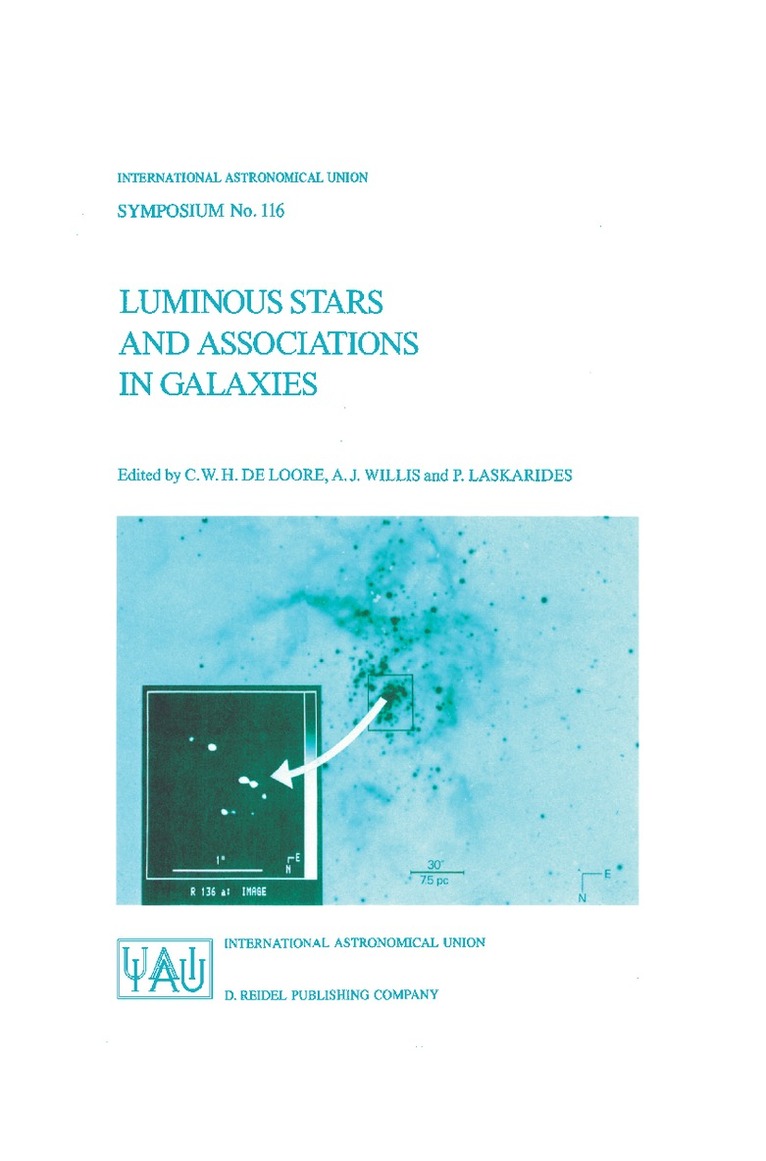
Proceedings of the 116th Symposium of the International Astronomical Union, held at Porto Heli, Greece, May 26-31, 1985
2 101 kr
Skickas inom 10-15 vardagar
Proceedings of the 116th Symposium of the International Astronomical Union, held at Porto Heli, Greece, May 26-31, 1985
1 064 kr
Skickas inom 10-15 vardagar
Massive stars occupy an exceptional place in general astrophysics. They trigger many if not all of the important processes in galactic evolution whereas due to their intrinsic brightness, they offer the (only until now) possibility to study the stellar content and stellar behaviour in distant galaxies. The last, say, 25 years, massive stars have been the subject of numerous meetings discussing the influence of massive stars on population synthesis, the number distribution of different types of massive stars, the LBV phenomenon, WR stars, X-ray binaries, stellar winds in massive stars, chemical pecularities in massive stars, supernova explosions of massive stars and the important SN1987A event, the influence of massive stars and chemical evolution of galaxies. It is clear that without a theory of stellar evolution, the study of these topics loses a lot of its significance. Massive star evolution therefore got a chance in these meetings, but rarely as a prime subject. The state of the art, the physical processes and the uncertainties in stellar evolution were barely touched. Even more, the influence of close binaries in all these massive star meetings slowly disappeared the last, say, 13 years without any scientific justification, although a significant fraction of stars occurs in close binaries with periods small enough so that both components will interact during their evolution. Denying the binaries or not discussing their influence on results and conclusions, makes the latter very uncertain or even completely unreliable.
Del 136 - Astrophysics and Space Science Library
Instabilities in Luminous Early Type Stars
Proceedings of a Workshop in Honour of Professor Cees De Jager on the Occasion of his 65th Birthday held in Lunteren, The Netherlands, 21–24 April 1986
Häftad, Engelska, 2011
536 kr
Skickas inom 10-15 vardagar
On April 28 1986 Cornelis de Jager reached the age of 65 years. On April 30 he officially retired from the University of Utrecht where he has held a Chair for Stellar Astrophysics, later changed into Space Physics, since 1958. Cees de Jager, as he prefers to be called by his friends, has had an active and successful life in science. His interest in astronomy was raised by his father under the clear skies of Celebes (Indonesia). He started a study in physics and astronomy as a student of the late M. Minnaert in Utrecht during World War II. When in 1943 the occupying forces recruited students who did not want to sign the declaration of loyalty for their war-efforts, Cees and three fellow students went into hiding at the Observatory in Utrecht. During this very "quiet" period van de Hulst developed the theory of the 21 em radiation of neutral hydrogen and de Jager started the observations of variable stars in the pitch dark nights of a country at war. The study of Beta Cepheids rapid ly awoke his interest which was kept throughout the years. In 1958 he organized an international campaign to observe 12 Lac spectroscopically and photometrically, which was a great success.