Henny J.G.L.M. Lamers – författare
Visar alla böcker från författaren Henny J.G.L.M. Lamers. Handla med fri frakt och snabb leverans.
7 produkter
7 produkter
Del 180 - International Astronomical Union Symposia
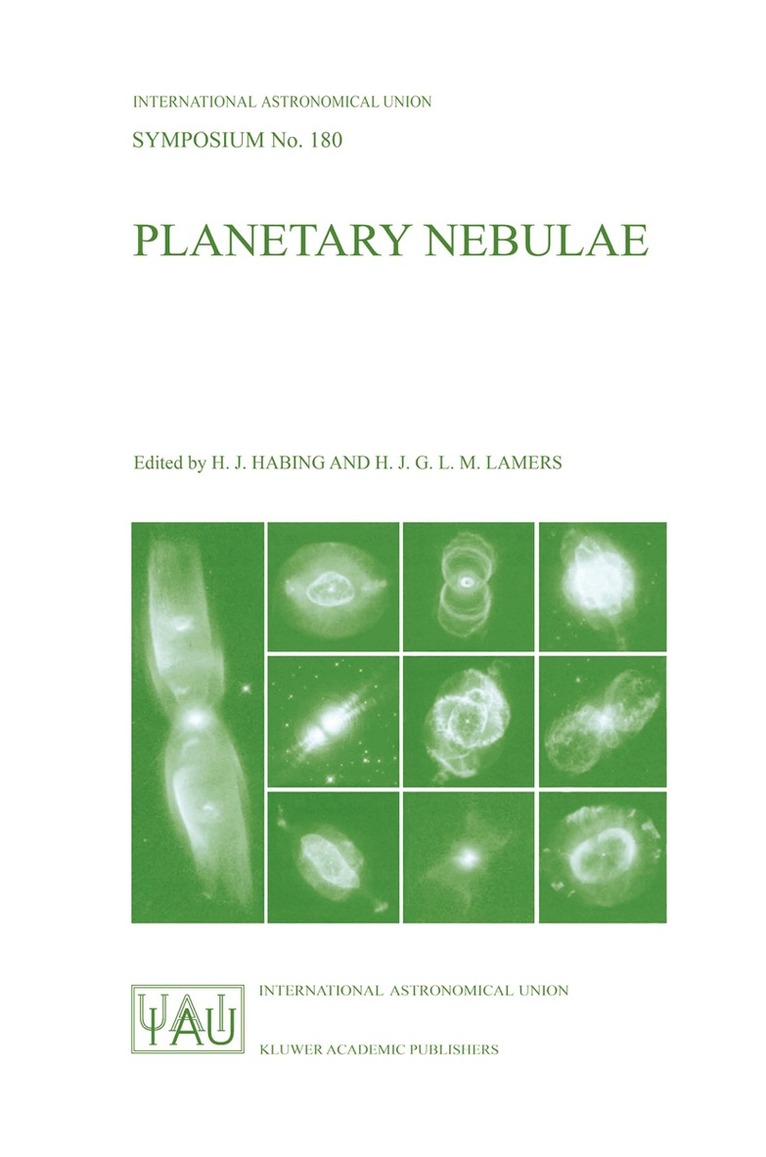
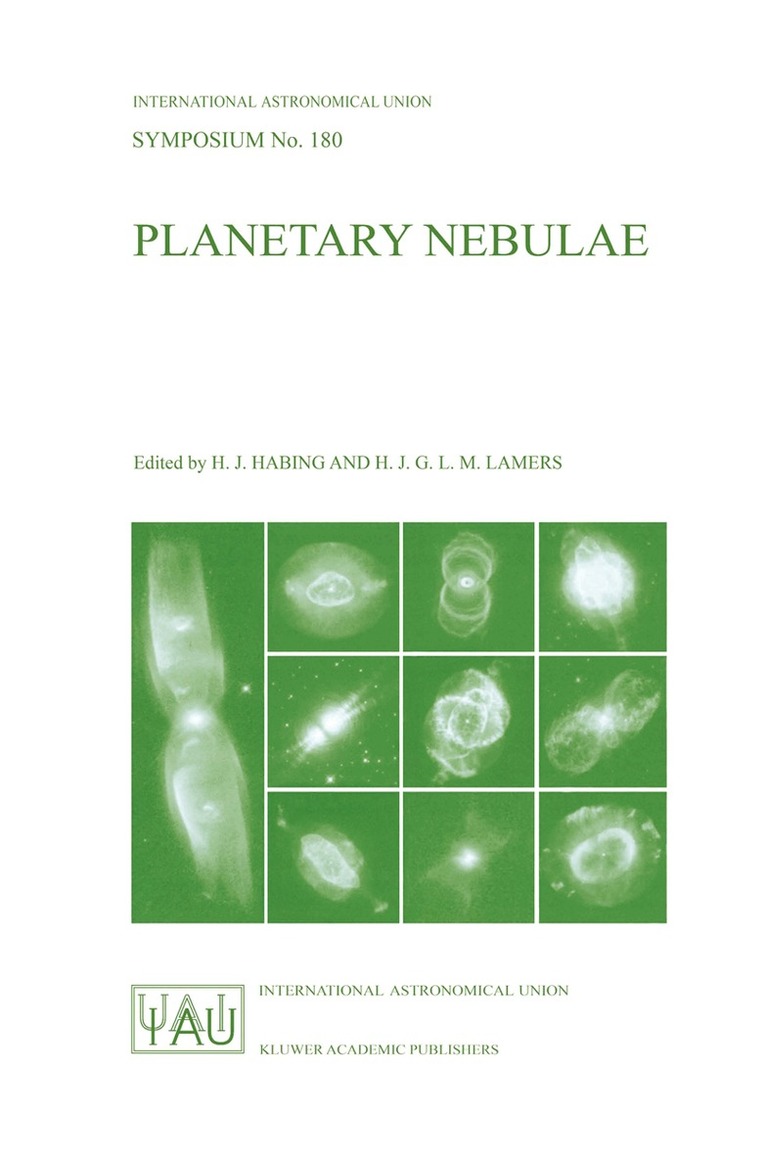
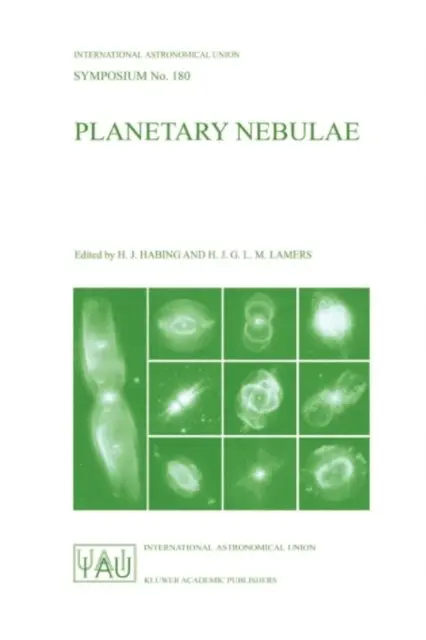
Planetary Nebulae
Proceedings of the 180th Symposium of the International Astronomical Union, Held in Groningen, The Netherlands, August, 26–30, 1996
Inbunden, Engelska, 1998
2 156 kr
Skickas inom 10-15 vardagar
Planetary nebulae present a range of shapes and morphologies. They are ideal laboratories for the study of different astrophysical processes: atomic physics, radiative transfer, stellar winds, shocks, wind-wind interaction, and the interaction between stellar winds and the interstellar medium. In addition, planetary nebulae provide information about the late stages of stellar evolution. In the mid-1990s studies of planetary nebulae have progressed rapidly and new phenomena and insights have been gained. This is partly due to observations (for example, from the Hubble Space Telescope, the ISO satellite and new infrared and millimeter spectrographs) and partly to the advancement of hydrodynamic simulations of the structures of planetary nebulae (PN). Many of these results were reported at IAU Symposium 180 in Groningen, the Netherlands, on August 26-30th, 1996. This symposium was dedicated to one of the pioneers of PN research: Stuart Pottasch. The book contains 29 reviews and more than 200 shorter contributions.
Häftad, Engelska, 1998
2 156 kr
Skickas inom 10-15 vardagar
Planetary nebulae present a range of shapes and morphologies. They are ideal laboratories for the study of different astrophysical processes: atomic physics, radiative transfer, stellar winds, shocks, wind-wind interaction, and the interaction between stellar winds and the interstellar medium. In addition, planetary nebulae provide information about the late stages of stellar evolution. In the mid-1990s studies of planetary nebulae have progressed rapidly and new phenomena and insights have been gained. This is partly due to observations (for example, from the Hubble Space Telescope, the ISO satellite and new infrared and millimeter spectrographs) and partly to the advancement of hydrodynamic simulations of the structures of planetary nebulae (PN). Many of these results were reported at IAU Symposium 180 in Groningen, the Netherlands, on August 26-30th, 1996. This symposium was dedicated to one of the pioneers of PN research: Stuart Pottasch. The book contains 29 reviews and more than 200 shorter contributions.
E-bok
PDF, Engelska, 20121 367 kr
Läs direkt efter köp
A strange field of speculation is opened by this phenomenon ... here we have a star fitfully variable to an astonishing extent. and whose fluctuations are spread over centuries. apparently in no settled period. and with no regularity of progression. What origin can we ascribe to these sudden flashes and relapses? What conclusions are we to draw as to the comfort or habitability of a system depending for its supply of light and heat on so uncertain a source? -- J. F. W. Herschel! We can imagine, at least, that the study of Luminous Blue Variable stars began as the official court astrophysicists of Eridu speculated about a new 5000 years ago first-magnitude star which persisted in their southern sky for several years.2 After that the topic languished for a while, but now it has been renewed following recent observations by Blaeu (P Cygni, c.1600) and Herschel (1] Argus, c.1840) ... -- More soberly, it is only within the past few years that we have begun to understand LBV''s and to recognize their coherence as a class. Thus only a minority of astronomers are familiar yet with this relatively new topic, whose potential impli cations are of great interest (see below). One purpose of this book, we hope, will be to provide an accessible overview of the subject for interested astronomers and astrophysicists in general.
E-bok
PDF, Engelska, 2012687 kr
Läs direkt efter köp
On April 28 1986 Cornelis de Jager reached the age of 65 years. On April 30 he officially retired from the University of Utrecht where he has held a Chair for Stellar Astrophysics, later changed into Space Physics, since 1958. Cees de Jager, as he prefers to be called by his friends, has had an active and successful life in science. His interest in astronomy was raised by his father under the clear skies of Celebes (Indonesia). He started a study in physics and astronomy as a student of the late M. Minnaert in Utrecht during World War II. When in 1943 the occupying forces recruited students who did not want to sign the declaration of loyalty for their war-efforts, Cees and three fellow students went into hiding at the Observatory in Utrecht. During this very "quiet" period van de Hulst developed the theory of the 21 em radiation of neutral hydrogen and de Jager started the observations of variable stars in the pitch dark nights of a country at war. The study of Beta Cepheids rapid ly awoke his interest which was kept throughout the years. In 1958 he organized an international campaign to observe 12 Lac spectroscopically and photometrically, which was a great success.
Del 157 - Astrophysics and Space Science Library
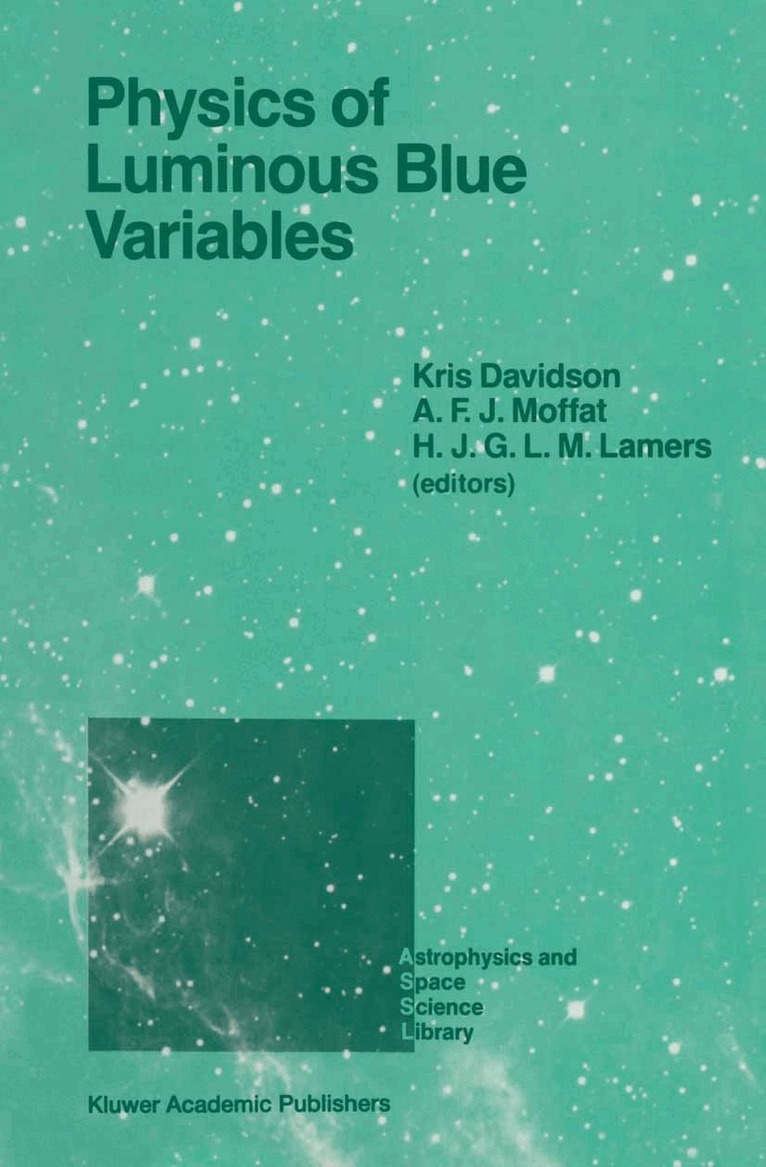
Physics of Luminous Blue Variables
Proceedings of the 113th Colloquium of the International Astronomical Union, Held at Val Morin, Quebec Province, Canada, August 15–18, 1988
Häftad, Engelska, 2011
1 073 kr
Skickas inom 10-15 vardagar
A strange field of speculation is opened by this phenomenon ... here we have a star fitfully variable to an astonishing extent. and whose fluctuations are spread over centuries. apparently in no settled period. and with no regularity of progression. What origin can we ascribe to these sudden flashes and relapses? What conclusions are we to draw as to the comfort or habitability of a system depending for its supply of light and heat on so uncertain a source? -- J. F. W. Herschel! We can imagine, at least, that the study of Luminous Blue Variable stars began as the official court astrophysicists of Eridu speculated about a new 5000 years ago first-magnitude star which persisted in their southern sky for several years.2 After that the topic languished for a while, but now it has been renewed following recent observations by Blaeu (P Cygni, c.1600) and Herschel (1] Argus, c.1840) ... -- More soberly, it is only within the past few years that we have begun to understand LBV's and to recognize their coherence as a class. Thus only a minority of astronomers are familiar yet with this relatively new topic, whose potential impli cations are of great interest (see below). One purpose of this book, we hope, will be to provide an accessible overview of the subject for interested astronomers and astrophysicists in general.
Del 136 - Astrophysics and Space Science Library
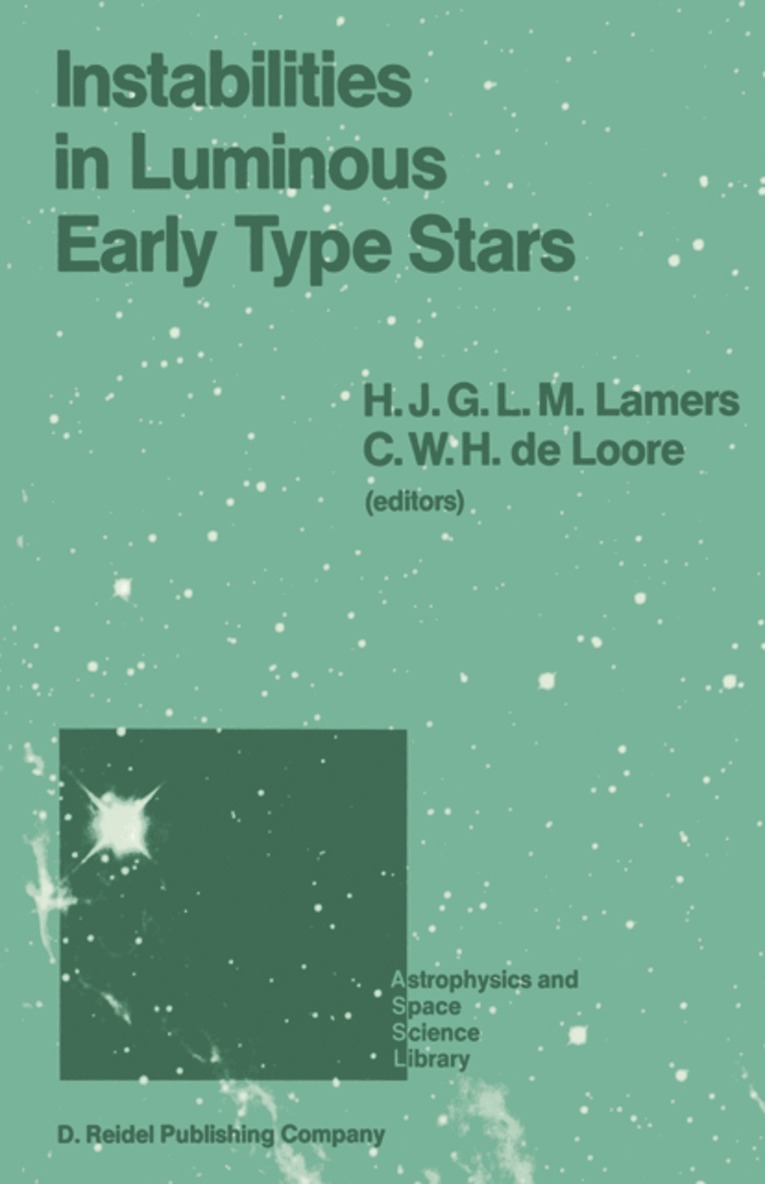
Instabilities in Luminous Early Type Stars
Proceedings of a Workshop in Honour of Professor Cees De Jager on the Occasion of his 65th Birthday held in Lunteren, The Netherlands, 21–24 April 1986
Häftad, Engelska, 2011
540 kr
Skickas inom 10-15 vardagar
On April 28 1986 Cornelis de Jager reached the age of 65 years. On April 30 he officially retired from the University of Utrecht where he has held a Chair for Stellar Astrophysics, later changed into Space Physics, since 1958. Cees de Jager, as he prefers to be called by his friends, has had an active and successful life in science. His interest in astronomy was raised by his father under the clear skies of Celebes (Indonesia). He started a study in physics and astronomy as a student of the late M. Minnaert in Utrecht during World War II. When in 1943 the occupying forces recruited students who did not want to sign the declaration of loyalty for their war-efforts, Cees and three fellow students went into hiding at the Observatory in Utrecht. During this very "quiet" period van de Hulst developed the theory of the 21 em radiation of neutral hydrogen and de Jager started the observations of variable stars in the pitch dark nights of a country at war. The study of Beta Cepheids rapid ly awoke his interest which was kept throughout the years. In 1958 he organized an international campaign to observe 12 Lac spectroscopically and photometrically, which was a great success.
E-bok
PDF, Engelska, 20122 765 kr
Läs direkt efter köp
Planetary nebulae present a fascinating range of shapes and morphologies. They are ideal laboratories for the study of different astrophysical processes: atomic physics, radiative transfer, stellar winds, shocks, wind-wind interaction, and the interaction between stellar winds and the interstellar medium. In addition, planetary nebulae provide information about the late stages of stellar evolution. In the last five years studies of planetary nebulae have progressed very rapidly and new phenomena and insights have been gained. This is partly due to new observations (e.g. from the Hubble Space Telescope, the ISO satellite and new infrared and millimeter spectrographs) and partly to the advancement of hydrodynamic simulations of the structures of planetary nebulae (PN). Many of these new results were reported at IAU Symposium 180 in Groningen, the Netherlands, on August 26 to 30, 1996. This symposium was dedicated to one of the pioneers of PN research: Stuart Pottasch. These proceedings contain chapters on: Introduction to PN with the basic parameters Distances of PN The central stars of PN The envelopes of PN The evolution from AGB to PN The evolution from PN to white dwarfs PN in the galactic context PN in extragalactic systems The future of PN research . The book contains 29 reviews and more than 200 shorter contributions.