Harm J. Habing – författare
Visar alla böcker från författaren Harm J. Habing. Handla med fri frakt och snabb leverans.
10 produkter
10 produkter
Inbunden, Engelska, 2003
1 718 kr
Skickas inom 10-15 vardagar
This book deals with the underlying astrophysical mechanisms of the objects known as asymptotic giant branch stars -- the structures that occur during the dramatic period prior to a star's death. Over the past three decades, asymptotic giant branch stars have become a topic of their own, and the contributions to this volume all focus on these entities themselves, rather than their connections to other fields of astronomy. Among the many topics covered are new methods of high- quality infrared observation and the more detailed and realistic simulations made possible by increasingly fast computers. This collection should be useful to graduate students who work in the field, teachers who want to address the subject in their courses, and to astronomers from various backgrounds who are interested in the astrophysics of AGB stars.
Inbunden, Engelska, 1993
1 718 kr
Skickas inom 10-15 vardagar
This book contains the proceedings of the first large IAU Symposium dedicated to the bulges of spiral galaxies. Detailed attention is paid to the bulge of the Milky Way, one of the major building blocks of this system. Topics include the definition of the bulge in our Galaxy and its relation to the so-called spheroid. Discussions are presented regarding the stars contained in this bulge, their astrophysical properties, their motions and the metallicity variations which appear to be present. The possible existence of a bar in the bulge and its origin and future are also examined. The same topics are discussed in less detail for the bulges of other galaxies.
Häftad, Engelska, 1993
1 076 kr
Skickas inom 10-15 vardagar
This book contains the proceedings of the first large IAU Symposium dedicated to the bulges of spiral galaxies. Detailed attention is paid to the bulge of the Milky Way, one of the major building blocks of this system. Topics include the definition of the bulge in our Galaxy and its relation to the so-called spheroid. Discussions are presented regarding the stars contained in this bulge, their astrophysical properties, their motions and the metallicity variations which appear to be present. The possible existence of a bar in the bulge and its origin and future are also examined. The same topics are discussed in less detail for the bulges of other galaxies.
Del 180 - International Astronomical Union Symposia
Planetary Nebulae
Proceedings of the 180th Symposium of the International Astronomical Union, Held in Groningen, The Netherlands, August, 26–30, 1996
Inbunden, Engelska, 1998
2 145 kr
Skickas inom 10-15 vardagar
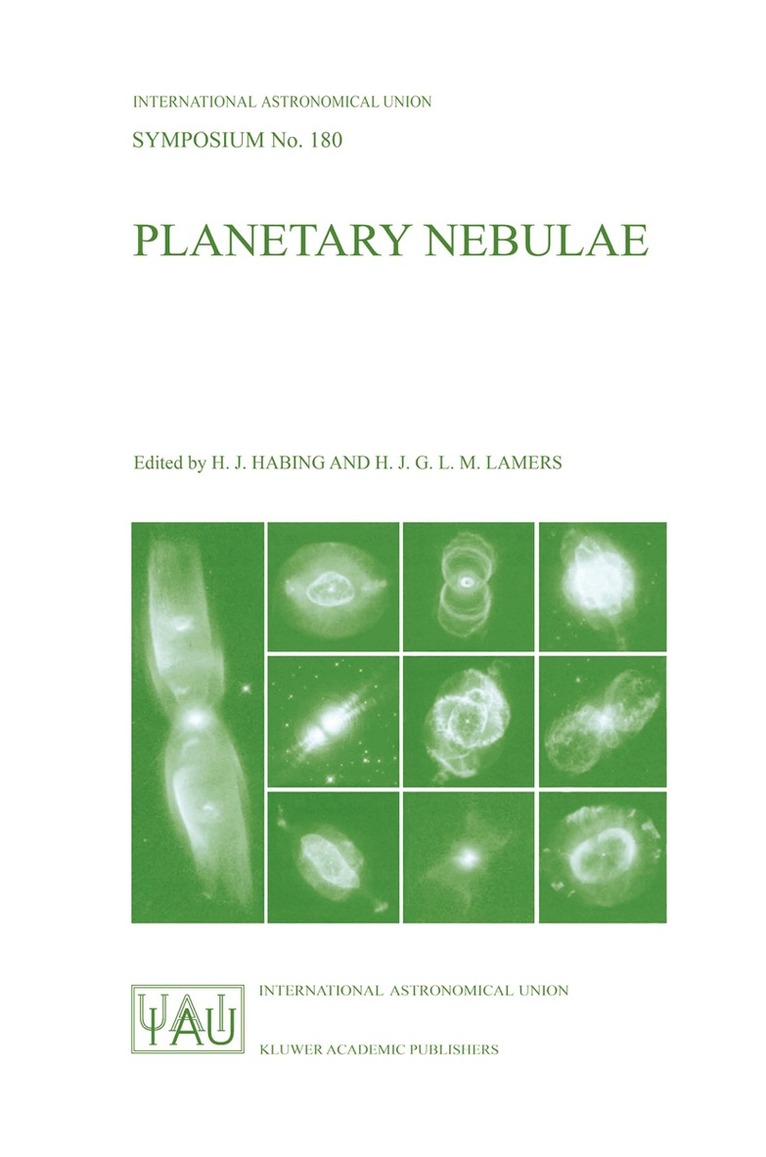
Planetary nebulae present a range of shapes and morphologies. They are ideal laboratories for the study of different astrophysical processes: atomic physics, radiative transfer, stellar winds, shocks, wind-wind interaction, and the interaction between stellar winds and the interstellar medium. In addition, planetary nebulae provide information about the late stages of stellar evolution. In the mid-1990s studies of planetary nebulae have progressed rapidly and new phenomena and insights have been gained. This is partly due to observations (for example, from the Hubble Space Telescope, the ISO satellite and new infrared and millimeter spectrographs) and partly to the advancement of hydrodynamic simulations of the structures of planetary nebulae (PN). Many of these results were reported at IAU Symposium 180 in Groningen, the Netherlands, on August 26-30th, 1996. This symposium was dedicated to one of the pioneers of PN research: Stuart Pottasch. The book contains 29 reviews and more than 200 shorter contributions.
Häftad, Engelska, 1998
2 145 kr
Skickas inom 10-15 vardagar
Planetary nebulae present a range of shapes and morphologies. They are ideal laboratories for the study of different astrophysical processes: atomic physics, radiative transfer, stellar winds, shocks, wind-wind interaction, and the interaction between stellar winds and the interstellar medium. In addition, planetary nebulae provide information about the late stages of stellar evolution. In the mid-1990s studies of planetary nebulae have progressed rapidly and new phenomena and insights have been gained. This is partly due to observations (for example, from the Hubble Space Telescope, the ISO satellite and new infrared and millimeter spectrographs) and partly to the advancement of hydrodynamic simulations of the structures of planetary nebulae (PN). Many of these results were reported at IAU Symposium 180 in Groningen, the Netherlands, on August 26-30th, 1996. This symposium was dedicated to one of the pioneers of PN research: Stuart Pottasch. The book contains 29 reviews and more than 200 shorter contributions.
Häftad, Engelska, 2011
1 718 kr
Skickas inom 10-15 vardagar
This book deals with stars during a short episode before they undergo a ma jor, and fatal, transition. Soon the star will stop releasing nudear energy, it will become a planetary nebula for abrief but poetic moment, and then it will turn into a white dwarf and slowly fade out of sight. Just before this dramatic change begins the star has reached the highest luminosity and the largest diameter in its existence, and while it is a star detectable in galaxies beyond the Local Group, its structure contains already the inconspicuous white dwarf it will become. It is called an "asymptotic giant branch star" or "AGB star". Over the last 30 odd years AGB stars have become a topic of their own although individual members of this dass had already been studied for cen turies without realizing what they were. In the early evolution, so called "E-AGB"-phase, the stars are a bit bluer than, but otherwise very similar to, what are now called red giant branch stars (RGB stars). It is only in the sec ond half of their anyhow brief existence that AGB stars differ fundamentally from RGB stars.
Inbunden, Engelska, 2019
2 145 kr
Skickas inom 10-15 vardagar
This richly illustrated book discusses the ways in which astronomy expanded after 1945 from a modest discipline to a robust and modern science. It begins with an introduction to the state of astronomy in 1945 before recounting how in the following years, initial observations were made in hitherto unexplored ranges of wavelengths, such as X-radiation, infrared radiation and radio waves. These led to the serendipitous discovery of more than a dozen new phenomena, including quasars and neutron stars, that each triggered a new area of research.The book goes on to discuss how after 1985, the further, systematic exploration of the earlier discoveries led to long-term planning and the construction of new, large telescopes on Earth and in Space. Key scientific highlights described in the text are the detection of exoplanets (1995), the unexpected discovery of the accelerated expansion of the Universe (1999), a generally accepted model for the large-scale properties of theUniverse (2003) and the ΛCDM theory (2005) that explains how the galaxies and stars of the present Universe were formed from minute irregularities in the (almost) homogenous gas that filled the early Universe.All these major scientific achievements came at a price, namely the need to introduce two new phenomena that are as yet unexplained by physics: inflation and dark energy. Probably the deepest unsolved question has to be: Why did all of this start with a Big Bang?
625 kr
Skickas inom 5-8 vardagar
Häftad, Engelska, 2013
1 076 kr
Skickas inom 10-15 vardagar
These eight lectures have been written up in a clear and pedagogical style in order to serve as an introduction for students to fields of modern astrophysical and astronomical research where otherwise textbooks are not available. The first four lectures cover topics in galactic astronomy (formation, structure and evolution of galaxies) and the remaining four are devoted to observational methods and astronomical instrumentation. The lecturers in the European Astrophysical Doctoral Network rank among the most highly respected specialists, and their lectures have been carefully edited and updated before publication.
Häftad, Engelska, 2011
542 kr
Skickas inom 10-15 vardagar
The following text forms the proceedings of a conference. It is supposed to contain what was actually reported and discussed, though it does this, one hopes, in a polished and organized way. A sense of actuality, a reporting quality, makes this book different from a collection of review papers as, for example, a book in the series on Stars and Stellar Systems. All Invited Reports have been included as the Reporters wrote them. The Editor's task has been restricted to improving the presentation, a process which in most cases involved only minor revisions. In a few Reports the Editor did some heavy rewriting; in those cases he checked with the Reporters. Obviously a different course had to be taken with respect to the Discussions. They were recorded on tape, transcribed verbatim and then passed back to the discussants. After the discussants returned their versions, the Editor rearranged and condensed the texts and made a considerable effort to provide references. (Unfortunately he was not able to locate all relevant Russian papers from 1968 and 1969. ) The Editor takes the responsibility for mistakes made in this process, which may have produced occasionally his own 'mix-master Universe'. Actually only a few discussion remarks were rejected, more often because of incomprehensibility, rather than because the remark was far from the subject of the Symposium, or was too long, or was too trivial. A few very long remarks have been condensed and put at the end of a Discussion.