Carl F. Ameringer – författare
Visar alla böcker från författaren Carl F. Ameringer. Handla med fri frakt och snabb leverans.
7 produkter
7 produkter
Inbunden, Engelska, 2026
541 kr
Kommande
Discover how a community of Catholic sisters helped build and transform America's healthcare system.For more than two centuries, the Daughters of Charity quietly worked to shape the institutions that became the backbone of American healthcare. Drawing on his experience as a healthcare attorney and his expertise in health policy and health administration, Carl F. Ameringer offers the first comprehensive history of the Daughters' healthcare apostolate in the United States, from the founding of their first hospital in 1823 to the transfer of their extensive hospital network in 2012.Donning their distinctive white-winged cornettes, the Daughters served the sick poor during wars and epidemics, economic recessions and urbanization, founding more than fifty hospitals nationwide. Ameringer shows how they navigated major transformations in medicine and society while overcoming prejudice against women and Catholics and opposition from clergy, physicians, and politicians along the way.The Daughters of Charity, Catholic Hospitals, and the Expansion of American Healthcare reveals the scale and significance of the Daughters' contribution to American healthcare and traces a legacy that continues to influence the field today.
Del 19 - California/Milbank Books on Health and the Public
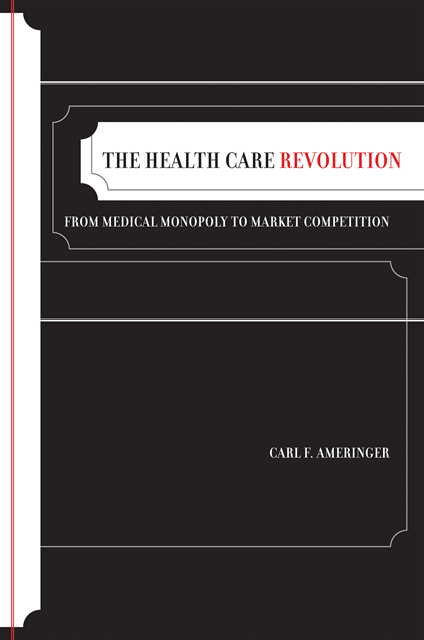
Health Care Revolution
From Medical Monopoly to Market Competition
Inbunden, Engelska, 2008
1 028 kr
Skickas inom 5-8 vardagar
America's market-based health care system, unique among the nations of the world, is in large part the product of an obscure, yet profound, revolution that overthrew the medical monopoly in the late 1970s. In this lucid, balanced account, Carl F. Ameringer tells how this revolution came into being when the U.S. Supreme Court and Congress prompted the antitrust agencies of the federal government - the Federal Trade Commission and the Justice Department - to change the rules of the health care system. Ameringer: lays out the key events that led up to this regime change; explores its broader social, political, and economic contexts; examines the views of both its proponents and opponents; and, considers its current trajectory.
E-bok
PDF, Engelska, 20081 230 kr
Läs direkt efter köp
America''s market-based health care system, unique among the nations of the world, is in large part the product of an obscure, yet profound, revolution that overthrew the medical monopoly in the late 1970s. In this lucid, balanced account, Carl F. Ameringer tells how this revolution came into being when the U.S. Supreme Court and Congress prompted the antitrust agencies of the federal government—the Federal Trade Commission and the Justice Department—to change the rules of the health care system. Ameringer lays out the key events that led up to this regime change; explores its broader social, political, and economic contexts; examines the views of both its proponents and opponents; and considers its current trajectory.
Inbunden, Engelska, 2018
1 101 kr
Skickas inom 7-10 vardagar
The unique composition and configuration of doctors and hospitals in the US is leading to a crisis in primary care provision. There are significantly more specialists than generalists, and many community hospitals and outpatient facilities are concentrated in affluent areas with high rates of comprehensive insurance coverage. These particular features present difficult challenges to policymakers seeking to increase access to care. Carl F. Ameringer shows why the road to universal healthcare is not built on universal finance alone. Policymakers in other countries successfully align finance with delivery to achieve better access, lower costs, and improved population health. This book explains how the US healthcare system developed, and why efforts to expand insurance coverage in the absence of significant changes to delivery will fuel higher costs without achieving the desired results.
Häftad, Engelska, 2018
338 kr
Skickas inom 7-10 vardagar
The unique composition and configuration of doctors and hospitals in the US is leading to a crisis in primary care provision. There are significantly more specialists than generalists, and many community hospitals and outpatient facilities are concentrated in affluent areas with high rates of comprehensive insurance coverage. These particular features present difficult challenges to policymakers seeking to increase access to care. Carl F. Ameringer shows why the road to universal healthcare is not built on universal finance alone. Policymakers in other countries successfully align finance with delivery to achieve better access, lower costs, and improved population health. This book explains how the US healthcare system developed, and why efforts to expand insurance coverage in the absence of significant changes to delivery will fuel higher costs without achieving the desired results.
E-bok
PDF, Engelska, 2018408 kr
Läs direkt efter köp
The unique composition and configuration of doctors and hospitals in the US is leading to a crisis in primary care provision. There are significantly more specialists than generalists, and many community hospitals and outpatient facilities are concentrated in affluent areas with high rates of comprehensive insurance coverage. These particular features present difficult challenges to policymakers seeking to increase access to care. Carl F. Ameringer shows why the road to universal healthcare is not built on universal finance alone. Policymakers in other countries successfully align finance with delivery to achieve better access, lower costs, and improved population health. This book explains how the US healthcare system developed, and why efforts to expand insurance coverage in the absence of significant changes to delivery will fuel higher costs without achieving the desired results.
408 kr
Läs direkt efter köp
The unique composition and configuration of doctors and hospitals in the US is leading to a crisis in primary care provision. There are significantly more specialists than generalists, and many community hospitals and outpatient facilities are concentrated in affluent areas with high rates of comprehensive insurance coverage. These particular features present difficult challenges to policymakers seeking to increase access to care. Carl F. Ameringer shows why the road to universal healthcare is not built on universal finance alone. Policymakers in other countries successfully align finance with delivery to achieve better access, lower costs, and improved population health. This book explains how the US healthcare system developed, and why efforts to expand insurance coverage in the absence of significant changes to delivery will fuel higher costs without achieving the desired results.