Carlos H. Waisman – författare
Visar alla böcker från författaren Carlos H. Waisman. Handla med fri frakt och snabb leverans.
6 produkter
Modernization and the Working Class
The Politics of Legitimacy
Häftad, 1982
275 kr
Lägg i varukorg
This is a fascinating inquiry into the factors that determine the acceptance or rejection of capitalism by the industrial working class. Combining classical social theory, historical evidence, and survey data, Waisman explores the relationship between the degree of modernization and the legitimacy …
Civil Society and Democracy in Latin America
Av R. Feinberg, C. Waisman m. fl.
Inbunden, 2006
548 kr
Lägg i varukorg
A dense web of private associations drawn from multiple social classes, interest groups and value communities makes for a firm foundation for strong democracy. In Latin America today, will civil society improve the quality of democracy or will it foster political polarization and reverse recent …
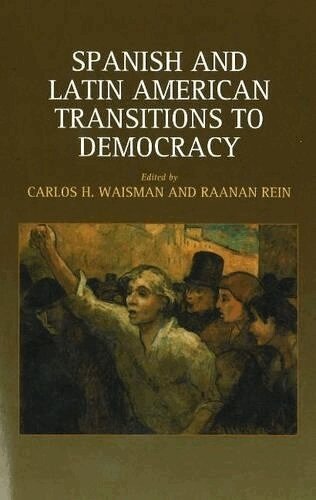
Spanish and Latin American Transitions to Democracy
Av Waisman, Carlos H. Waisman m. fl.
Häftad
2569 kr
Lägg i varukorg
Globality and Multiple Modernities
Comparative North American & Latin American Perspectives
Av Luis Roniger, Carlos H Waisman
Inbunden, 2002
1897 kr
Lägg i varukorg
This book analyzes the Americas, North and South, in the global and comparative arena, showing how these societies gazed each other and Europe as they followed the road to multiple forms of modernity and globalization. New insights are contributed on the ways in which reflected conceptions of …
Spanish and Latin American Transitions to Democracy
Av Carlos H Waisman, Raanan Rein
Inbunden, 2005
1897 kr
Lägg i varukorg
This volume compares the Spanish and Latin American 'double transitions' to liberal democracy and an open-market economy. Spain's transitions in the 1960 to 1980s have become the paradigmatic case of successful institutional transformation, and thus the standard for the evaluation of the economic …
Globality and Multiple Modernities
Comparative North American & Latin American Perspectives
Av Luis Roniger, Carlos H Waisman
Inbunden, 2002
1900 kr
Tillfälligt slut
This book analyzes the Americas, North and South, in the global and comparative arena, showing how these societies gazed each other and Europe as they followed the road to multiple forms of modernity and globalization. New insights are contributed on the ways in which reflected conceptions of …