Cecilia Ugaz - Böcker
Visar alla böcker från författaren Cecilia Ugaz. Handla med fri frakt och snabb leverans.
2 produkter
2 produkter
2 572 kr
Skickas inom 5-8 vardagar
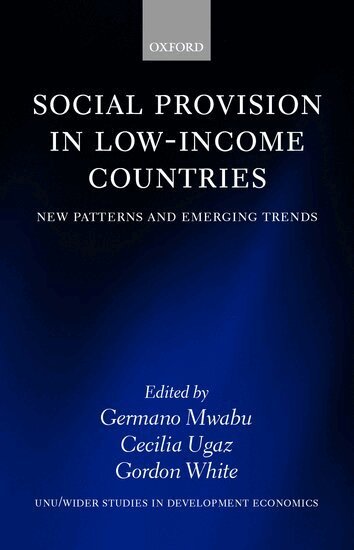
During recent years, provision of key social services in low-income countries has been affected by adverse macroeconomic conditions and by radical changes in economic thinking. For example, the welfarist approach, which gives prominence to the state in delivering and financing social services, has been challenged by the neoliberal approach, which limits the role of the government to that of residual provider for the very poor. According to the neoliberal approach, the private sector could, by relying on price mechanisms, achieve more efficient provision. However, this approach relies on a rather narrow definition of efficiency which ignores social externalities in the delivery and use of services."Social Provision in Low-Income Countries" analyses the merits and limitations of both welfarist and neoliberal approaches to the provision of key social services in terms of the outcomes and sustainability of the two approaches. The volume proposes an alternative model of social provision, characterized by multiplicity in service delivery and financing.The new model, in which households, civil society, and government play important roles, avoids the inefficiencies of state provision and the exclusion and fragmentation of market-based systems. The authors argue for an integrative approach which encourages the equity and efficiency gained from a synergistic relationship between various service providers. They further argue that the well-known market and government failures in social provision are due to undesirable extremes in policy design, rather than to inherent characteristics of market or government institutions.The strengths of this new approach are illustrated with case studies from Chile, China, Tanzania, and Zimbabwe. The volume also describes how social services in Finland were organized in the early stages, and draws policy lessons for present day developing countries.
1 978 kr
Skickas inom 7-10 vardagar
Latin American countries have now privatized a large number of their utility industries and make more use of market approaches to delivery through networks. Privatization has major consequences for efficiency, long-term growth, consumer welfare and income distribution but insufficient attention has been paid to the direct effect on consumers of regulation and the introduction of competition. This book assesses how reform processes can be improved, particularly in the light of experience in some Latin American and European countries. The authors address the question of infrastructure reforms in a novel way by focusing on the impact which they can have on consumers through the prices paid by different groups and on their access to the networks. They analyse original material from four Latin American countries - Argentina, Bolivia, Chile, Peru - and two European countries - Spain and the UK. Access is especially relevant when considering immature systems which have not yet extended to cover the majority of the population, as is the case in many Latin American countries. The authors also address the widespread impact of privatization on the economy (via macroeconomic influences) and the more general issues of subsidies and regulation which are endemic to these industries. The book focuses on the reform of four sectors: telecommunications, electricity, gas, and water and sanitation.Academics, students, practitioners and policymakers specialising in economics, development and institutional reform will value the book's unique focus on the consumer experience of utility privatization and regulation, complemented by the rigorous case study analysis of the effects on prices and access.