Celina Su - Böcker
Visar alla böcker från författaren Celina Su. Handla med fri frakt och snabb leverans.
6 produkter
6 produkter
1 016 kr
Skickas inom 7-10 vardagar
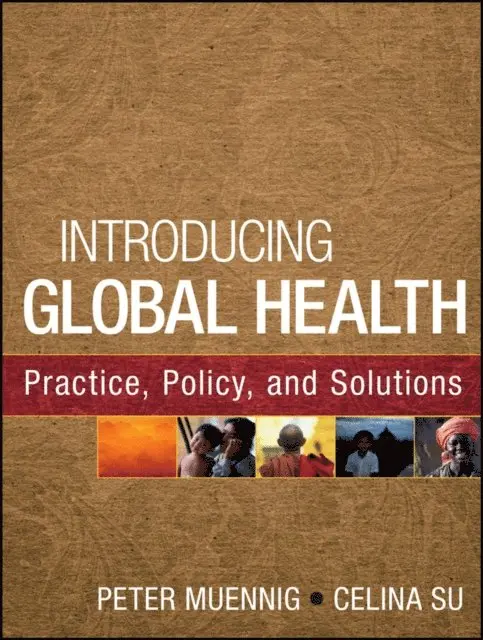
Introducing Global Health: Practice, Policy, and Solutions is a contemporary overview of the major issues in global public health. The book explores how population health might be maximized with the right blend of health system, education, antipoverty, infectious disease, urban development, governance, and incentive-based policies. It covers topics critical for understanding the state of the world today, including wars for natural resources, the missing women phenomenon, and whether global aid really works. The book's case studies focus on developing economies, mixed economies, and new emerging superpowers. Thematic chapters are interwoven with running motifs, such as the health risks and benefits associated with different totalitarian, capitalist, and market socialist economies. Moving beyond statistics, the book represents a major innovation in the teaching of global health by presenting technical concepts including the incidence and prevalence of disease within the context of more accessible topics such as global poverty. This helps students contextualize otherwise challenging but critical concepts, such as the burden of infectious disease.By encouraging reflection, focusing on what works, and using activities and exercises, Introducing Global Health both teaches fundamentals of global public health and cultivates a policy perspective that is appealing and compelling for today's students.
226 kr
Skickas inom 7-10 vardagar
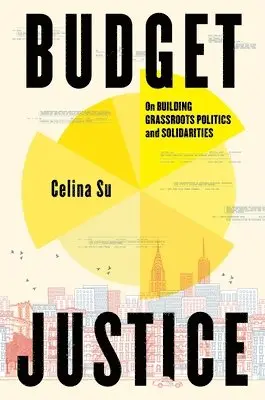
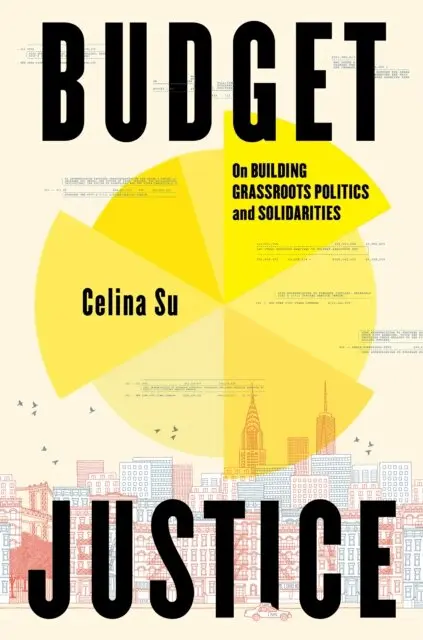
A bold vision that empowers communities to solve our cities’ most pressing problemsAmid political repression and a deepening affordability crisis, Budget Justice challenges everything you thought you knew about “dull” and daunting government budgets. It shows how the latter confuse and mislead the public by design, not accident. Arguing that they are moral documents that demand grassroots participation to truly work for everyone, the book reveals how everyday citizens can shape policy to tackle everything from rising housing and food costs to unabated police violence, underfunded schools, and climate change–driven floods and wildfires.Drawing on her years of engagement with democratic governance in New York City and around the globe, Celina Su proposes a new kind of democracy—in which city residents make collective decisions about public needs through processes like participatory budgeting, and in which they work across racial divides and segregated spaces as neighbors rather than as consumers or members of voting blocs. Su presents a series of “interludes” that vividly illustrate how budget justice plays out on the ground, including in-depth interviews with activists from Porto Alegre, Brazil, Barcelona, Spain, and Jackson, Mississippi, and shares her own personal reflections on how changing social identities inform one’s activism.Essential reading to empower citizens, Budget Justice explains why public budgets reflect a crisis not so much in accounting as in democracy, and enables everyone, especially those from historically marginalized communities, to imagine and enact people’s budgets and policies—from universal preschool to affordable housing—that will enable their communities to thrive.
Streetwise for Book Smarts
Grassroots Organizing and Education Reform in the Bronx
Inbunden, Engelska, 2009
1 502 kr
Skickas inom 10-15 vardagar
In Streetwise for Book Smarts, Celina Su examines the efforts of parents and students who sought to improve the quality of education in their local schools by working with grassroots organizations and taking matters into their own hands. In these organizations, everyday citizens pursued not only education reform but also democratic accountability and community empowerment. These groups had similar resources and operated in the same political context, yet their strategies and tactics were very different: while some focused on increasing state and city aid to their schools, others tried to change the way the schools themselves operated. Some coalitions sought accommodation with administrators and legislators; others did not.The events Su describes began with a series of stabbings in Bronx high schools during the 2003-2004 school year. After this rash of violence, several grassroots groups cited the need for additional safety patrols. Mothers from one school spoke of how they had previously protested until they got extra officers, a fairly scarce resource in New York public schools, at their local elementary school. Others asserted that not all the safety patrol officers already in place were treating students humanely. Parent organizations and school officials battled over who was to blame for the school violence. Did a police presence solve the problem, or did it exacerbate the schools' violence-prone conditions? Members of different groups proposed and mobilized behind a range of remedies. These divergent responses shed light on the ways in which the choices made by each organization mattered.By learning from Su's close observation of four activist groups in the Bronx, including Mothers on the Move and Sistas and Brothas United, we can better understand strategies that may ultimately lead to better and safer schools everywhere and help to revitalize American democracy.
Streetwise for Book Smarts
Grassroots Organizing and Education Reform in the Bronx
Häftad, Engelska, 2009
290 kr
Skickas inom 10-15 vardagar
In Streetwise for Book Smarts, Celina Su examines the efforts of parents and students who sought to improve the quality of education in their local schools by working with grassroots organizations and taking matters into their own hands. In these organizations, everyday citizens pursued not only education reform but also democratic accountability and community empowerment. These groups had similar resources and operated in the same political context, yet their strategies and tactics were very different: while some focused on increasing state and city aid to their schools, others tried to change the way the schools themselves operated. Some coalitions sought accommodation with administrators and legislators; others did not.The events Su describes began with a series of stabbings in Bronx high schools during the 2003-2004 school year. After this rash of violence, several grassroots groups cited the need for additional safety patrols. Mothers from one school spoke of how they had previously protested until they got extra officers, a fairly scarce resource in New York public schools, at their local elementary school. Others asserted that not all the safety patrol officers already in place were treating students humanely. Parent organizations and school officials battled over who was to blame for the school violence. Did a police presence solve the problem, or did it exacerbate the schools' violence-prone conditions? Members of different groups proposed and mobilized behind a range of remedies. These divergent responses shed light on the ways in which the choices made by each organization mattered.By learning from Su's close observation of four activist groups in the Bronx, including Mothers on the Move and Sistas and Brothas United, we can better understand strategies that may ultimately lead to better and safer schools everywhere and help to revitalize American democracy.
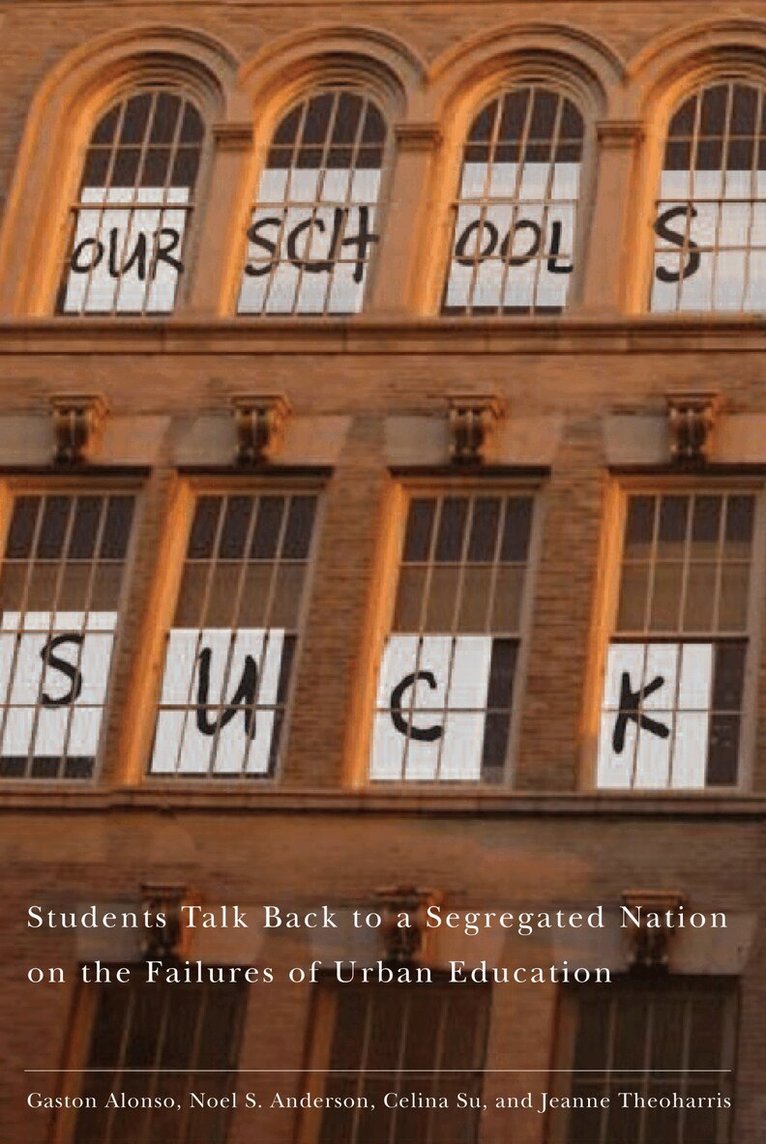
Our Schools Suck
Students Talk Back to a Segregated Nation on the Failures of Urban Education
Inbunden, Engelska, 2009
883 kr
Skickas inom 10-15 vardagar
Shares the voices of students speaking out against the failures of urban education"Our schools suck." This is how many young people of color call attention to the kind of public education they are receiving. In cities across the nation, many students are trapped in under-funded, mismanaged and unsafe schools. Yet, a number of scholars and of public figures have shifted attention away from the persistence of school segregation to lambaste the values of young people themselves. Our Schools Suck forcefully challenges this assertion by giving voice to the compelling stories of African American and Latino students who attend under-resourced inner-city schools, where guidance counselors and AP classes are limited and security guards and metal detectors are plentiful—and grow disheartened by a public conversation that continually casts them as the problem with urban schools.By showing that young people are deeply committed to education but often critical of the kind of education they are receiving, this book highlights the dishonesty of public claims that they do not value education. Ultimately, these powerful student voices remind us of the ways we have shirked our public responsibility to create excellent schools. True school reform requires no less than a new civil rights movement, where adults join with young people to ensure an equal education for each and every student.
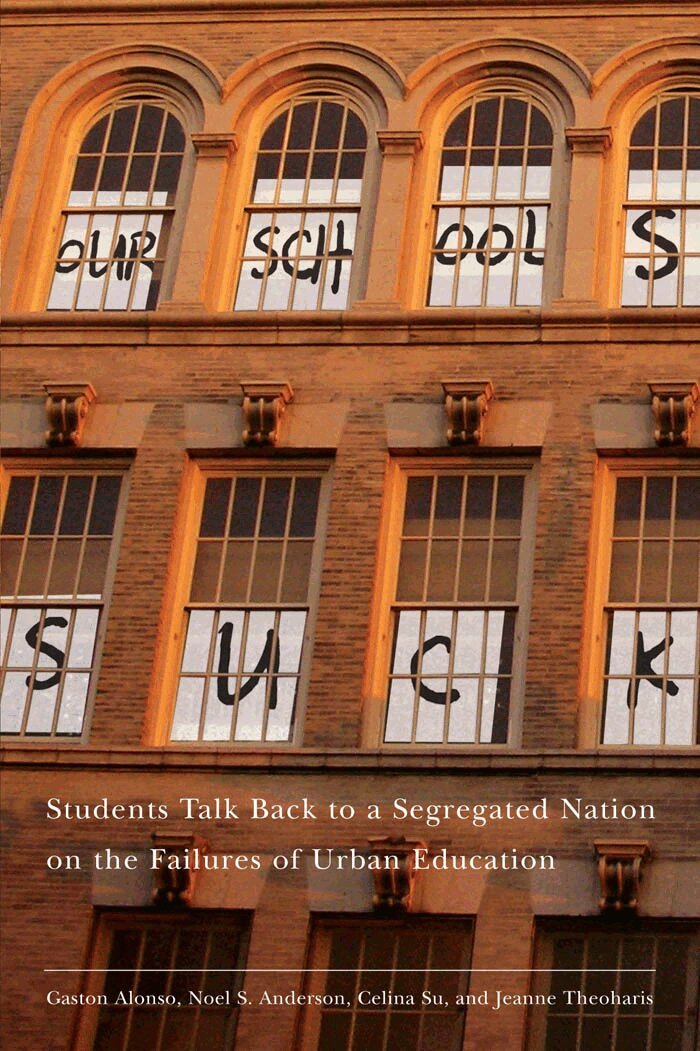
Our Schools Suck
Students Talk Back to a Segregated Nation on the Failures of Urban Education
Häftad, Engelska, 2009
388 kr
Skickas inom 7-10 vardagar
Shares the voices of students speaking out against the failures of urban education"Our schools suck." This is how many young people of color call attention to the kind of public education they are receiving. In cities across the nation, many students are trapped in under-funded, mismanaged and unsafe schools. Yet, a number of scholars and of public figures have shifted attention away from the persistence of school segregation to lambaste the values of young people themselves. Our Schools Suck forcefully challenges this assertion by giving voice to the compelling stories of African American and Latino students who attend under-resourced inner-city schools, where guidance counselors and AP classes are limited and security guards and metal detectors are plentiful—and grow disheartened by a public conversation that continually casts them as the problem with urban schools.By showing that young people are deeply committed to education but often critical of the kind of education they are receiving, this book highlights the dishonesty of public claims that they do not value education. Ultimately, these powerful student voices remind us of the ways we have shirked our public responsibility to create excellent schools. True school reform requires no less than a new civil rights movement, where adults join with young people to ensure an equal education for each and every student.