Charles Bernheimer - Böcker
Visar alla böcker från författaren Charles Bernheimer. Handla med fri frakt och snabb leverans.
5 produkter
5 produkter
2 067 kr
Skickas inom 3-6 vardagar
655 kr
Skickas inom 3-6 vardagar
-- The Women's Review of Books
760 kr
Skickas
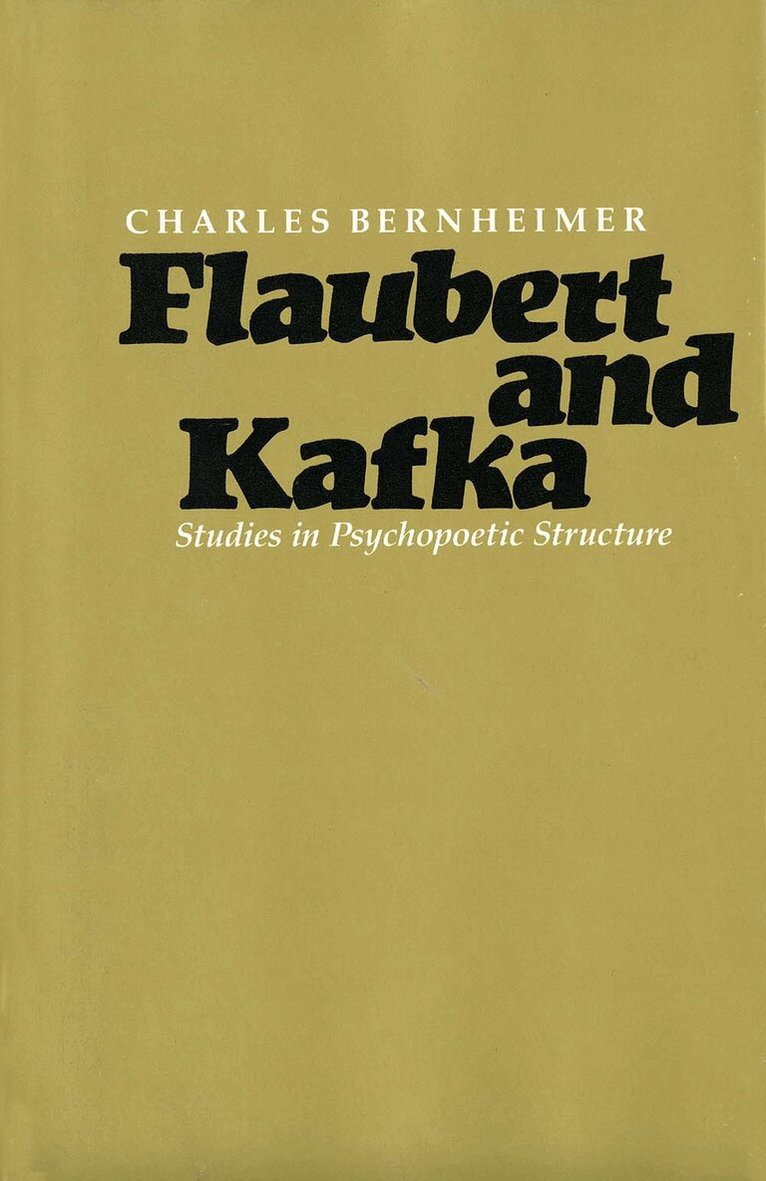
Although their styles appear remarkably different, Flaubert and Kafka share a common identification with the writing process itself. “I am a human pen,” wrote Flaubert; “I am nothing but literature,” declared Kafka. This stimulating book is the first to explore the link between these writers.Introducing his conception of psychopoetics, Charles Bernheimer brings new clarity to many controversial issues in psychoanalysis, rhetoric, and critical theory. In chapters on Flaubert and Kafka he probes the desires and fears motivating each writer’s search for a fully satisfying literary style. His interpretation of the strategies the authors adopt to harness the negativity of writing reveals the creative function of such psychological phenomena as narcissism, fetishism, and sadomasochism. The major works, Bernheimer argues, dramatize the conflict between the structures of Eros and Thanatos, metonymy and metaphor, through which they are constituted. From this illuminating perspective he traces the genesis of each writer’s mature style, analyzes two early works, La Tentation de saint Antoine and “The Judgment,” and examines two late masterpieces, Bouvard et Pécuchet and The Castle, applying to the latter Walter Benjamin’s description of the allegorical mode.This highly original work of theoretical criticism will interest not only readers of Flaubert and Kafka but all students of literary theory and the creative process.
429 kr
Skickas inom 7-10 vardagar
In recent years, the idea of multiculturalism has become a powerful-and controversial-influence in a variety of social and cultural territories. In the academic world it has profoundly influenced curriculum and scholarship in the humanities, particularly in traditionally Eurocentric disciplines such as comparative literature. It was hardly surprising, then, that the 1993 report "Comparative Literature at the Turn of the Century"-which endorses a multicultural orientation for the discipline-generated an unprecedented level of interest. The third such report on professional standards issued by the American Comparative Literature Association since 1965, it continues to be the subject of lively discussion and debate. At issue is not only the definition of a discipline but also the cultural function of literary study in general. This book brings together the three ACLA reports (issued in 1965, 1975, and 1993), three responses to the latest report presented at the 1993 MLA convention (by K. Anthony Appiah, Mary Louise Pratt, and Michael Riffaterre), and thirteen additional position papers by prominent scholars in the humanities. Contributors: Ed Ahearn * K.Anthony Appiah * Emily Apter * Charles Bernheimer * Peter Brooks * Rey Chow * Jonathan Culler * David Damrosch * Elizabeth Fox-Genovese * Roland Greene * Margaret R. Higonnet * Francoise Lionnet * Marjorie Perloff * Mary Russo * Tobin Siebers * Mary Louise Pratt * Michael Riffaterre * Arnold Weinstein
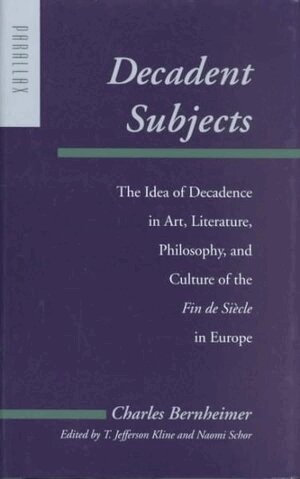
Decadent Subjects
The Idea of Decadence in Art, Literature, Philosophy, and Culture of the Fin de Siècle in Europe
Inbunden, Engelska, 2002
562 kr
Tillfälligt slut
Charles Bernheimer described decadence as a "stimulant that bends thought out of shape, deforming traditional conceptual molds." In this posthumously published work, Bernheimer succeeds in making a critical concept out of this perennially fashionable, rarely understood term. Decadent Subjects is a coherent and moving picture of fin de siecle decadence. Mature, ironic, iconoclastic, and thoughtful, this remarkable collection of essays shows the contradictions of the phenomenon, which is both a condition and a state of mind. In seeking to show why people have failed to give a satisfactory account of the term decadence, Bernheimer argues that we often mistakenly take decadence to represent something concrete, that we see as some sort of agent. His salutary response is to return to those authors and artists whose work constitutes the topos of decadence, rereading key late nineteenth-century authors such as Nietzsche, Zola, Hardy, Wilde, Moreau, and Freud to rediscover the very dynamics of the decadent.Through careful analysis of the literature, art, and music of the fin de siecle including a riveting discussion of the many faces of Salome, Bernheimer leaves us with a fascinating and multidimensional look at decadence, all the more important as we emerge from our own fin de siecle.