T. Jefferson Kline - Böcker
Visar alla böcker från författaren T. Jefferson Kline. Handla med fri frakt och snabb leverans.
10 produkter
10 produkter
Del 6 - Wiley Blackwell Companions to Film Directors
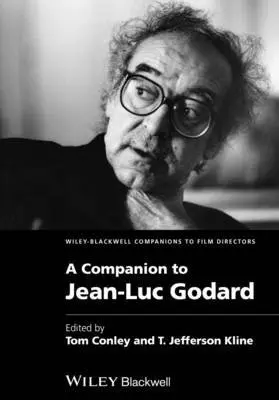
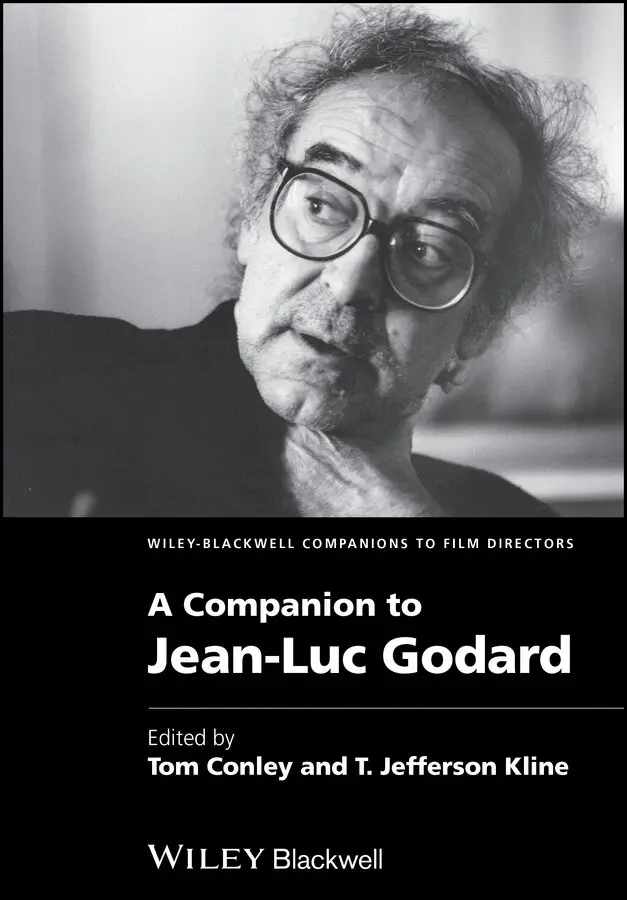
Companion to Jean-Luc Godard
Inbunden, Engelska, 2014
2 318 kr
Skickas inom 7-10 vardagar
This compendium of original essays offers invaluable insights into the life and works of one of the most important and influential directors in the history of cinema, exploring his major films, philosophy, politics, and connections to other critics and directors. Presents a compendium of original essays offering invaluable insights into the life and works of one of the most important and influential filmmakers in the history of cinemaFeatures contributions from an international cast of major film theorists and criticsProvides readers with both an in-depth reading of Godard’s major films and a sense of his evolution from the New Wave to his later political periodsBrings fresh insights into the great director’s biography, including reflections on his personal philosophy, politics, and connections to other critics and filmmakersExplores many of the 80 features Godard made in nearly 60 years, and includes coverage of his recent work in video
Decadent Subjects
The Idea of Decadence in Art, Literature, Philosophy, and Culture of the Fin de Siècle in Europe
Inbunden, Engelska, 2002
562 kr
Tillfälligt slut
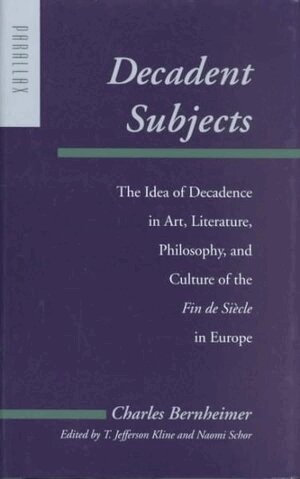
Charles Bernheimer described decadence as a "stimulant that bends thought out of shape, deforming traditional conceptual molds." In this posthumously published work, Bernheimer succeeds in making a critical concept out of this perennially fashionable, rarely understood term. Decadent Subjects is a coherent and moving picture of fin de siecle decadence. Mature, ironic, iconoclastic, and thoughtful, this remarkable collection of essays shows the contradictions of the phenomenon, which is both a condition and a state of mind. In seeking to show why people have failed to give a satisfactory account of the term decadence, Bernheimer argues that we often mistakenly take decadence to represent something concrete, that we see as some sort of agent. His salutary response is to return to those authors and artists whose work constitutes the topos of decadence, rereading key late nineteenth-century authors such as Nietzsche, Zola, Hardy, Wilde, Moreau, and Freud to rediscover the very dynamics of the decadent.Through careful analysis of the literature, art, and music of the fin de siecle including a riveting discussion of the many faces of Salome, Bernheimer leaves us with a fascinating and multidimensional look at decadence, all the more important as we emerge from our own fin de siecle.
396 kr
Skickas inom 7-10 vardagar
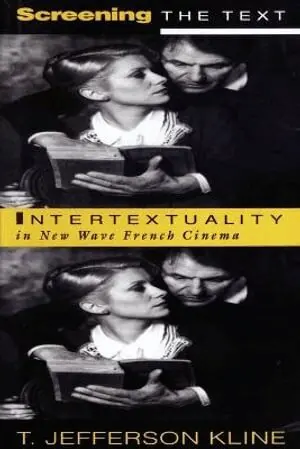
Cinema has always been "literary" in its desire to tell stories and in its need to borrow plots and narrative techniques from novels. But the French New Wave directors of the 1950s self-consciously rejected the idea that film was a mere extension of literature. With subversive techniques that exploded traditional methods of film narrative, they embraced fragmentation and alienation. Their cinema would be literature's rival, not its apprentice. In Screening the Text, T. Jefferson Kline argues that the New Wave's rebellious stance is far more complex and problematic than critics have acknowledged. Challenging conventional views of film and literature in postwar France, Kline explores the New Wave's unconscious obsession with the tradition it claimed to reject. He uncovers the wide range of the literary and cultural texts-American films, classical mythology, French literature, and a variety of Russian, Norwegian, German, and English writers and philosophers-as "screened" in seven films: Truffaut's Jules et Jim; Malle's Les Amants; Resnais's L'Annee derniere a Marienbad; Chabrol's Le Beau Serge; Rohmer's Ma Nuit chez Maud; Bresson's Pickpocket; and Godard's Pierrot le fou.
410 kr
Skickas inom 7-10 vardagar
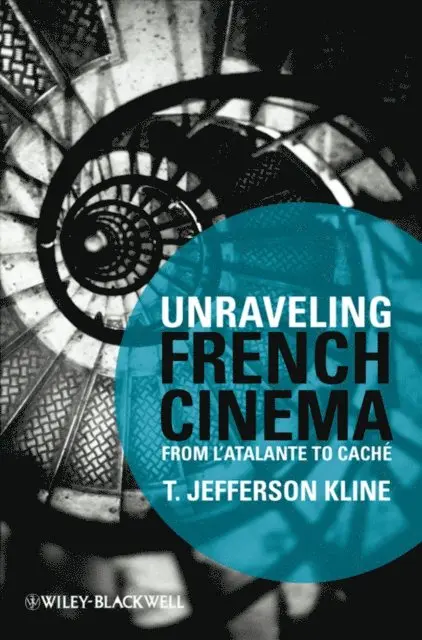
Unraveling French Cinema provides a much needed introduction to the complexities of French film for students, cineastes, and the movie-loving public. Looks at the differences between French and American national cinemaExplores how French directors shape their films around two potentially divergent goals: the narration of a story and an elaboration of some theory about film itself.Demystifies the "difficulty" of French cinema, allowing the American movie-goer to enjoy films that are too often perplexing at a first viewing.Offers extended analyses of classic, New Wave, and contemporary French films—including L'Atalante, Adele H., The Rules of the Game, and Cache.
888 kr
Tillfälligt slut
328 kr
Skickas inom 7-10 vardagar
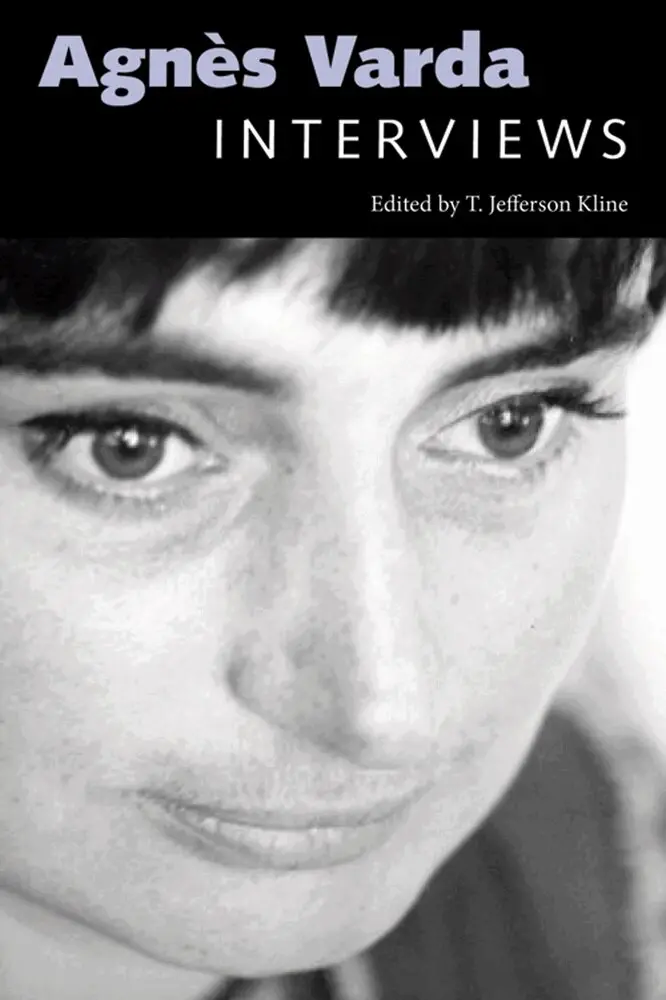
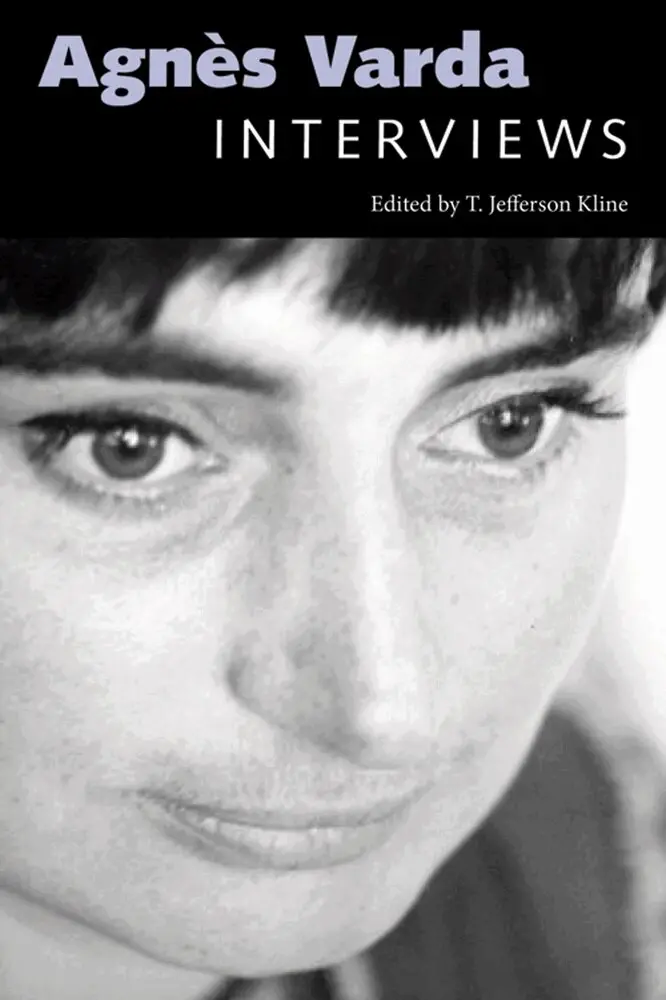
Over nearly sixty years, Agnès Varda (b. 1928) has given interviews that are revealing not only of her work, but of her remarkably ambiguous status. She has been called the ""Mother of the New Wave"" but suffered for many years for never having been completely accepted by the cinematic establishment in France. Varda's first film, La Pointe Courte (1954), displayed many of the characteristics of the two later films that launched the New Wave, Truffaut's 400 Blows and Godard's Breathless. In a low-budget film, using (as yet) unknown actors and working entirely outside the prevailing studio system, Varda completely abandoned the ""tradition of quality"" that Truffaut was at that very time condemning in the pages of Cahiers du cinema. Her work, however, was not ""discovered"" until after Truffaut and Godard had broken onto the scene in 1959. Varda's next film, Cleo from 5 to 7, attracted considerably more attention and was selected as France's official entry for the Festival in Cannes. Ultimately, however, this film and her work for the next fifty years continued to be overshadowed by her more famous male friends, many of whom she mentored and advised.Her films have finally earned recognition as deeply probing and fundamental to the growing awareness in France of women's issues and the role of women in the cinema. ""I'm not philosophical,"" she says, ""not metaphysical. Feelings are the ground on which people can be led to think about things. I try to show everything that happens in such a way and ask questions so as to leave the viewers free to make their own judgments."" The panoply of interviews here emphasize her core belief that ""we never stop learning"" and reveal the wealth of ways to answer her questions.
1 254 kr
Skickas inom 10-15 vardagar
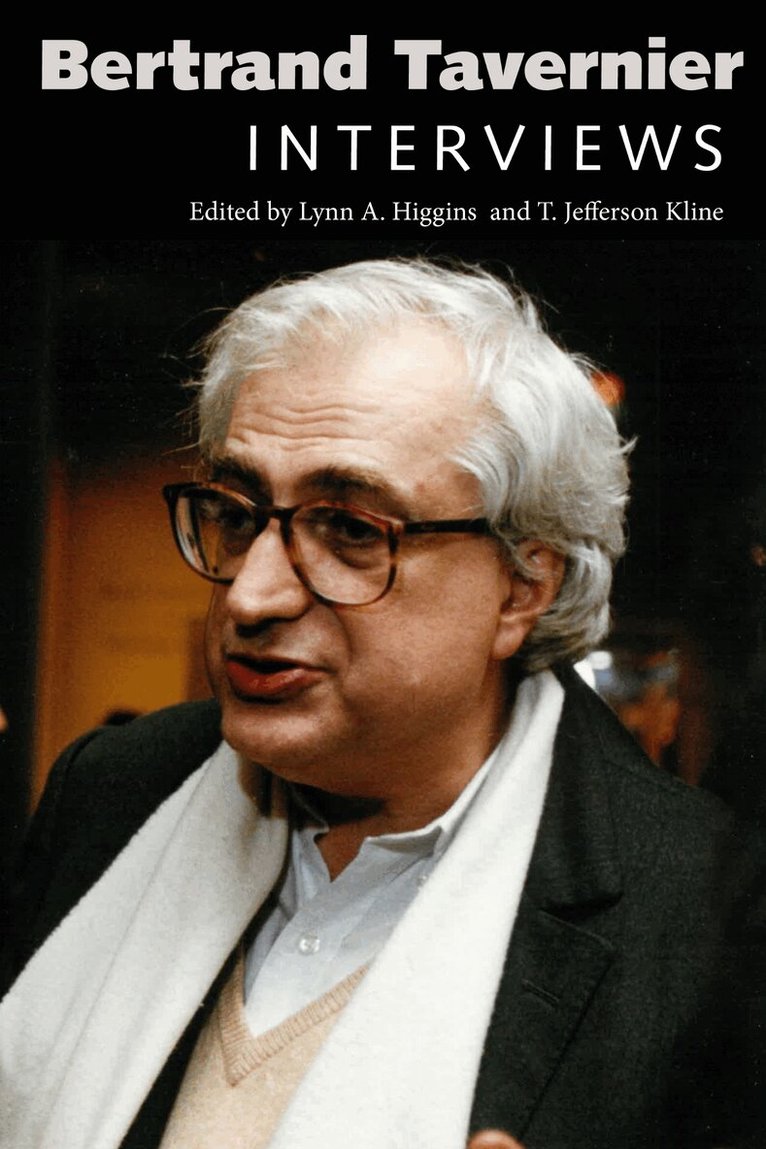
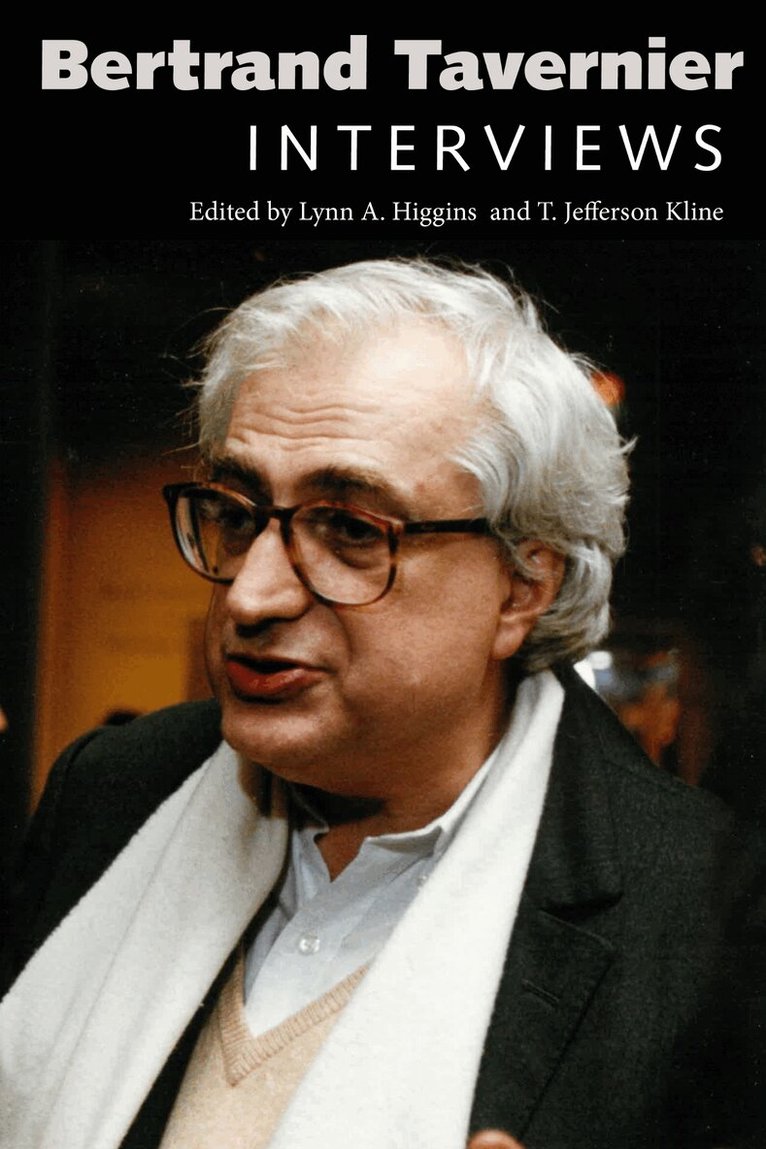
Bertrand Tavernier (b. 1941) is widely considered to be the leading light in a generation of French filmmakers who launched their careers in the 1970s, in the wake of the New Wave. In just over forty years, he has directed twenty-two feature films in an eclectic range of genres, from intimate family portrait to historical drama and neo-Western. Beginning with his debut feature--L'Horloger de Saint-Paul (1974), which won the prestigious Louis Delluc prize--Tavernier has shown himself to be a public intellectual. Like his films, he is deeply engaged with the pressing issues facing France and the world: the consequences of war, colonialism and its continuing aftermath, the price of heroism, and the power of art. A voracious cinephile, he is immensely knowledgeable about world cinema and American film in particular. Tavernier's roots are in Lyon, the birthplace of the cinema. He founded and presides over the Institut Lumière, which hosts retrospectives and an annual film festival in the factory where the Lumière brothers made the first films.In this collection, containing numerous interviews translated from French and available in English for the first time, he discusses the arc of his career following in the lineage of the Lumière brothers, in that his goal, like theirs, is to ""show the world to the world.""It is no surprise, then, that an interview with Tavernier is a treat. Beginning with discussions of his own films, the interviews in this volume cover a vast range of topics. At the core are his thoughts about the ways cinema can inspire the imagination and contribute to the broadest possible public conversation.
328 kr
Skickas inom 7-10 vardagar
Bertrand Tavernier (b. 1941–2021) was widely considered to be the leading light in a generation of French filmmakers who launched their careers in the 1970s in the wake of the New Wave. In just over forty years, he directed twenty-two feature films in an eclectic range of genres from intimate family portrait to historical drama and neo-Western. Beginning with his debut feature—L’Horloger de Saint-Paul (1974), which won the prestigious Louis Delluc prize—Tavernier showed himself to be a public intellectual. Like his films, he was deeply engaged with the pressing issues facing France and the world: the consequences of war, colonialism and its continuing aftermath, the price of heroism, and the power of art. A voracious cinephile, he was immensely knowledgeable about world cinema and American film in particular. Tavernier’s roots were in Lyon, the birthplace of the cinema. He founded and presided over the Institut Lumière, which hosts retrospectives and an annual film festival in the factory where the Lumière brothers made the first films.In this collection, containing numerous interviews translated from French and available in English for the first time, he discusses the arc of his career following in the lineage of the Lumière brothers, in that his goal, like theirs, is to "show the world to the world."It is no surprise, then, that an interview with Tavernier is a treat. Beginning with discussions of his own films, the interviews in this volume cover a vast range of topics. At the core are his thoughts about the ways cinema can inspire the imagination and contribute to the broadest possible public conversation.
333 kr
Skickas inom 10-15 vardagar
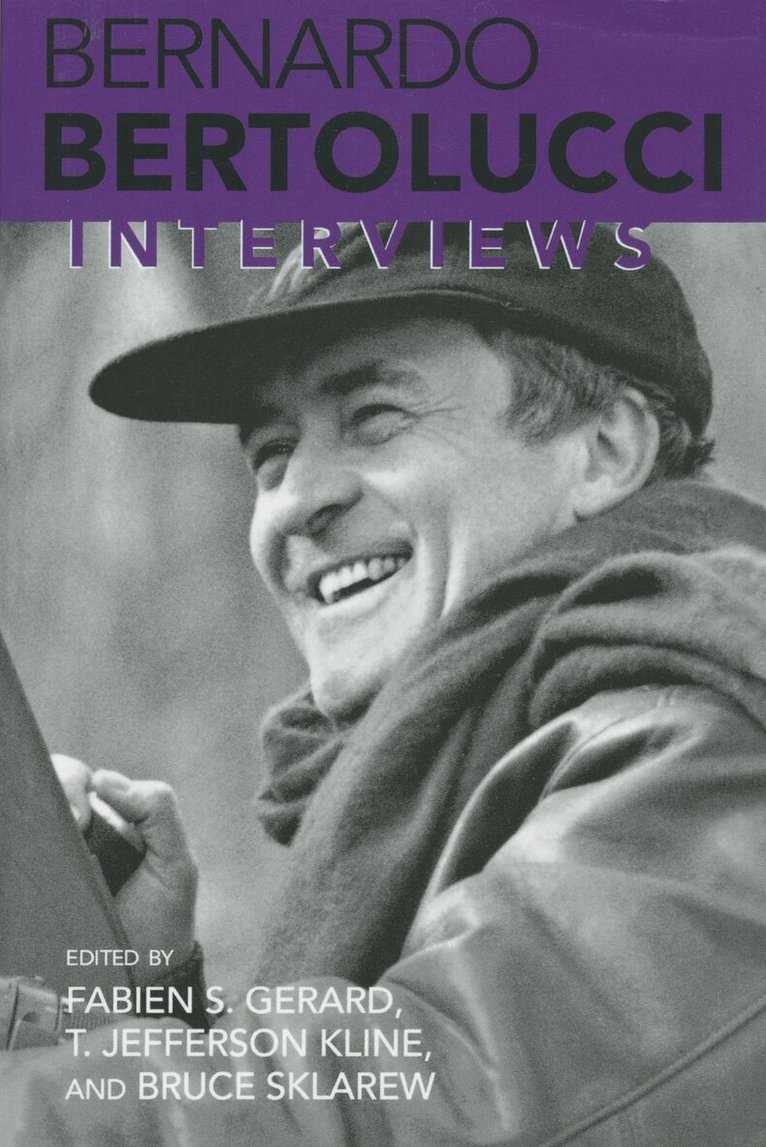
Collected here are forty years of the thoughts of one of the most influential filmmakers of our time. Although the winner of nine Academy Awards for his The Last Emperor, Bernardo Bertolucci may ultimately be best remembered for his Last Tango in Paris, which Pauline Kael called the most erotic film ever made. This volume gives a privileged view of Bertolucci's career from the days of his first radical experiments to the present, when he has become an elder statesman of world cinema. Half of these twenty-three interviews appear in English for the first time. The conversations resonate with themes that run throughout Bertolucci's work and thought from his early experimental films--Before the Revolution, The Spider's Strategem, The Conformist, and Last Tango in Paris--to his more mainstream works--The Last Emperor, The Sheltering Sky, Little Buddha, and Besieged. These conversations with Bertolucci reveal the significance of psychoanalysis in his films, the relationship between films and dreams, his early fascination with Godard and the ""New Wave,"" his views on extremism and radical politics, and his personal search for cinematic truth. As the interviews progress through four decades of his filmmaking, they show his artistic evolution. In the earliest he is questing for answers to questions about the ""fundamental cinema problem."" In the latest he has come to recognize the need to please his audience. As Bertolucci speaks, he provides his autobiography, his psychohistory, a production journal of each of his films, a portrait gallery of his contemporaries, a compendium of film theory, and an ABC of ideas that range from auteur theory, Bazin, the camera, dance, editing, right on to Zen. He speaks of his early poetry, his fiercely revolutionary stances of the 1960s, and his gradual discovery that he always has to be in love with his audiences. In all, this is a stunning self-portrait of one of cinema's greatest filmmakers. Fabien S. Gerard has been working as Bertolucci's script supervisor for the last ten years and is the author of the shooting diary of The Last Emperor. He currently teaches film history at Brussels University. Bruce Sklarew, a Washington, D. C., psychoanalyst and physician, is director of the Forum for the Psychoanalytic Study of Film and is a friend of Bertolucci's. T. Jefferson Kline has been a professor of French at Boston University since 1979 and is the author of Bertolucci's Dream Loom: A Psychoanalytic Study of Cinema and other books.
1 254 kr
Skickas inom 10-15 vardagar
Over nearly sixty years, Agnès Varda (b. 1928) has given interviews that are revealing not only of her work, but of her remarkably ambiguous status. She has been called the ""Mother of the New Wave"" but suffered for many years for never having been completely accepted by the cinematic establishment in France. Varda's first film, La Pointe Courte (1954), displayed many of the characteristics of the two later films that launched the New Wave, Truffaut's 400 Blows and Godard's Breathless. In a low-budget film, using (as yet) unknown actors and working entirely outside the prevailing studio system, Varda completely abandoned the ""tradition of quality"" that Truffaut was at that very time condemning in the pages of Cahiers du cinema. Her work, however, was not ""discovered"" until after Truffaut and Godard had broken onto the scene in 1959. Varda's next film, Cleo from 5 to 7, attracted considerably more attention and was selected as France's official entry for the Festival in Cannes. Ultimately, however, this film and her work for the next fifty years continued to be overshadowed by her more famous male friends, many of whom she mentored and advised.Her films have finally earned recognition as deeply probing and fundamental to the growing awareness in France of women's issues and the role of women in the cinema. ""I'm not philosophical,"" she says, ""not metaphysical. Feelings are the ground on which people can be led to think about things. I try to show everything that happens in such a way and ask questions so as to leave the viewers free to make their own judgments."" The panoply of interviews here emphasize her core belief that ""we never stop learning"" and reveal the wealth of ways to answer her questions.