Charvaka Duvvury - Böcker
Visar alla böcker från författaren Charvaka Duvvury. Handla med fri frakt och snabb leverans.
5 produkter
5 produkter
1 984 kr
Skickas inom 7-10 vardagar
* Examines the various methods available for circuit protection, including coverage of the newly developed ESD circuit protection schemes for VLSI circuits.* Provides guidance on the implementation of circuit protection measures.* Includes new sections on ESD design rules, layout approaches, package effects, and circuit concepts.* Reviews the new Charged Device Model (CDM) test method and evaluates design requirements necessary for circuit protection.
1 578 kr
Skickas inom 10-15 vardagar
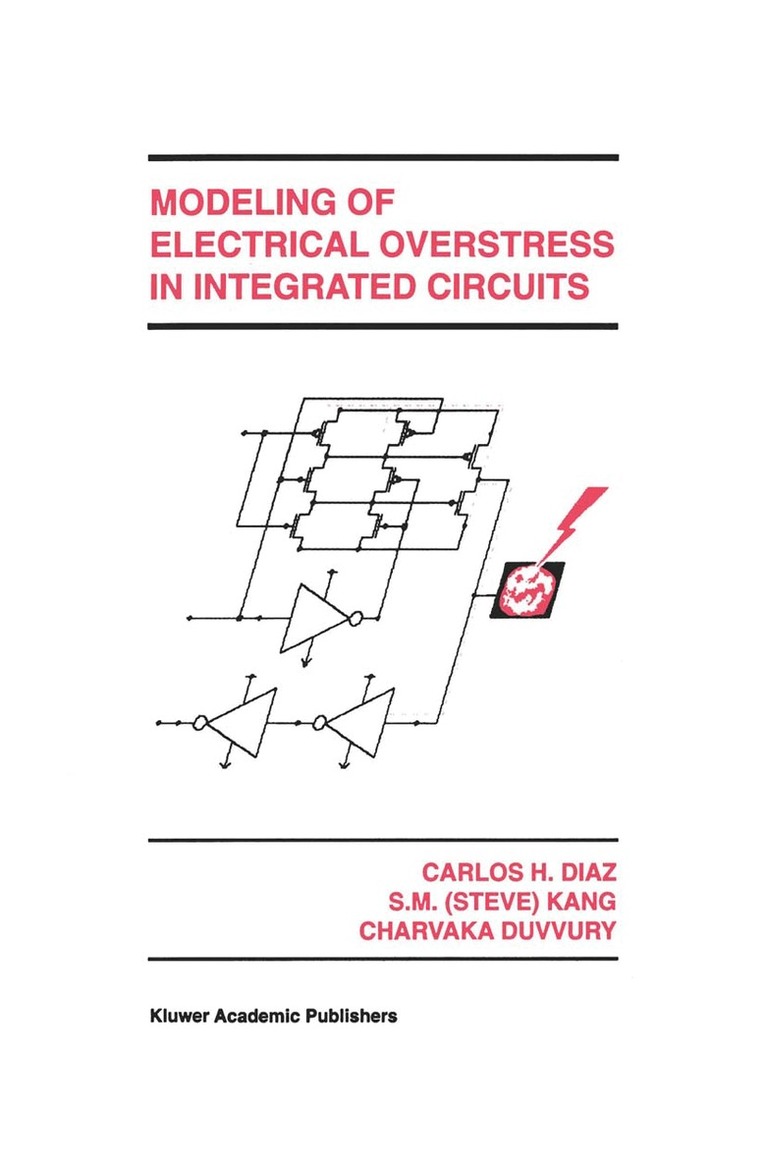
Electrical overstress (EOS) and Electrostatic discharge (ESD) pose one of the most dominant threats to integrated circuits (ICs). These reliability concerns are becoming more serious with the downward scaling of device feature sizes. This text presents a comprehensive analysis of EOS/ESD-related failures in I/O protection devices in integrated circuits. The design of I/O protection circuits has been done in a hit-or-miss way due to the lack of systematic analysis tools and concrete design guidelines. In general, the development of on-chip protection structures is a lengthy expensive iterative process that involves tester design, fabrication, testing and redesign. When the technology is changed, the same process has to be repeated almost entirely. This can be attributed to the lack of efficient CAD tools capable of simulating the device behaviour up to the onset of failure which is a 3-D electrothermal problem. For these reasons, it is important to develop and use an adequate measure of the EOS robustness of integrated circuits in order to address the on-chip EOS protection issue.Fundamental understanding of the physical phenomena leading to device failures under ESD/EOS events is needed for the development of device models and CAD tools that can efficiently describe the device behaviour up to the onset of thermal failure. This text should be suitable for VLSI designers and reliability engineers, particularly those who are working on the development of EOS/ESD analysis tools. CAD engineers working on development of circuit level and device level electrothermal simulators should also benefit from the material covered. This book should also be of interest to researchers and first- and second-year graduate students working in semiconductor devices and IC reliability fields.
888 kr
Kommande
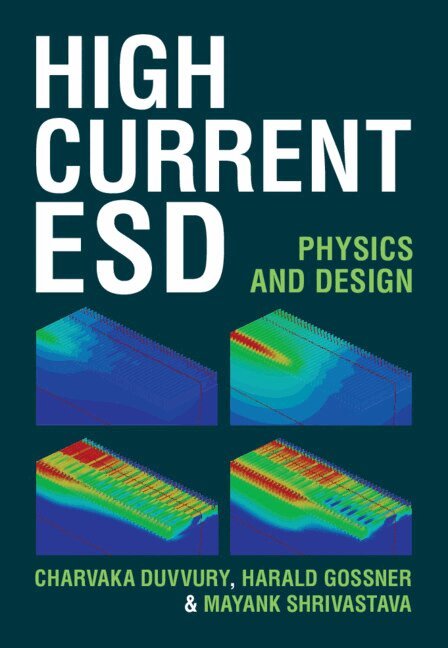
Synthesizing experience from industry and academia, this book offers a comprehensive and nuanced perspective on the Physics of Electrostatic Discharge (ESD) phenomena in a range of semiconductor device technologies, illustrating robust design practices. Starting with fundamental insights into high-current ESD behaviour in semiconductor devices, it gradually builds toward practical design principles and real-world reliability challenges in advanced CMOS, FinFETs, GaN HEMTs, carbon nanostructures and TFT technologies. Device-level physics and practical design implications are explored throughout, bridging the gap between deep theoretical understanding and real-world design constraints. Including unique simulation techniques alongside experimental results, this book thoroughly explores core ESD design principles. Including multiple curated case studies, this book will equip readers with all the tools needed to address current ESD design challenges and embrace covers the challenges of the future. A reliable and thought-provoking exploration, ideal for graduate students, industry professionals and researchers working in device physics, design, and reliability.
1 369 kr
Skickas inom 5-8 vardagar
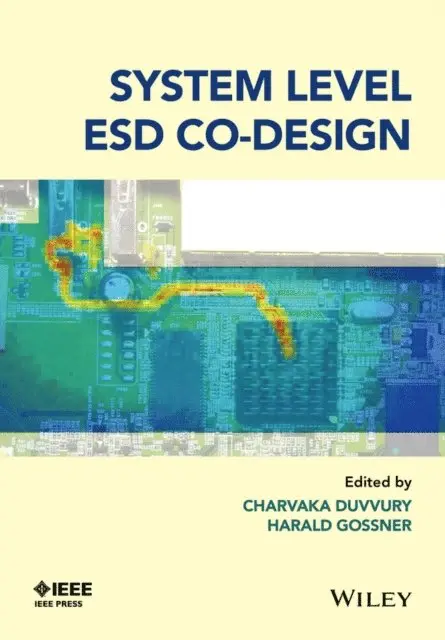
An effective and cost efficient protection of electronic system against ESD stress pulses specified by IEC 61000-4-2 is paramount for any system design. This pioneering book presents the collective knowledge of system designers and system testing experts and state-of-the-art techniques for achieving efficient system-level ESD protection, with minimum impact on the system performance. All categories of system failures ranging from 'hard' to 'soft' types are considered to review simulation and tool applications that can be used.The principal focus of System Level ESD Co-Design is defining and establishing the importance of co-design efforts from both IC supplier and system builder perspectives. ESD designers often face challenges in meeting customers' system-level ESD requirements and, therefore, a clear understanding of the techniques presented here will facilitate effective simulation approaches leading to better solutions without compromising system performance.With contributions from Robert Ashton, Jeffrey Dunnihoo, Micheal Hopkins, Pratik Maheshwari, David Pomerenke, Wolfgang Reinprecht, and Matti Usumaki, readers benefit from hands-on experience and in-depth knowledge in topics ranging from ESD design and the physics of system ESD phenomena to tools and techniques to address soft failures and strategies to design ESD-robust systems that include mobile and automotive applications.The first dedicated resource to system-level ESD co-design, this is an essential reference for industry ESD designers, system builders, IC suppliers and customers and also Original Equipment Manufacturers (OEMs).Key features: Clarifies the concept of system level ESD protection.Introduces a co-design approach for ESD robust systems.Details soft and hard ESD fail mechanisms.Detailed protection strategies for both mobile and automotive applications.Explains simulation tools and methodology for system level ESD co-design and overviews available test methods and standards.Highlights economic benefits of system ESD co-design.
1 578 kr
Skickas inom 10-15 vardagar
Electrical overstress (EOS) and Electrostatic discharge (ESD) pose one of the most dominant threats to integrated circuits (ICs). These reliability concerns are becoming more serious with the downward scaling of device feature sizes. Modeling of Electrical Overstress in Integrated Circuits presents a comprehensive analysis of EOS/ESD-related failures in I/O protection devices in integrated circuits. The design of I/O protection circuits has been done in a hit-or-miss way due to the lack of systematic analysis tools and concrete design guidelines. In general, the development of on-chip protection structures is a lengthy expensive iterative process that involves tester design, fabrication, testing and redesign. When the technology is changed, the same process has to be repeated almost entirely. This can be attributed to the lack of efficient CAD tools capable of simulating the device behavior up to the onset of failure which is a 3-D electrothermal problem. For these reasons, it is important to develop and use an adequate measure of the EOS robustness of integrated circuits in order to address the on-chip EOS protection issue. Fundamental understanding of the physical phenomena leading to device failures under ESD/EOS events is needed for the development of device models and CAD tools that can efficiently describe the device behavior up to the onset of thermal failure. Modeling of Electrical Overstress in Integrated Circuits is for VLSI designers and reliability engineers, particularly those who are working on the development of EOS/ESD analysis tools. CAD engineers working on development of circuit level and device level electrothermal simulators will also benefit from the material covered. This book will also be of interest to researchers and first and second year graduate students working in semiconductor devices and IC reliability fields.