Christine Godt - Böcker
Visar alla böcker från författaren Christine Godt. Handla med fri frakt och snabb leverans.
6 produkter
6 produkter
2 165 kr
Skickas inom 5-8 vardagar
This book is the result of a long-term comparative research project on intellectual property, with topics ranging from patents to copyright, examined across 16 jurisdictions. It does not aim at commenting on current policy issues. The country reports unearth the culturally, morally and historically imprinted thought patterns across Europe which underpin current discussions on the appropriation of information, and which do not change quickly. The research results question the common narratives of the distinctiveness of private and public law, of contracts and property, and of morality and the law.The point of departure is the public good character of information, with the focus being on public interests pursued when assigning information as property. The 14 selected cases, based on recent, and in some cases futuristic when the project began in 2001, scenarios, aim to identify how boundaries to information property emerge, the areas of law that are applied and the principles that are followed in order to balance the conflicting interests at stake. The issues discussed revolve around well-known interfaces such as IP and competition law, monetary interests versus personal interests in human genome data, individual freedoms-to-operate versus collective action models as found in basic research or ‘creative commons’. The book shows how some national discussions appear similar on the surface, in terms of resorting to parallel principles, but subsequent domestic policy answers vary greatly. Even legislation which aims at harmonisation may result into more diversity. Inversely, we found legal institutions applied which install contrasting legal rules which however aim at exactly the same behavioural change.The national reports in Part III are complemented by comparative analyses by the editors, whilst the chapters in Part II are dedicated to an analysis of the submissions from a theoretical point of view, departing from the editors’ own research interests. The chapter in Part I describes the overall ‘Common Core’ research method, which splits the national reports into operative, descriptive and metalegal formants.Boundaries of Information Property is aimed at researchers in IP and practitioners interested in the foundational theory of their subject. It is an inspiring read for those interested in the deeper structures of regulating information.With a foreword by Sjef van Erp (em. University of Maastricht) and contributions by Christine Godt (Carl von Ossietzky University of Oldenburg), Geertrui Van Overwalle (University of Leuven), Lucie Guibault (Dalhousie University), Deryck Beyleveld (University of Durham), Mike Adcock (University of Durham), Ramūnas Birštonas (Vilnius University), Maja Bogataj Jančič (Intellectual Property Institute, Ljubljana), Konstantinos Christodoulou (University of Athens), Teresa Franquet Sugrañes (University Rovira i Virgili), Pablo Garrido Pérez (University of Barcelona), Christophe Geiger (Luiss Guido Carli University), Silvia Gómez Trinidad (University of Barcelona), Mariona Gual Dalmau (University of Barcelona), Aleksei Kelli (University of Tartu), Tomaž Keresteš (University of Maribor), Maja Lubarda (Lawyer, Ljubljana), Thomas Margoni (University of Leuven), Jan Mates (Attorney-at-Law, Prague), Maureen O’Sullivan (NUI Galway), Andrea Pradi (University of Trento), Martina Repas (University of Maribor), Giorgio Resta (University of Rome 3), Ole-Andreas Rognstad (University of Oslo), Cristina Roy Pérez (University of Barcelona), Jens Schovsbo (University of Copenhagen), Agnes Schreiner (University of Amsterdam), Simone Schroff (Plymouth University), Tobias Schulte in den Bäumen (Hapag-Llyod, Hamburg), Simona Štrancar (University of Maribor), Tomasz Targosz (Jagiellonian University), Elżbieta Traple (Jagiellonian University), and Gabriele Venskaityte (European Commission, Brussels).
Del 9 - Geistiges Eigentum und Wettbewerbsrecht
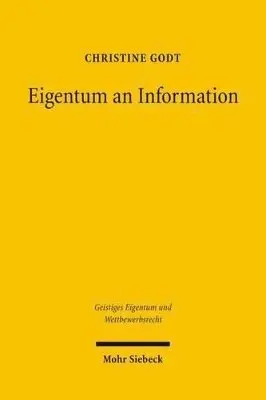
Eigentum an Information
Patentschutz und allgemeine Eigentumstheorie am Beispiel genetischer Information
Inbunden, Tyska, 2007
2 709 kr
Tillfälligt slut
Christine Godt untersucht die wachsende Bedeutung des Geistigen Eigentumsrechts bei der Transformation der Industrie- in eine Informationsgesellschaft. Dem geistigen Eigentum wird als Innovationsmotor eine zentrale Rolle für das Wirtschaftswachstum und für die Behauptung im internationalen Wettbewerb der marktwirtschaftlich organisierten Wissensgesellschaften zugewiesen. Diese Entwicklung bedingt einen Funktionszuwachs, der sich nicht mehr in dem Anreiz für den Erfinder erschöpft, sondern die Kommodifizierung von Information in den Mittelpunkt rückt. Die Autorin arbeitet diese Veränderung heraus und bettet die regulative Bedeutung in ein privatrechtsverankertes Eigentumsverständnis ein. In dem Grundlagenkapitel werden zunächst die rechtsmateriellen Gründe der Ausweitung der geistigen Eigentumsrechte, insbesondere des Patentschutzes, dargestellt. Drei anschließende Fallstudien konkretisieren den Funktionswandel für die Bereiche der Forschungs- und Technologiepolitik, des internationalen Umweltschutzes und der internationalen Wirtschaftspolitik. Das Kernstück der Arbeit ist die theoretische Konzeption der Rechtskollisionen im Geistigen Eigentumsrecht. Auf breiter disziplinenübergreifender Basis wird eine Funktionsbestimmung des wechselseitigen Verhältnisses von privatrechtlicher Zuweisung von Information und der öffentlichen Sphäre unternommen. Die Autorin identifiziert die verschiedenen privaten und öffentlichen Rechtskollisionen bei Geistigen Eigentumsrechten und weist sie Akteuren zu. In einem rechtsdogmatischen Teil ordnet sie diese Konstellationen einzelnen Tatbeständen zu und entwickelt Modelle, wie die Rechtskollisionen im Rechtsdiskurs artikuliert und zum Ausgleich gebracht werden können.
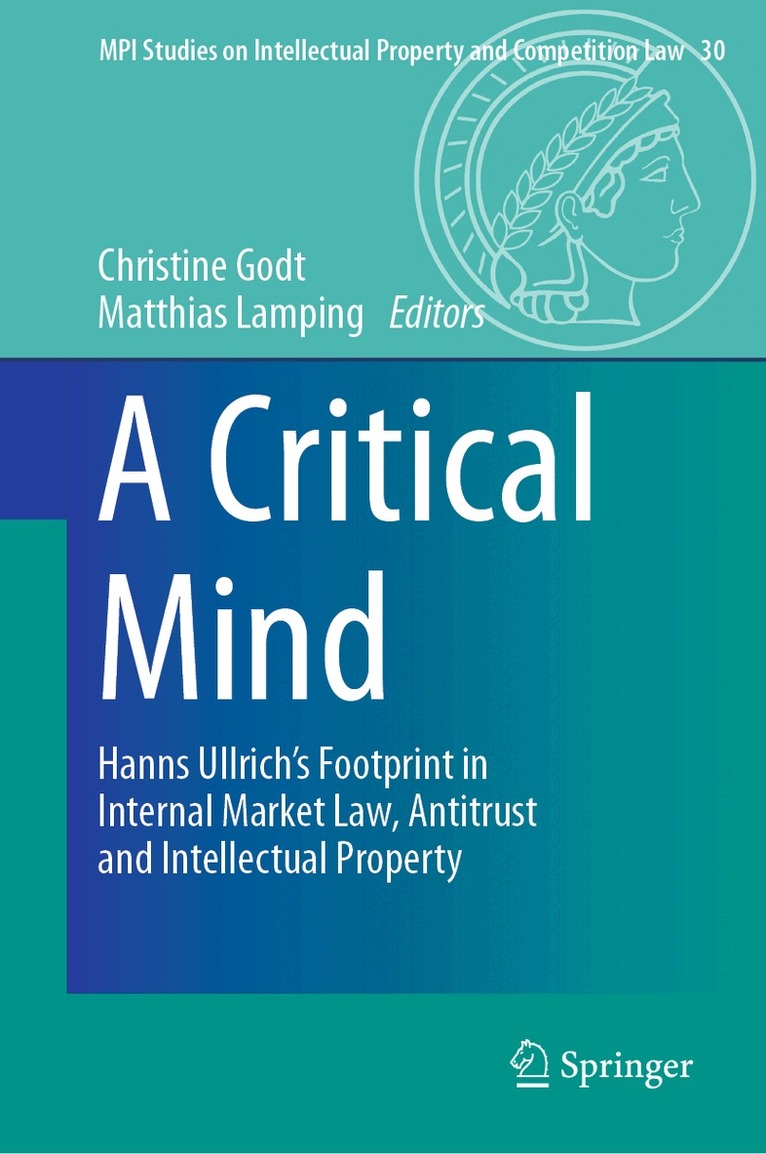
Critical Mind
Hanns Ullrich’s Footprint in Internal Market Law, Antitrust and Intellectual Property
Inbunden, Engelska, 2023
2 704 kr
Skickas inom 10-15 vardagar
This book traces the academic footprint of Hanns Ullrich. Thirty contributions revolve around five central topics of his oeuvre: the European legal order, competition law, intellectual property, the regulation of new technologies, and the global market order. Acknowledging him as a trailblazer, the book aims to capture how deeply Hanns Ullrich has influenced contemporaries and subsequent generations of scholars. The contributors re-iterate the path-breaking patterns of his teachings, such as his contemplation of intellectual property as embedded in competition, the necessity of balancing private and public interests in intellectual property law, the policies of market integration, and the peculiar relationship of technological advancement and protectionism.
A Critical Mind : Hanns Ullrich's Footprint in Internal Market Law, Antitrust and Intellectual Property
Engelska, 2023
584 kr
Skickas inom 5-8 vardagar
Critical Mind
Hanns Ullrich’s Footprint in Internal Market Law, Antitrust and Intellectual Property
Häftad, Engelska, 2024
2 704 kr
Skickas inom 10-15 vardagar
This book traces the academic footprint of Hanns Ullrich. Thirty contributions revolve around five central topics of his oeuvre: the European legal order, competition law, intellectual property, the regulation of new technologies, and the global market order. Acknowledging him as a trailblazer, the book aims to capture how deeply Hanns Ullrich has influenced contemporaries and subsequent generations of scholars. The contributors re-iterate the path-breaking patterns of his teachings, such as his contemplation of intellectual property as embedded in competition, the necessity of balancing private and public interests in intellectual property law, the policies of market integration, and the peculiar relationship of technological advancement and protectionism.
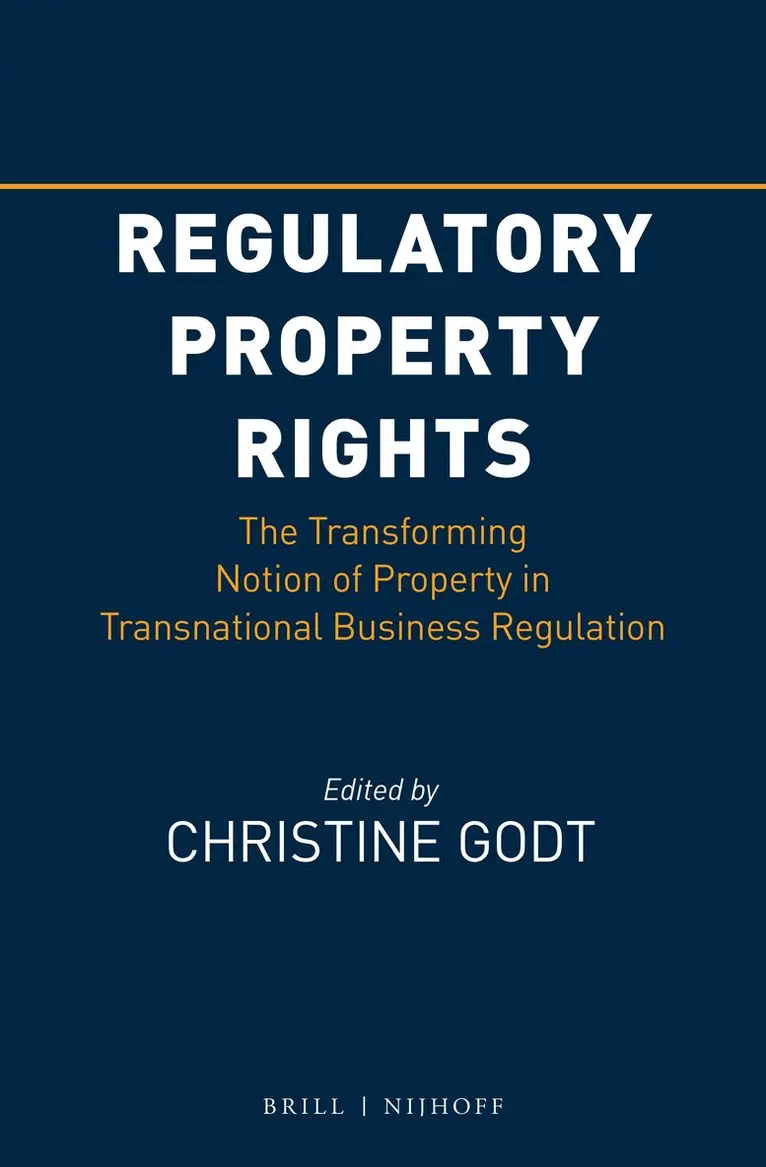
Regulatory Property Rights
The Transforming Notion of Property in Transnational Business Regulation
Inbunden, Engelska, 2016
2 077 kr
Skickas inom 5-8 vardagar
In Regulatory Property Rights: The Transforming Notion of Property in Transnational Business Regulation, editor Christine Godt generates fresh impetus for rethinking modern property theory. The book’s central theme is the transformation of property in response to societal changes brought about by internationalization, digitalization and new forms of collective action. The contributions sketch a vision of modern property, which grew out of 18th and 19th century ideologies. It operates in the modern multilevel system, and is not confined to the nation state. It is conscious about the broad range of functionalities of the title holder with regard to managing international supply and distribution chains and modern rationalities of the capital market, and at the same time acknowledges the legitimate interests of third parties and modern forms of governance.